Join us on a literary world trip!
Add this book to bookshelf
Grey
Write a new comment Default profile 50px
Grey
Subscribe to read the full book or read the first pages for free!
All characters reduced
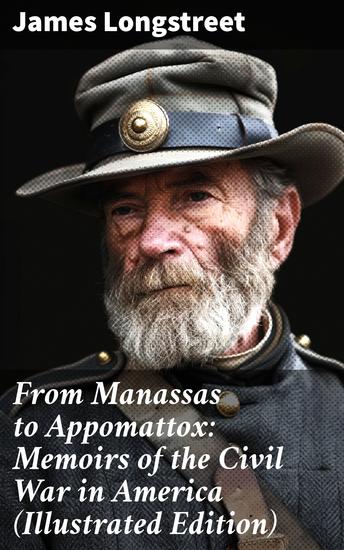
From Manassas to Appomattox: Memoirs of the Civil War in America (Illustrated Edition) - Civil War Memories Series - cover

From Manassas to Appomattox: Memoirs of the Civil War in America (Illustrated Edition) - Civil War Memories Series

James Longstreet

Publisher: Good Press

  • 0
  • 0
  • 0

Summary

In "From Manassas to Appomattox: Memoirs of the Civil War in America (Illustrated Edition)," James Longstreet offers a compelling first-person account of his experiences during one of the most tumultuous periods in American history. Written with a striking immediacy, this meticulously detailed memoir captures the essence of Civil War battles, strategic decisions, and the personal dilemmas faced by soldiers. Longstreet's narrative is imbued with a reflective tone, providing both a military analysis and a profound understanding of the human cost of war, all illustrated to enhance the visual appeal and historical understanding of his text. James Longstreet, a prominent Confederate general and trusted advisor to General Robert E. Lee, drew from his extensive military career to craft this memoir. Having fought in major battles such as Gettysburg and Chickamauga, Longstreet'Äôs perspective is invaluable, recognizing the complexities of leadership and the moral quandaries that accompanied the conflict. His candid reflections on strategy and his eventual post-war reconciliation efforts convey a unique narrative arc that elucidates both personal and national growth. This illustrated edition is essential for readers seeking an authentic glimpse into the Civil War's battles and the minds of its leaders. Whether scholars or casual enthusiasts, readers will find Longstreet's work a powerful testament to the resilience of the human spirit amid adversity, making it a significant addition to any historical library.
Available since: 12/09/2023.
Print length: 521 pages.


Other books that might interest you

  • The Pilgrims - History and Background of the Early English Settlers on the American Continent - cover

    The Pilgrims - History and...

    Kelly Mass

    • 0
    • 0
    • 0
    The Pilgrims, also known as the Pilgrim Fathers, were a group of English settlers who made the historic journey across the Atlantic on the Mayflower and founded the Plymouth Colony in what is now Plymouth, Massachusetts. The colony was named after the port of Plymouth in England, which had been the final departure point for their voyage. The Pilgrims were part of a religious movement rooted in the Puritan faith, but with distinct beliefs that set them apart from other Puritans at the time. 
    The Pilgrims were part of a religious group called the Brownists, or Separatists, who believed that the Church of England was beyond reform. They shared many of the same Calvinist and Puritan religious convictions as the broader Puritan community, particularly in their emphasis on personal piety, Bible study, and the rejection of Catholic practices. However, unlike other Puritans, the Pilgrims felt that the Church of England was corrupt and that their congregations should be completely separate from it. This belief led them to seek religious freedom in places where they could practice their faith without interference from the English state church, which they saw as a violation of their spiritual beliefs. 
    Initially, the Pilgrims found refuge in Holland, where they lived for several years in the city of Leiden. The Netherlands offered a more tolerant environment for religious dissenters, allowing them to practice their faith freely. However, the Pilgrims faced challenges in Holland, including economic difficulties and concerns about the erosion of their cultural identity. They eventually decided to seek a new home in the New World, where they could establish a society that would align with their religious principles.
    Show book
  • Rethinking global value chains amid geo-economic fragmentation - cover

    Rethinking global value chains...

    Matteo Bursi, Ettore Greco

    • 0
    • 0
    • 0
    The uneven recovery from the 2008 global financial crisis led to a stabilisation of international trade and capital flows. However, in the following years the surge of protectionist measures and deepening rivalries between big powers precipitated a crisis of the rule-based multilateral order. The pandemic crisis and the impact of the Russian invasion of Ukraine have boosted international economic fragmentation along geopolitical lines and may drive the global economy towards a reversal of the globalisation process that marked the second half of the 20th century.
    Mounting cross-border restrictions on the exchange of essential goods and services during the recent poly-crisis has caused big disruptions in global production networks evamping the debate on the future of global economic interdependence, and the potentialities and downsides of reshoring, nearshoring or friendshoring processes. Indeed, the reconfiguration of global value chains (GVCs) has been increasingly debated as an economic policy tool to secure the supply of critical products and establish economic security at the national level. Such defensive posturing raises concerns over how to manage emerging trade-offs between the benefits of openness (economic integration) and those of autonomy (economic security).
    The Istituto Affari Internazionali (IAI), in the framework of its partnership with Intesa Sanpaolo, launched a task force of experts to contribute to the current discussion on the implications and possible future configurations of international production networks at a time of a resurgence of national economic security. The overall research effort has involved different regional perspectives and multidisciplinary approaches to shed light on the implications of the policy-driven process of international economic fragmentation in the fields of trade, technology, labour, international finance, global public goods and other dimensions of international economic relations.
    Show book
  • Fixing America - An Engineer’s Solution to our Social Cultural and Political Problems - cover

    Fixing America - An Engineer’s...

    William M Taggart IV

    • 0
    • 0
    • 0
    Have you been wondering about the big issues dominating the news? Is climate change a massive threat or not? What is really going on with immigration? More importantly, how did American politics become so divided and hostile?  What if we approached American social, cultural and political problems from a purely rational perspective? What if we focus on functional systems instead of division? Careful analysis of readily available data can help us discover patterns and uncover the real issues. An engineering perspective allows us to focus on what needs to be fixed rather than ideological divisions.  
       Finally, one of America's top engineers has brought these topics and others together in a thought-provoking book. This book is rooted in history, facts, and logic, and it lays out solutions to America's problems. A book focused to get Americans talking to one another again, so we can rise to the occasion and solve today's problems together.  
        William Taggart has over thirty years as a professional engineer in industry. He has travelled the world, building some of industry’s biggest projects and solving some of their thorniest problems. Now, he has applied analytical skills developed in industry, coupled with his natural inquisitiveness and thirst for creative solutions, to the problems of modern-day American politics. Seeking answers to questions many of us have been asking, he has focused his keen mind on researching these, and other big issues. He invites everyone to think about what America really needs.
    Show book
  • KGB History: 100 Years Of Soviet Terror - The Secret Police Of Russia: Cheka GPU OGPU NKVD KGB FSK & FSB - cover

    KGB History: 100 Years Of Soviet...

    HISTORY FOREVER

    • 0
    • 0
    • 0
    ★ Did you know that the first KGB was called Cheka and formed in 1917? ★ 
    ★ Did you know that the KGB once was the largest secret police and foreign-intelligence organization in the world? ★ 
      
    ★ BUY THIS BOOK NOW AND LEARN ABOUT THE LARGEST SECRET POLICE TODAY! ★ 
    In this book you will discover; 
    ·       Why KGB is so feared 
    ·       The Early Years of KGB - Cheka 
    ·       The Early Years of KGB - GPU 
    ·       The Early Years of KGB - OGPU 
    ·       OGPU & The Soviet State 
    ·       The NKVD and the Forming of KGB 
    ·       The new KGB: FSK & FSB 
    ·       How Stalin's NKVD Spies Took Down Trotsky       
    ·       The end of a superpower - The collapse of the Soviet Union 
    ·       How Novichok used as Political Instrument 
    ★ BUY THIS BOOK NOW AND LEARN ABOUT THE LARGEST SECRET POLICE TODAY! ★
    Show book
  • Philosophers - Critical Thinking Philosophy and Stoicism (3 in 1) - cover

    Philosophers - Critical Thinking...

    Coral Nunez

    • 0
    • 0
    • 0
    This book contains the following three titles: 
    Critical Thinking - Critical thinking is not simply about having opinions or being able to argue well. It involves the disciplined process of thinking that requires clarity, accuracy, relevance, and consistency. By developing your ability to think critically, you gain the power to dissect problems, challenge assumptions, and avoid common cognitive pitfalls like biases and faulty logic. Whether you’re analyzing a business strategy, making a personal choice, or evaluating the news, critical thinking enables you to navigate through confusion and uncertainty with confidence. 
    Philosophy - Philosophy, at its core, is the study of fundamental questions about existence, knowledge, values, reason, and the human condition. It is not merely an academic subject but a way of thinking, questioning, and understanding the world. The term "philosophy" comes from the Greek words "philo" (love) and "sophia" (wisdom), meaning "the love of wisdom." This pursuit of wisdom has been a defining aspect of human civilization for thousands of years, shaping our perspectives on reality, morality, and truth. 
    Stoicism - Stoicism is often associated with a few key figures, including Epictetus, Seneca, and Marcus Aurelius. Each of these philosophers contributed their own insights into the practice of Stoicism, emphasizing different aspects of the philosophy. Epictetus, for example, taught that true freedom comes from mastering our internal world, while Seneca focused on the importance of reflection and mindfulness in everyday life. Marcus Aurelius, a Roman emperor, applied Stoic principles to leadership and the challenges of ruling an empire, demonstrating how Stoicism can be practiced by anyone, no matter their role in society.
    Show book
  • The Quick And Easy Guide To Building Better Boundaries - How to Install Stop Signs and Borders to Protect Yourself own Your Life and Make Good Choices - cover

    The Quick And Easy Guide To...

    Jim Colajuta

    • 0
    • 0
    • 0
    Personal boundaries are the restrictions and norms we set for ourselves within relationships. Healthy boundaries allow people to say "no" to others when necessary. Still, they are also comfortable with closeness and personal connections. This restriction determines what we are ready to accept (or reject) as a suitable and safe method for others to engage with us. We may set personal limits for everyone we contact and specific boundaries for certain individuals at other times. Setting expectations begins with knowing and establishing your boundaries via your words and actions.  
    Setting healthy personal boundaries is necessary for maintaining a positive self-concept or self-image. With this Quick and Easy Guide to Building Better Boundaries, you will learn the effectiveness of your boundaries, identify various boundary types, and identify methods to enhance them. 
    Show book