Join us on a literary world trip!
Add this book to bookshelf
Grey
Write a new comment Default profile 50px
Grey
Subscribe to read the full book or read the first pages for free!
All characters reduced
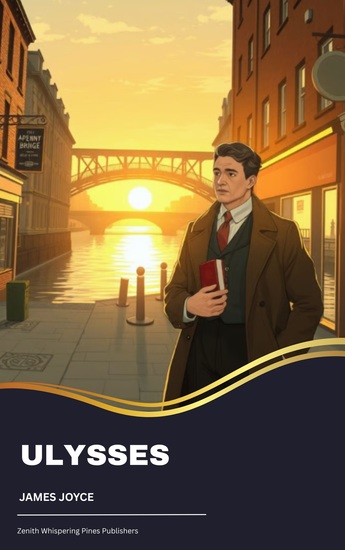
Ulysses - cover

Ulysses

James Joyce

Publisher: Zenith Whispering Pines Publishers

  • 0
  • 0
  • 0

Summary

One ordinary day. One extraordinary city. One journey that changed modern literature forever.
Set over a single day in Dublin, Ulysses follows Leopold Bloom, Stephen Dedalus, and Molly Bloom as their paths cross through moments tender, comic, heartbreaking, and profoundly human. What seems like a simple day becomes an epic of thought, memory, desire, and self-discovery—told with daring style and emotional depth.

Celebrated as "the greatest novel of the twentieth century," Joyce's masterpiece captures the fullness of life: its chaos and beauty, its secrets and longings, its quiet battles and private triumphs. It remains a book that challenges, surprises, and rewards every reader who enters its world.

If you love ambitious storytelling, innovative language, and novels that reveal new wonders with every page, this landmark classic belongs in your library.

Open the book—and experience a single day that contains an entire universe.
Available since: 12/10/2025.
Print length: 710 pages.

Other books that might interest you

  • Poems of the Fire - Book of Poems - cover

    Poems of the Fire - Book of Poems

    Judy Blishen Soto

    • 0
    • 0
    • 0
    The campfire that started on November 8, 2018, burned the town of Paradise, California. It was California's deadliest forest fire, leaving thousands of people homeless with nothing more than the clothes on their backs. Not only did it destroy my home, but most of my town. I escaped with my life, and that is what inspired my poems. These poems helped me to express my feelings deeply on paper.
    There were so many people trying to leave town at the same time, and it was bumper to bumper. The fire was moving so fast that several people were burned in their cars. People were abandoning their cars and running down the street on foot. This fire brought many people closer together than ever before. We all had to start over again with nothing.
    The reason you are reading these poems is that I woke up much earlier than usual on the morning of the fire and wandered down the hall to the kitchen. The clock said 7:00 am, and I never get up that early. I felt so good I decided to stay up, make some coffee, and enjoy the early morning, which I never do. When the phone rang, the voice on the other end said to 'Evacuate now!' These poems will take you on a journey as I found new hope and a new beginning. I hope you enjoy what I have composed.
    Show book
  • Conor McPherson Plays: Three - cover

    Conor McPherson Plays: Three

    Conor McPherson

    • 0
    • 0
    • 0
    This volume of Conor McPherson's collected plays, covering a decade of writing, celebrates a fascination with the uncanny which has led him to be described as 'quite possibly the finest playwright of his generation' (New York Times).
    In Shining City, a man seeks help from a counsellor, claiming to have seen the ghost of his dead wife. The play, premiered at the Royal Court, London, is 'up there with The Weir, moving, compassionate, ingenious and absolutely gripping' (Daily Telegraph).
    The Seafarer, premiered at the National Theatre before going on to become a Tony Award-winning Broadway hit, tells the story of an extended Christmas Eve card game, but one played for the highest stakes possible. 'McPherson proves yet again he is both a born yarn-spinner and an acute analyst of the melancholy Irish manhood' (Guardian)
    Set in 'the big house' in 1820s rural Ireland, The Veil is McPherson's first period play. Seventeen-year-old Hannah is to be married off in order to settle the debts of the crumbling estate. But when Reverend Berkeley arrives, determined to orchestrate a séance, chaos is unleased. 'A cracking fireside tale of haunting and decay' (The Times)
    The Birds, hauntingly adapted from the short story by Daphne du Maurier, is 'deliciously chilling, claustrophobic, questioning, frightening; and with a twist' (Irish Independent). It is published here for the first time, as is The Dance of Death, a new version of Strindberg's classic, which premiered at the Trafalgar Studios in London. 'A spectacularly bleak yet curiously bracing drama that often makes you laugh out loud' (Daily Telegraph).
    Completing the volume is a Foreword by the author.
    Show book
  • The Ballad Of The White Horse - An epic poem about King Alfred's Christian endeavors resisting the Viking conquest of England - cover

    The Ballad Of The White Horse -...

    Gilbert Keith Chesterton

    • 0
    • 0
    • 0
    "The Last Great Epic Poem in the English Language"- Dale Ahlquist"The ending is absurd. The brilliant smash and glitter of the words and phrases (when they come off, and are not mere loud colours) cannot disguise the fact that G. K. C. knew nothing whatever about the 'North', heathen or Christian."- JRR TolkienThe tale of King Alfred, the Christian king who in 878AD battled a Viking invasion that had conquered the rest of England and burnt some cakes. He then became the last holdout of resistance against the invaders and forced the conversion of the Danish king Guthrum to Christianity after the battle of Ethandun. Chesterton says "This ballad needs no historical notes, for the simple reason that it does not profess to be historical. All of it that is not frankly fictitious, as in any prose romance about the past, is meant to emphasize tradition rather than history. That is the use of tradition: it telescopes history."Named after the chalk horses carved into English hills (and partly set at Uffington), it begins with an exhortation to true Christianity in the face of despair and defeat, and ends with a prediction of more barbarian invasions. It focuses on the nature of faith in times of despair, and on the true strength of local kings in the face of empires."... you and all the kind of ChristAre ignorant and brave,And you have wars you hardly winAnd souls you hardly save...."In some far century, sad and slow,I have a vision, and I knowThe heathen shall return...."They shall come mild as monkish clerks,With many a scroll and pen;And backward shall ye turn and gaze,Desiring one of Alfred's days,When pagans still were men."
    Show book
  • Southern Bred - Poems - cover

    Southern Bred - Poems

    Charles Ghigna

    • 0
    • 0
    • 0
    Discover the captivating allure of the Deep South through the haunting and powerful verses of one of today’s most accomplished poets. 
      
    Southern Bred is a haunting, powerful collection of gothic poems that captivate and transport the reader into the heart and soul of the Deep South. Each poem offers a glimpse into its mystery and enchantment, drawing you in with a blend of beauty and darkness. In the style of a memoir in verse, it showcases Ghigna’s southern soul and his tender, yet piercing language, and affirms his place as one of the finest poets of our time. 
      
    “You don’t so much read these poems as fall into them. It’s like plummeting into someone else’s memories—a great rush of beauty and darkness, joy and weirdness. As soon as you finish one, you want to start over again from the beginning. This book is such a gift.”—Gin Phillips, author of Fierce Kingdom and Family Law
    Show book
  • blood work: poems - cover

    blood work: poems

    bani haykal, David Wong Hsien...

    • 0
    • 0
    • 0
    blood/work brings together three poets whose voices intertwine across themes of endurance, immanent pain, and the body’s remembering. Moving between confession and collaboration, the collection traces how blood—as kinship, sacrifice, and persistence—binds us to histories both chosen and imposed.  
     
    Each poet writes into the work of living: the physical, the emotional, and the collective labour of becoming. In dialogue, their poems blur boundaries of voice and authorship, building a shared anatomy of care and survival. blood/work asks what is passed through us, what we carry, and how writing might transform what wounds into what endures.
    Show book
  • Antony And Cleopatra - cover

    Antony And Cleopatra

    William Shakespeare

    • 0
    • 0
    • 0
    Antony and Cleopatra begins two years after Julius Caesar . Mark Antony was supposed to be in Egypt to conduct government affairs on behalf of the Roman Empire. Instead, he fell in love with the beautiful Queen Cleopatra, became her lover, and abandoned his duties to his wife and country. A messenger arrives bearing news that Antony's wife and brother are dead after attempting to kill Octavius Caesar, and one of Caesar's generals, Pompey, is gathering an army against the Roman leaders. Mark Antony has no choice but to return to Rome. When Antony returns to the capital, he argues with Caesar over his loyalty to the empire and the other triumvirs. The only way that Antony can prove his fidelity to Caesar is to marry his sister, Octavia. The news of this marriage makes its way back to Egypt and its queen. The play was published in 1606 after the great success of Macbeth .
    Show book