Join us on a literary world trip!
Add this book to bookshelf
Grey
Write a new comment Default profile 50px
Grey
Subscribe to read the full book or read the first pages for free!
All characters reduced
Ulysses - cover

Ulysses

James Joyce, Bookish

Publisher: Bookish

  • 0
  • 0
  • 0

Summary

Contains Active Table of Contents (HTML) and ​in the end of book include a bonus link to the free audiobook.

Embark on a literary journey that transcends time and space—experience 'ULYSSES'!

Delve into the depths of Dublin on an ordinary day turned extraordinary through the eyes of Leopold Bloom. James Joyce's seminal work, "ULYSSES," is more than just a book; it's an exploration of life itself, capturing moments of insight amidst the mundane. From the streets bustling with vibrant characters to the introspective silences that speak volumes, this eBook edition brings Joyce's complex narrative and language to life. Witness the weaving of various literary techniques that challenge the very form of traditional storytelling, ensuring a reading experience filled with joy, surprise, and the comforting familiarity of human emotions.

Praised as a cornerstone of modernist literature, "ULYSSES" has inspired countless readers and scholars. The novel has been analyzed and celebrated in literary circles worldwide and continues to be a subject of study and admiration. It was voted the best novel of the 20th century in numerous polls and has influenced a myriad of writers and artists.

Don't miss the chance to own this masterpiece in a beautifully formatted eBook edition. Click 'Buy Now' and unlock the magic of Joyce's most famous work today. Dive deep into the stream of consciousness with "ULYSSES Unleashed" and let your literary adventure begin!
Available since: 11/12/2023.
Print length: 729 pages.
Other books that might interest you

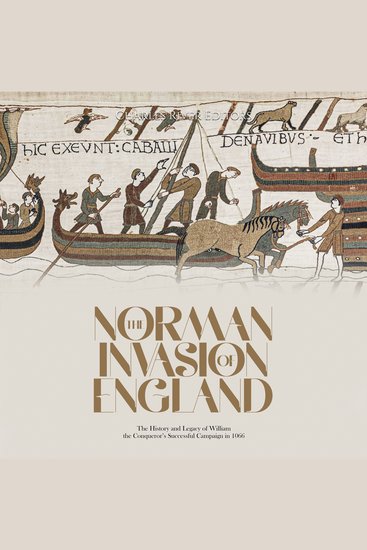
  • Norman Invasion of England The: The History and Legacy of William the Conqueror’s Successful Campaign in 1066 - cover

    Norman Invasion of England The:...

    Editors Charles River

    • 0
    • 0
    • 0
    For hundreds of years, the Anglo-Saxons – who had been harassing the Saxon Shore as pirates –began to settle in Britain, creating a patchwork of little kingdoms and starting a new era of English history. Several early medieval historians, writing well after the events, said the Anglo-Saxons were invited to Britain to defend the region from the northern tribes and ended up taking over. The Venerable Bede (672 or 673-735) said in his Historia ecclesiastica gentis Anglorum (“Ecclesiastical History of the English People”) that in the year 449, “The British consulted what was to be done and where they should seek assistance to prevent or repel the cruel and frequent incursions of the northern nations. They all agreed with their king Vortigern to call over to their aid, from the parts beyond the sea, the Saxon nation. … The two first commanders are said to have been Hengist and Horsa.” 
    	However they came to control most of England, the Anglo-Saxons became the dominant power in the region for nearly 500 years, and the strength of their cultural influence could be felt even after William the Conqueror won the Battle of Hastings and became the first Norman ruler on the island. William is one of history’s most famous conquerors, but the efforts to consolidate his rule in England were complicated from the start, both due to external enemies and those jockeying for his position while he was still alive. William ultimately decided to split Normandy and England. His son Robert, still in open revolt, would nonetheless inherit Normandy, while the next in line, his second son William, would rule England. The two states that William left behind were hardly united or at peace. Soon after his death, Odo conspired with Robert to oust his brother from the English throne and re-establish a united state, but the revolt failed, and King William “Rufus” II would rule England until his suspicious death in 1100.
    Show book
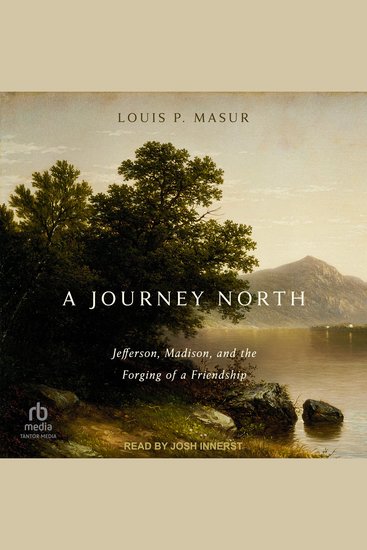
  • A Journey North - Jefferson Madison and the Forging of a Friendship - cover

    A Journey North - Jefferson...

    Louis P. Masur

    • 0
    • 0
    • 0
    Between May 21 and June 16, 1791, Thomas Jefferson and James Madison went on a trip together through Upstate New York and parts of New England on horseback. Whether the country could overcome regional and political differences and remain unified, however, was still very much in question. Hence why some observers at the time wondered whether this excursion into Federalist New England by the two most prominent southern Democratic-Republicans, both future presidents, had an ulterior motive. 


    While in Vermont, they focused on the sugar maple tree, which many hoped might offer a domestic alternative to slave-grown sugar cane imports. An encounter with a free Black farmer at Fort George resulted in a journal entry that illuminates their attitudes toward slavery and race. A meeting with members of the Unkechaug tribe on Long Island led to a vocabulary project that preoccupied Jefferson for decades, and which remains relevant today. 


    Madison later recalled that the trip made Jefferson and him "immediate companions," solidifying a bond with almost no peer in the annals of American history, one that thrived for fifty years. Jefferson declared at the end of his life, that his friendship with Madison had been "a source of constant happiness" to him. This book reveals the moment when it took hold.
    Show book
  • Jewish Palestine Arab Palestine: A History of Conflict - cover

    Jewish Palestine Arab Palestine:...

    Debra Cohen

    • 0
    • 0
    • 0
    This nonfiction book is a basic outline of the events that led up to the statehood of Israel at the time of the British Mandates, and explains why the Arab Palestinians did not achieve statehood. Based on secret documents that were recently discovered in the UK Archives, this book explains a very complex issue in the Middle East in easy-to-understand terms. This book is narrated by the author, who hopes this will enlighten every reader and inspire them to find a better peace plan for Israel and her hostile neighbors who live in Gaza and Judea-Samaria.
    Show book
  • Areopagitica - cover

    Areopagitica

    John Milton

    • 0
    • 0
    • 0
    John Milton is renowned for his poetry, yet during most of his lifetime he was best known as a writer of prose, both celebrated and denounced for his fiery polemics in an era of religious and political controversy, radical pamphleteering and civil war. This annotated edition of his major English prose writings includes Milton's tractates in favour of divorce, on progressive education, in defence of the execution of Charles I and the new Republican state, and Areopagitica, his famous attack on censorship and call for a free press. Rhetorical, powerful, heterodox, these are monuments to the ideals of liberty and free speech from a master of English prose.
    Show book
  • Another Sojourner Looking for Truth - My Journey from Civil Rights to Black Power and Beyond - cover

    Another Sojourner Looking for...

    Millicent E. Brown

    • 0
    • 0
    • 0
    Memories and insights of a lifetime fighting for Black freedom and social justice 


    Millicent E. Brown's family home at 270 Ashley Avenue in Charleston, South Carolina, was a center of civil rights activity. There Brown gained intimate knowledge of the struggle for racial justice, and those experiences set her on a life course dedicated to the civil rights struggle. Best known as the named plaintiff in the federal court case that, in 1963, forced the initial desegregation of public schools in South Carolina, her experiences as an activist range across years and well beyond her native state. Another Sojourner Looking for Truth is Brown's insightful reflection on her search for freedom in a nation deeply mired in white supremacist beliefs and overt violence against people of color. 


    In this revealing memoir, Brown writes about her fears and doubts, as well as the challenges of being a teenager expected to "represent the race" and combat negative stereotypes of African Americans. Listeners also gain perspective on the interpersonal aspects of white backlash to civil rights progress and strategic machinations within the movement. Overall, Brown's words will inform, inspire, and challenge everyone to better understand the Black Freedom Struggle and confront its ongoing challenges.
    Show book
  • Tank Warfare on the Eastern Front 1941-1942 - Schwerpunkt - cover

    Tank Warfare on the Eastern...

    Robert A. Forczyk

    • 0
    • 0
    • 0
    The German panzer armies that swept into the Soviet Union in 1941 were an undefeated force that had honed their skill in combined arms warfare to a fine edge. The Germans focused their panzers and tactical air support at points on the battlefield defined as Schwerpunkt—main effort—to smash through any defensive line and then advance to envelope their adversaries. 


    Initially, these methods worked well in the early days of Operation Barbarossa and the tank forces of the Red Army suffered defeat after defeat. Although badly mauled in the opening battles, the Red Army's tank forces did not succumb to the German armored onslaught and German planning and logistical deficiencies led to over-extension and failure in 1941. In the second year of the invasion, the Germans directed their Schwerpunkt toward the Volga and the Caucasus and again achieved some degree of success, but the Red Army had grown much stronger and by November 1942, the Soviets were able to turn the tables at Stalingrad. 


    Robert Forczyk's incisive study offers fresh insight into how the two most powerful mechanized armies of WWII developed their tactics and weaponry during the early years of the Russo-German War. He uses German, Russian, and English sources to provide the first comprehensive overview and analysis of armored warfare from the German and Soviet perspectives.
    Show book