Join us on a literary world trip!
Add this book to bookshelf
Grey
Write a new comment Default profile 50px
Grey
Subscribe to read the full book or read the first pages for free!
All characters reduced
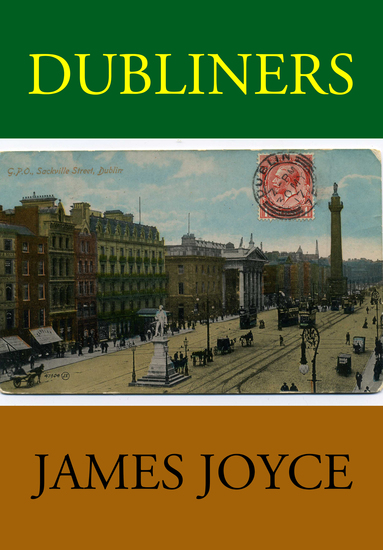
Dubliners - cover

Dubliners

James Joyce

Publisher: CrossReach Publications

  • 0
  • 0
  • 0

Summary

Dubliners is a collection of fifteen short stories by James Joyce, first published in 1914. It presents a naturalistic depiction of Irish middle class life in and around Dublin in the early years of the 20th century.
 
The stories were written when Irish nationalism was at its peak, and a search for a national identity and purpose was raging; at a crossroads of history and culture, Ireland was jolted by various converging ideas and influences. They centre on Joyce's idea of an epiphany (a moment where a character experiences a life-changing self-understanding or illumination) and the theme of paralysis (Joyce felt Irish nationalism stagnated cultural progression, placing Dublin at the heart of a regressive movement). The first three stories in the collection are narrated by child protagonists, while the subsequent stories are written in the third person and deal with the lives and concerns of progressively older people, in line with Joyce's division of the collection into childhood, adolescence, maturity, and public life. Many of the characters in Dubliners later appeared in minor roles in Joyce's novel Ulysses.
Available since: 06/09/2022.
Print length: 244 pages.
Other books that might interest you

  • Crocker's Hole - From their pens to your ears genius in every story - cover

    Crocker's Hole - From their pens...

    R D Blackmore

    • 0
    • 0
    • 0
    Richard Doddridge Blackmore was born on 7th June, 1825 at Longworth in Berkshire (now part of Oxfordshire), where his father, John Blackmore, was Curate-in-charge of the parish. His mother died a few months after his birth the victim of an outbreak of typhus. With this loss the family moved to Bushey, Hertfordshire, then on to their native Devon.  His elder brother Richard (by a year), however, was taken by his aunt to live near Oxford. His father married again in 1831, whereupon Richard returned to live with them.  With much of his childhood spent in the lush and pastoral "Doone Country" of Exmoor, and along the Badgworthy Water, Blackmore came to love the very countryside he immortalised in Lorna Doone.  In November 1853 he married his wife Lucy.  And the following year, 1854, his literary career began with a collection of Poems and for the next 15 years he would write in the winters and garden in the summers.  In 1860 with inherited money he built a house in Teddington just outside of London and established a market garden for the cultivation of fruit.  He loved horticulture but having little business experience could never really exploit it.  However with the publication of Lorna Doone in 1869 he was catapulted to fame.  And although he continued to write extensively nothing caught the public imagination quite like Lorna Doone.  RD Blackmore died at Teddington on 20th January, 1900 after a long and painful illness, and was buried next to his wife in Teddington cemetery.
    Show book
  • Book The (Unabridged) - cover

    Book The (Unabridged)

    H. P. Lovecraft

    • 0
    • 0
    • 0
    "The Book" is an unfinished short story by American horror fiction writer H. P. Lovecraft, believed to have been written in late 1933. It was first published in the journal Leaves in 1938, after Lovecraft's death.
    In the story fragment, the narrator is given an ancient book by a strange bookseller, and when he takes it home and examines it, weird and sinister events ensue.
    In October 1933, Lovecraft wrote in a letter: I am at a sort of standstill in writing disgusted at much of my older work, and uncertain as to avenues of improvement. In recent weeks I have done a tremendous amount of experimenting with different styles and perspectives, but have destroyed most of the results.
    Show book
  • The Shadow over Innsmouth - cover

    The Shadow over Innsmouth

    H.P. Lovecraft

    • 0
    • 0
    • 0
    Forming part of Lovecraft’s Cthulhu Mythos, THE SHADOW OVER INNSMOUTH tells the strange story of an unnamed student, whose visit to a decrepit Massachusetts seaport—the crumbling town of Innsmouth—leads to a number of shocking and personal revelations… 
    This is HorrorBabble's 2024 recording of the story, featuring immersive sound design intended to enhance the listening experience.
    Show book
  • The Time Machine The Lost Manuscript - Stories For Everyone - cover

    The Time Machine The Lost...

    H.G. Wells

    • 0
    • 0
    • 0
    Herbert George Wells was an English writer. Prolific in many genres, he wrote dozens of novels, short stories, and works of social commentary, history, satire, biography, and autobiography. His work also included two books on recreational war games. Wells is now best remembered for his science fiction novels and is often called the "father of science fiction", along with Jules Verne. 
     
    During his own lifetime, however, he was most prominent as a forward-looking, even prophetic social critic who devoted his literary talents to the development of a progressive vision on a global scale. A futurist, he wrote a number of utopian works and foresaw the advent of aircraft, tanks, space travel, nuclear weapons, satellite television, and something resembling the World Wide Web. His science fiction imagined time travel, alien invasion, invisibility, and biological engineering.  
     
    Wells's earliest specialized training was in biology, and his thinking on ethical matters took place in a specifically and fundamentally Darwinian context. He was also an outspoken Socialist from a young age, often (but not always, as at the beginning of the First World War) sympathizing with pacifist views. His later works became increasingly political and didactic, and he wrote little science fiction, while he sometimes indicated on official documents that his profession was that of a journalist. Novels such as Kipps and The History of Mr. Polly, which describe lower-middle-class life, led to the suggestion that he was a worthy successor to Charles Dickens, but Wells described a range of social strata and even attempted a diagnosis of English society as a whole.
    Show book
  • The Emancipated - cover

    The Emancipated

    George Gissing

    • 0
    • 0
    • 0
    The Emancipated explores the complexities of marriage, personal freedom, and societal expectations in late Victorian England. The story centers on Everard Domby, a disillusioned barrister trapped in a loveless marriage to a woman whose conventional mindset stifles his intellectual and emotional growth. As he grows closer to Dora Mead, a divorced and independent-minded woman considered scandalous by society, Everard is forced to confront his own ideals versus social reality. Gissing critiques the institution of marriage and the rigid moral codes of the time, portraying the inner turmoil of individuals torn between duty and desire. With psychological depth and sharp social observation, the novel questions what it truly means to be free—especially for those who challenge the norms of family, gender, and class.
    Show book
  • Last Words (Unabridged) - cover

    Last Words (Unabridged)

    Booker T. Washington

    • 0
    • 0
    • 0
    Booker Taliaferro Washington (April 5, 1856 - November 14, 1915) was an American educator, author, orator, and adviser to several presidents of the United States. Between 1890 and 1915, Washington was the dominant leader in the African American community and of the contemporary black elite. Washington was from the last generation of black American leaders born into slavery and became the leading voice of the former slaves and their descendants. They were newly oppressed in the South by disenfranchisement and the Jim Crow discriminatory laws enacted in the post-Reconstruction Southern states in the late 19th and early 20th centuries.
    LAST WORDS: We have come to the close of another school year. Some of you will go out from among us now, not to return. Others will go home for the summer vacation and return at the end of that for the next school year.
    Show book