

Join us on a literary world trip!
Add this book to bookshelf
Grey
Write a new comment Default profile 50px
Grey
Subscribe to read the full book or read the first pages for free!
All characters reduced
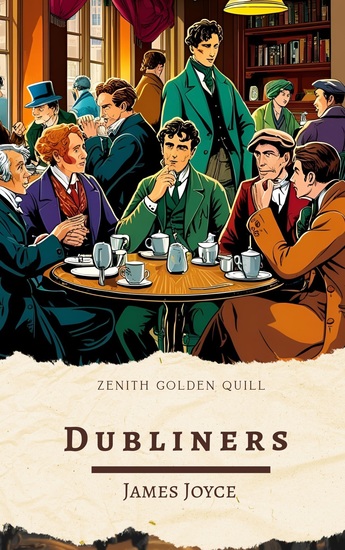
Dubliners - Timeless Stories of Everyday Life and Epiphany in Early 20th Century Dublin - cover

Dubliners - Timeless Stories of Everyday Life and Epiphany in Early 20th Century Dublin

James Joyce, Zenith Golden Quill

Publisher: Zenith Golden Quill

  • 0
  • 0
  • 0

Summary

A city. A people. A turning point in literature.

In Dubliners, James Joyce paints a vivid, intimate portrait of life in Dublin at the turn of the 20th century. Through fifteen interconnected short stories, Joyce explores themes of identity, paralysis, social expectation, and personal revelation—laying the groundwork for literary modernism.

From the innocence of childhood in "Araby" to the haunting climax of "The Dead," Dubliners captures ordinary lives with extraordinary emotional depth and stylistic clarity. This edition includes insightful annotations and historical context, making it ideal for both new readers and serious scholars of literature.

"A perfect introduction to Joyce's world and the human condition." — The Guardian
"Joyce's genius in miniature. Every word matters." — The New York Review of Books

Click Buy Now to explore a literary landmark that continues to shape storytelling.
Available since: 05/13/2025.
Print length: 215 pages.


Other books that might interest you

  • Hamlet - William Shakespeare - cover

    Hamlet - William Shakespeare

    William Shakespeare

    • 0
    • 0
    • 0
    The Tragedy of Hamlet, Prince of Denmark, often shortened to Hamlet, is a tragedy written by William Shakespeare sometime between 1599 and 1601. It is Shakespeare's longest play.
    Show book
  • The Old Fellow's Letter - cover

    The Old Fellow's Letter

    Lucy Maud Montgomery

    • 0
    • 0
    • 0
    Lucy Maud Montgomery (November 30, 1874 – April 24, 1942), published as L. M. Montgomery, was a Canadian author best known for a series of novels beginning in 1908 with Anne of Green Gables. The book was an immediate success. The title character, orphan Anne Shirley, made Montgomery famous in her lifetime and gave her an international following.
    The Old Fellow's Letter: Ruggles and I were down on the Old Fellow. It doesn't matter why and, since in a story of this kind we must tell the truth no matter what happens or else where is the use of writing a story at all? I'll have to confess that we had deserved all we got and that the Old Fellow did no more than his duty by us.
    Show book
  • The Vampyre - cover

    The Vampyre

    John William Polidori

    • 0
    • 0
    • 0
    Noted as one of the first pieces of literature to feature vampirism effectively, The Vampyre follows the adventures of a wealthy young man named Aubrey who befriends a mysterious, suave nobleman named Lord Ruthven. As Aubrey begins to realize just how dangerous Lord Ruthven is, he discovers that his beloved sister is in the monster's sights. A product of a competition that also produced Mary Shelley's Frankenstein, this classic gothic novella became the foundation of the romantic vampire genre.
    Show book
  • The Timeless Classic Persuasion - cover

    The Timeless Classic Persuasion

    Jane Austen

    • 0
    • 0
    • 0
    Persuasion is a novel by Jane Austen that follows the story of Anne Elliot, an unmarried woman struggling to reconcile her feelings for a man she met and fell in love with eight years earlier, Captain Frederick Wentworth. The fast-paced novel explores themes of love, class, and social expectations in 19th-century England. Austen uses Anne's character to highlight the societal limitations placed upon women during this time. Women were expected to marry for financial security and status, rather than for love. Anne's struggle to navigate her desires and the expectations of her family and society highlights the conflict that many women faced during this period. In addition to exploring themes of love and societal expectations, the novel also delves into the class system of England at that time. Austen uses the characters of the landed gentry and the navy officers to comment on the societal changes that were occurring during this time period. Through these characters, Austen highlights the shifting power dynamics and changing social structures of the time.
    Show book
  • A Model Crime - From their pens to your ears genius in every story - cover

    A Model Crime - From their pens...

    William Pett Ridge

    • 0
    • 0
    • 0
    William Pett Ridge was born at Chartham, near Canterbury, Kent, on 22nd April 1859.  
    His family’s resources were certainly limited. His father was a railway porter, and the young Pett Ridge, after schooling in Marden, Kent became a clerk in a railway clearing-house. The hours were long and arduous, but self-improvement was Pett Ridge’s goal.  After working from nine until seven o’clock he would attend evening classes at Birkbeck Literary and Scientific Institute and then to follow his passion; the ambition to write.  He was heavily influenced by Dickens and several critics thought he had the capability to be his successor.  
    From 1891 many of his humourous sketches were published in the St James's Gazette, the Idler, Windsor Magazine and other literary periodicals of the day. 
    Pett Ridge published his first novel in 1895, A Clever Wife. By the advent of his fifth novel, Mord Em'ly, a mere three years later in 1898, his success was obvious.  His writing was written from the perspective of those born with no privilege and relied on his great talent to find humour and sympathy in his portrayal of working class life. 
    Today Pett Ridge and other East End novelists including Arthur Nevinson, Arthur Morrison and Edwin Pugh are being grouped together as the Cockney Novelists.   
    In 1924, Pugh set out his recollections of Pett Ridge from the 1890s: “I see him most clearly, as he was in those days, through a blue haze of tobacco smoke. We used sometimes to travel together from Waterloo to Worcester Park on our way to spend a Saturday afternoon and evening with H. G. Wells. Pett Ridge does not know it, but it was through watching him fill his pipe, as he sat opposite me in a stuffy little railway compartment, that I completed my own education as a smoker... Pett Ridge had a small, dark, rather spiky moustache in those days, and thick, dark, sleek hair which is perhaps not quite so thick or dark, though hardly less sleek nowadays than it was then”. 
    With his success, on the back of his prolific output and commercial success, Pett Ridge gave generously of both time and money to charity. In 1907 he founded the Babies Home at Hoxton.  This was one of several organisations that he supported that had the welfare of children as their mission.  
    His circle considered Pett Ridge to be one of life's natural bachelors. In 1909 they were rather surprised therefore when he married Olga Hentschel.  
    As the 1920’s arrived Pett Ridge added to his popularity with the movies. Four of his books were adapted into films.  
    Pett Ridge now found the peak of his fame had passed. Although he still managed to produce a book a year he was falling out of fashion and favour with the reading public and his popularity declined rapidly.  His canon runs to over sixty novels and short-story collections as well as many pieces for magazines and periodicals. 
    William Pett Ridge died, on 29th September 1930, at his home, Ampthill, Willow Grove, Chislehurst, at the age of 71. 
    He was cremated at West Norwood on 2nd October 1930.
    Show book
  • A Wireless Message - From their pens to your ears genius in every story - cover

    A Wireless Message - From their...

    Ambrose Bierce

    • 0
    • 0
    • 0
    Ambrose Gwinnett Bierce was born on 24th June 1842 at Horse Cave Creek in Meigs County, Ohio. His parents were poor but they introduced him to literature at an early age, instilling in him a deep appreciation of books, the written word and the elegance of language.  
    Growing up in Koscuisko County, Indiana poverty and religion were defining features of his childhood, and he would later describe his parents as “unwashed savages” and fanatically religious, showing him little affection but always quick to punish. He came to resent religion, and his introduction to literature appears to be their only positive effect. 
    At age 15 Bierce left home to become a printer’s devil, mixing ink and fetching type at The Northern Indian, a small Ohio paper. Falsely accused of theft he returned to his farm and spent time sending out work in the hopes of being published. 
    His Uncle Lucius advised he be sent to the Kentucky Military Institute. A year later he was commissioned as an Officer.  As the Civil War started Bierce enlisted in the 9th Indiana Infantry Regiment.  
    In April 1862 Bierce fought at the Battle of Shiloh, an experience which, though terrifying, became the source of several short stories. Two years later he sustained a serious head wound and was off duty for several months. He was discharged in early 1865.  
    A later expedition to inspect military outposts across the Great Plains took him all the way to San Francisco. He remained there to become involved with publishing and editing and to marry, Mary Ellen on Christmas Day 1871.  They had a child, Day, the following year.  
    In 1872 the family moved to England for 3 years where he wrote for Fun magazine. His son, Leigh, was born, and first book, ‘The Fiend’s Delight’, was published.  
    They returned to San Francisco and to work for a number of papers where he gained admiration for his crime reporting. In 1887 he began a column at the William Randolph Hearst’s San Francisco Examiner.  
    Bierce’s marriage fell apart when he discovered compromising letters to his wife from a secret admirer. The following year, 1889 his son Day committed suicide, depressed by romantic rejection. 
    In 1891 Bierce wrote and published the collection of 26 short stories which included ‘An Occurrence at Owl Creek Bridge’.  Success and further works including poetry followed.  
    Bierce with Hearst’s resources helped uncover a financial plot by a railroad to turn 130 million dollars of loans into a handout. Confronted by the railroad and asked to name his price Bierce answered “my price is $130 million dollars. If, when you are ready to pay, I happen to be out of town, you may hand it over to my friend, the Treasurer of the United States”.  
    He now began his first foray as a fabulist, publishing ‘Fantastic Fables’ in 1899.  But tragedy again struck two years later when his second son Leigh died of pneumonia relating to his alcoholism.  
    He continued to write short stories and poetry and also published ‘The Devil’s Dictionary’.  
    At the age of 71, in 1913 Bierce departed from Washington, D.C., for a tour of the battlefields where he had fought during the civil war. At the city of Chihuahua he wrote his last known communication, a letter to a friend. It’s closing words were “as to me, I leave here tomorrow for an unknown destination,” Ambrose Bierce then vanished without trace.
    Show book
