Join us on a literary world trip!
Add this book to bookshelf
Grey
Write a new comment Default profile 50px
Grey
Subscribe to read the full book or read the first pages for free!
All characters reduced
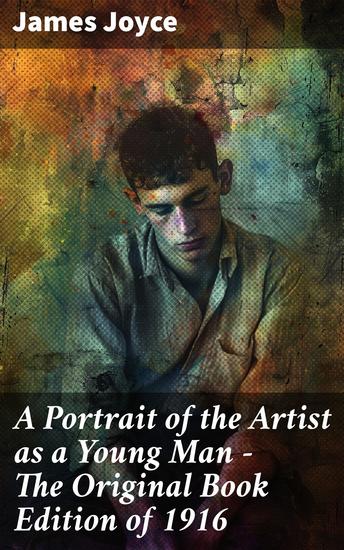
A Portrait of the Artist as a Young Man - The Original Book Edition of 1916 - A Masterpiece of Self-Discovery and Artistic Growth - cover

A Portrait of the Artist as a Young Man - The Original Book Edition of 1916 - A Masterpiece of Self-Discovery and Artistic Growth

James Joyce

Publisher: Good Press

  • 0
  • 0
  • 0

Summary

James Joyce's "A Portrait of the Artist as a Young Man," originally published in 1916, is a seminal work of modernist literature that explores the development of identity and self-awareness through the lens of Stephen Dedalus, a young man grappling with his artistic ambitions and societal constraints in late 19th-century Ireland. Joyce employs a stream-of-consciousness narrative style, rich with lyrical language and innovative techniques, reflecting the complexities of thought and perception. The novel is set against a backdrop of religious and cultural upheaval, capturing the tensions between individual creativity and communal norms, thus positioning itself as a pivotal text in the exploration of the modern artist's psyche. James Joyce, an Irish novelist, poet, and major figure in 20th-century literature, draws on his own experiences in "A Portrait of the Artist as a Young Man." Through Stephen Dedalus, Joyce channels his struggles with identity, rebellion against conventions, and the pursuit of self-expression. His innovative approach to narrative structure and character development was influenced by his own literary ambitions, leading him to challenge traditional storytelling methods within the context of his Irish upbringing. This compelling novel is highly recommended for readers interested in the intricate process of artistic maturation, as well as those seeking insight into the formation of individual identity amidst cultural constraints. Joyce's rich prose and profound exploration of consciousness make this work a cornerstone of modernist literature, ensuring its relevance for both scholarly examination and personal reflection.
Available since: 12/05/2023.
Print length: 467 pages.

Other books that might interest you

  • 20000 Leagues under the Sea - cover

    20000 Leagues under the Sea

    Jules Verne

    • 0
    • 0
    • 0
    "The sea is only the embodiment of a supernatural and wonderful existence. It is nothing but love and emotion; it is the 'Living Infinite.'"
    
    In 1866, ships across the globe report sightings of a mysterious and deadly sea monster. Professor Pierre Aronnax, his servant Conseil, and the Canadian harpooner Ned Land join an expedition to hunt the creature, only to discover that the "monster" is actually a futuristic submarine: the Nautilus. Taken prisoner by the enigmatic Captain Nemo, the trio is whisked away on a 20,000-league journey beneath the waves. From the coral graveyards of the Red Sea to the sunken ruins of Atlantis and the icy barriers of the South Pole, they witness wonders and horrors hidden from the eyes of the world.
    
    A Marvel of Victorian Engineering: The true star of the novel is the Nautilus itself. Driven entirely by electricity—a novelty in Verne's time—it features a library of 12,000 volumes, a museum of rare pearls, and a massive glass window that offers a front-row seat to the mysteries of the deep. Verne's technical foresight remains a staggering achievement of the "hard" science fiction genre.
    
    The Enigma of Captain Nemo: Captain Nemo is more than a scientist; he is an exile, a rebel, and a man driven by a profound hatred for the empires of the land. His motto, Mobilis in Mobili (Moving in the Moving Element), reflects his desire for total freedom. The novel explores the tension between his genius and his thirst for vengeance against a world that took everything from him.
    
    Man vs. The Living Infinite: From the terrifying encounter with a forest of giant kelp to the legendary battle with the "pouples" (giant squids), Verne creates a world of high-stakes adventure. It is a story that captures the human spirit of discovery and the humbling power of the natural world.
    
    Dive into the unknown. Purchase "20,000 Leagues Under the Sea" today and join the crew of the Nautilus.
    Show book
  • Schalken the Painter - cover

    Schalken the Painter

    Joseph Sheridan Le Fanu

    • 0
    • 0
    • 0
    "He was not a man of this world, and the gold he paid with had a cold, ancient gleam."
    
    In the workshops of 17th-century Leyden, the young and talented artist Godfried Schalken falls in love with Rose, the beautiful niece of his master, Gerard Douw. But their romance is shattered by the arrival of a mysterious suitor: Minheer Vanderhausen. Blue-skinned, breathless, and draped in magnificent but outdated finery, Vanderhausen offers a chest of gold so immense that Douw cannot refuse. Rose is bartered away to this living corpse, disappearing into a nightmare from which there is no return. Years later, Schalken is granted one final, terrifying glimpse of his lost love—and the horrific entity she now serves in the shadows.
    
    The Horror of the Visual: Le Fanu, himself an admirer of art, uses the techniques of the Dutch masters to tell his story. He describes scenes as if they were paintings, utilizing chiaroscuro—the intense contrast between deep shadows and bright light—to hide the grotesque features of the supernatural antagonist. The result is a story that feels as textured and atmospheric as an oil painting come to life.
    
    A Tale of Moral Decay: At its heart, the story is a critique of avarice. Gerard Douw's willingness to sell his niece for a chest of gold is the "true" horror that invites the supernatural in. Le Fanu explores the idea that human greed can be more monstrous than any phantom, leading to a tragedy that haunts the protagonist until his dying day.
    
    The Legacy of the "Demon Lover": Schalken the Painter is a foundational text in the "demon lover" tradition of Gothic fiction. It avoids the typical "clanking chains" of 18th-century ghosts, opting instead for a quiet, physical, and deeply uncanny presence. The final image of the story—the "living" painting—remains one of the most famous and frightening endings in horror literature.
    
    Don't look too closely at the shadows. Purchase this masterpiece of the macabre today.
    Show book
  • Exasperated - A Short Story Collection - The simplest things become the hardest tasks - cover

    Exasperated - A Short Story...

    J M Barrie, Frank Stockton, G K...

    • 0
    • 0
    • 0
    In this volume we discover that the obvious and the easy are not perhaps as obvious and easy as our authors first present them. 
     
    They play with us.  There is certainty.  Then there is uncertainty.  There is a fact and then seemingly not. 
     
    One thing we can rely on though is that each new twist and turn takes us on a journey of frustration and exasperation that is as enjoyable as it is bewildering. 
     
    And, in the company of the sparkling wits of Chesterton, Aumonier, Barrie and a host of others who summon indignation and vexation as they rile and befuddle us then being exasperated was never quite so much fun. 
     
    01 - Exasperated - A Short Story Collection - An Introduction 
    02 - A Somewhat Improbable Story by G K Chesterton 
    03 - The Man Who Did Not Believe in Luck by Jerome K Jerome 
    04 - Putois by Anatole France 
    05 - The Lady, or the Tiger by Frank Stockton 
    06 - The Inconsiderate Waiter by J M Barrie 
    07 - The Absent Minded Man by Jerome K Jerome 
    08 - The Little Room by Madeline Yale Wynne 
    09 - The Mysterious Card by Cleveland Moffet 
    10 - Where Was Wych Street by Stacy Aumonier
    Show book
  • The voyage out - cover

    The voyage out

    Virginia Woolf

    • 0
    • 0
    • 0
    "The Voyage Out" is the first novel written by Virginia Woolf. It was published in 1915 and is considered a significant work in the modernist literary movement. The novel follows the journey of Rachel Vinrace, a young woman, as she embarks on a sea voyage from England to South America. "The Voyage Out" explores themes of self-discovery, societal conventions, and the limitations imposed on women in the early 20th century. Woolf weaves a narrative that delves into the complexities of human relationships and the impact of cultural norms on individual lives. The novel is known for its introspective and psychological depth, laying the groundwork for Woolf's later, more experimental works.
    Show book
  • The Odd Women - cover

    The Odd Women

    George Gissing

    • 0
    • 0
    • 0
    Before he was 21 George Gissing conceived the ambition of writing a long series of novels, somewhat in the manner of Balzac, whom he admired. The first of these, Workers in the Dawn, appeared in 1880, to be followed by 21 others. Between 1886 and 1895 he published one or more novels every year. He also wrote Charles Dickens: A Critical Study (1898), a perceptive piece of literary criticism. 
     
    Gissing's work has a good deal of documentary interest for its detailed and accurate accounts of lower-middle-class London life. On the social position and psychology of women, he is particularly acute: The Odd Women is a powerful study of female frustration. He did not lack human sympathies, but his obvious contempt for so many of his characters reflects an artistic limitation. Gissing was deeply critical, in an almost wholly negative way, of contemporary society. Of his novels, New Grub Street, considered by some critics to be his only great book, is unique in its merciless analysis of the compromises required by the literary life. 
     
    Gissing's 1893 novel takes on the 19th century "Woman Question" by looking at themes of feminism, marriage, and love. The novel raises these issues through the lives of several contrasting women: Mary Barfoot, a feminist philanthropist who helps train women for careers; her close friend Rhoda Nunn, who believes marriage is a disastrous choice for women; and Monica Madden, who starts out as one of their protegees but chooses to marry a seemingly kind older man. As Monica experiences the challenges of married life, Rhoda finds herself drawn to Mary's cousin, the charming but apparently profligate Everard
    Show book
  • The Disappearance of Lady Frances Carfax - cover

    The Disappearance of Lady...

    Arthur Conan Doyle

    • 0
    • 0
    • 0
    The Disappearance of Lady Frances Carfax is one of the 56 Sherlock Holmes short stories written by Sir Arthur Conan Doyle. It is one of the eight stories in the cycle collected as His Last Bow, and one of the few stories in which for much of the plot Watson must act alone and try his best with Holmes left in the background.Holmes sends Dr. Watson to Lausanne to investigate Lady Frances Carfax's disappearance since he himself is too busy in London. Lady Frances is a lone, unwed woman denied a rich inheritance on account of her sex. She does, however, carry valuable jewels with her. It is also her habit to write to her old governess, Miss Dobney, every other week, but for the past five weeks, there has not been a word from her. She has left the Hôtel National for parts unknown. Her last two bank transactions were cheques, one to pay her hotel bill, and another for £50 to her maid, Miss Marie Devine.In Switzerland, Watson finds out that Lady Frances stayed at the Hôtel International for several weeks, but then suddenly left in a hurry one day. Only one witness could suggest an explanation, one involving a big, bearded man who kept hounding her. It also emerges that Lady Frances's maid has left her employ, although it is not known why...Famous works of the author Arthur Conan Doyle: A Study in Scarlet, The Sign of the Four, The Adventures of Sherlock Holmes, The Memoirs of Sherlock Holmes, The Hound of the Baskervilles, The Return of Sherlock Holmes, The Valley of Fear, His Last Bow, The Case-Book of Sherlock Holmes, Stories of Sherlock Holmes, The Lost World.
    Show book