Join us on a literary world trip!
Add this book to bookshelf
Grey
Write a new comment Default profile 50px
Grey
Subscribe to read the full book or read the first pages for free!
All characters reduced
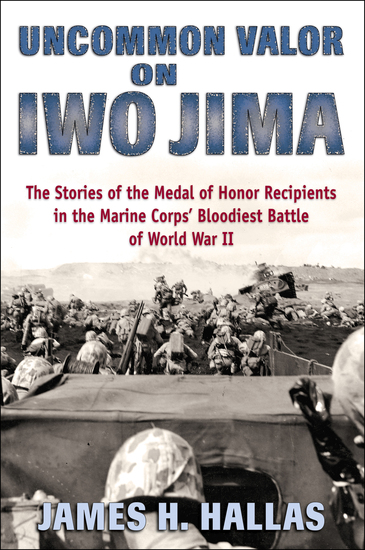
Uncommon Valor on Iwo Jima - The Stories of the Medal of Honor Recipients in the Marine Corps' Bloodiest Battle of World War II - cover

Uncommon Valor on Iwo Jima - The Stories of the Medal of Honor Recipients in the Marine Corps' Bloodiest Battle of World War II

James H Hallas

Publisher: Stackpole Books

  • 0
  • 0
  • 0

Summary

The epic Battle of Iwo Jima is recounted through the stories of twenty-eight American soldiers who showed uncommon valor during one of WWII’s most bitter conflicts. When the smoke cleared on Iwo Jima in March of 1945, nineteen-thousand American Marines had been wounded and seven-thousand were dead, a casualty rate of nearly thirty-nine percent. Lasting over a month, Iwo was the Marines’ bloodiest battle of the Second World War and the only Pacific battle in which a U.S. landing force suffered more casualties than it inflicted. It was also the most highly decorated single engagement in Marine Corps history.  This volume captures the bravery of those who fought in that epic battle through the stories of twenty-two Marines and five Navy personnel who received the Medal of Honor in recognition of their gallantry under fire.
Available since: 06/14/2023.
Print length: 421 pages.

Other books that might interest you

  • Mughal Empire The: The History of the Modern Dynasty that Ruled Much of India Before the British - cover

    Mughal Empire The: The History...

    Editors Charles River

    • 0
    • 0
    • 0
    In the late 15th century, Western Europe entered the Renaissance, which is often credited with the origins of modern, scientific thought. The Age of Exploration also began around that time, and 1517 is when the Reformation began. Meanwhile, the Islamic world was also quickly evolving around the same time, with the Ottoman Empire expanding into Eastern Europe and wiping the Orthodox Christian Byzantine Empire off the face of the map. And while the Ottomans were establishing themselves as the premier Islamic power with the help of early gunpowder weapons, hundreds of miles away in Central Asia, another “gunpowder empire” was forming.  
    	The Mughals, a group with Turkish and Mongolian roots, also used gunpowder weapons to sweep into northern India, topple the existing Islamic dynasty in Delhi, and eventually subject most of India to their rule. The term “gunpowder empire” was originally coined by Russian scholar V. V. Bartold and popularized by American historians William McNeil and Marshall Hodgson in the mid-20th century to describe the Islamic Ottoman, Safavid, and Mughal empires, which they claimed came to power through gunpowder. Although that core thesis has been challenged by historians in recent years, who argue that gunpowder weapons were a feature or result of the rise of these empires, not the cause for them, the term is still used (Streusand 2011, 3).  
    	To be fair, the Mughals rose through a combination of political acumen and battlefield brutality, and they held onto their empire for hundreds of years in much the same way. In the process, the Mughals developed a state that was unique in many ways, adopting elements of Islamic culture and meshing them with native Indian culture and even Western European culture. When the British conquered India in the mid-19th century, they had the benefit of inheriting the Mughal system, which, despite many problems, proved to be a suitable template for rule over a land as vast and diverse as India.
    Show book
  • History of Britain: A Captivating Guide to Events and Facts You Should Know about the Story of England Wales Northern Ireland and Scotland - cover

    History of Britain: A...

    Captivating History

    • 0
    • 0
    • 0
    The vast history of Britain is now at your fingertips! 
    Britain has a long history, from the days of Roman settlements, such as Londinium (modern-day London), to the days of Britain ruling the waves to the subsequent decline of the empire and the rise of the Commonwealth. It is hard to cover the entire history of Britain in just one book. However, this text seeks to break its history down into easily digestible sections. 
    This book starts us off at the point at which Britain entered into the historical record. Follow along as we unveil the invasion of Julius Caesar and the conquests of later Romans. These were the first people to write down their thoughts and feelings about Britain’s inhabitants. 
    The Roman Empire itself would eventually crash, but Hadrian’s Wall, as well as a multitude of Roman settlements, would remain. These were inherited by the Anglo-Saxons, who arrived from the German-speaking lands just across the English Chanel. The Anglo-Saxons created a rich history and culture but would be supplanted by the Normans in 1066. 
    The Tudor dynasty emerged in 1485, fundamentally changing life in Britain. The most notorious Tudor of all, King Henry VIII, broke free from Roman Catholicism and instituted the Church of England with himself at its head. 
    Here is just a peek at what you will learn:The rise of Anglo-Saxon rule and the establishment of EnglandWilliam the Conqueror and how he changed the course of British historyHenry VIII and the Protestant ReformationThe many conflicts between England, Scotland, Wales, and Northern IrelandThe legacy of Wales and Welsh cultureScotland’s role in British affairsBritain’s involvement in World War One and World War TwoFamous myths and legends of the British Isles 
    Scroll up and click the “add to cart” button to begin learning about the fascinating history of Britain!
    Show book
  • Haunting Truths: Navigating Life's Battles with Addiction - Discover 'Haunting Truths'—empowering audio narratives to conquer life's addiction battles effortlessly - cover

    Haunting Truths: Navigating...

    Jasper Nightingale

    • 0
    • 0
    • 0
    Haunting Truths: Navigating Life's Battles with Addiction   
    ⭐⭐ Simplified Audio Guide with Explanations ⭐⭐ 
    Are you eager to move forward in life and enhance your understanding of overcoming challenges such as addiction? 
    Searching for a complete guide that equips you with everything needed to conquer life's difficulties? 
    Look no further! 
    This guide serves as your ultimate resource for deepening your insight, honing your coping skills, and applying them effectively. With this, you're prepared for success. 
    Updated to reflect the latest strategies for navigating life's challenges. 
    Key features of this insightful guide: 
    - Profound insights on building strength and resilience   
    - Detailed explanations on overcoming life's hurdles   
    - Effective strategies for preparation and tackling challenges   
    Our guide stands out with its extensive coverage, ensuring you are fully prepared to face and triumph over difficulties. Concepts are explored thoroughly and with accuracy. 
    Note that this guide is a completely independent resource crafted for your benefit. 
    Structured with clarity and using straightforward language, our guide offers smooth transitions between topics. Say goodbye to complicated jargon and welcome clear, accurate content. 
    So, why wait? Click the BUY NOW button, secure your guide, and start your journey to discovering strength and resilience in overcoming life's challenges!
    Show book
  • School Communities of Strength - Strategies for Educating Children Living in Deep Poverty - cover

    School Communities of Strength -...

    Jr. Peter W. Cookson, David C....

    • 0
    • 0
    • 0
    In School Communities of Strength, Peter W. Cookson, Jr., lays out a blueprint for providing equitable educational opportunities for students from all socioeconomic strata, and particularly for the five million American children who live with the extreme material hardship known as deep poverty. This work issues an urgent call to action for K–12 schools to put in place the policies, practices, and programs that enable economically vulnerable students to thrive. 


    Drawing from up-to-date findings in the science of learning and development as well as analyses of schools that serve students in poverty, Cookson pinpoints success strategies that can help schools improve their poverty responsiveness. He shows how these strategies can help educators create the culturally responsive, inclusive environments that provide a base of safety from which students can better engage with their education. 


    Offering astute analysis, Cookson notes that school communities of strength require adequate funding and also meaningful collaboration among families, neighborhood partners, and educators. This book amplifies the idea that communities working together can drive transformative change, and it brings into focus three primary policy initiatives that can advance educational equity.
    Show book
  • Mughal Empire - The Taj Mahal Legacy - cover

    Mughal Empire - The Taj Mahal...

    Rolf Hedger

    • 0
    • 0
    • 0
    The Mughal Empire emerged as one of the most powerful and influential dynasties in Indian history, leaving a lasting impact on culture, architecture, and governance. Its foundation was laid by Babur, a descendant of both Timur and Genghis Khan, who established Mughal rule in the early 16th century. Babur's military prowess and strategic vision enabled him to defeat the Delhi Sultanate in the First Battle of Panipat in 1526. This victory marked the beginning of Mughal dominance in the Indian subcontinent. However, Babur’s reign was short-lived, and it was his grandson, Akbar, who truly solidified the empire’s foundation. 
    Akbar ascended the throne at a young age and quickly proved himself to be an exceptional leader. His reign, which lasted from 1556 to 1605, was marked by territorial expansion, administrative reforms, and a commitment to cultural and religious harmony. Unlike previous rulers, Akbar recognized the diversity of India and sought to integrate different communities into his empire. He abolished the jizya tax on non-Muslims, promoted interfaith dialogue, and appointed talented individuals from various backgrounds to key positions in his administration. His policy of religious tolerance and inclusive governance earned him the loyalty of many, contributing to the stability and prosperity of the empire. 
    One of Akbar’s most remarkable achievements was the establishment of an efficient administrative system. He divided his empire into provinces, each governed by appointed officials who reported directly to the central authority. This system ensured effective governance and facilitated tax collection, trade, and law enforcement. Additionally, Akbar introduced a standardized revenue system that helped regulate the economy and promote agricultural growth. His emphasis on merit-based appointments created a well-organized bureaucracy that endured long after his reign.
    Show book
  • How We Think - cover

    How We Think

    John Dewey

    • 0
    • 0
    • 0
    How We Think is a seminal work by the American philosopher and educator John Dewey, first published in 1910. The book explores the process of human thought and inquiry, examining how we develop ideas and knowledge, and how we use critical thinking and problem-solving to make sense of the world around us. 
    Dewey's approach emphasizes the importance of experience and reflection in the process of learning and thought. He argues that our thinking is influenced by our past experiences and that we must reflect on those experiences in order to form new ideas and perspectives. He also advocates for a scientific approach to inquiry, emphasizing the importance of observation, experimentation, and testing in the development of knowledge. 
    In How We Think, Dewey also introduces his ideas on experimentalism and pragmatism, arguing that knowledge must be grounded in experience and that theories and ideas must be tested through practical application. He discusses the role of logic and critical thinking in this process, and the importance of education in fostering these skills. 
    How We Think is a groundbreaking work in the fields of philosophy, education, and psychology, and remains relevant today for its insights into the nature of human thought and learning
    Show book