Join us on a literary world trip!
Add this book to bookshelf
Grey
Write a new comment Default profile 50px
Grey
Subscribe to read the full book or read the first pages for free!
All characters reduced
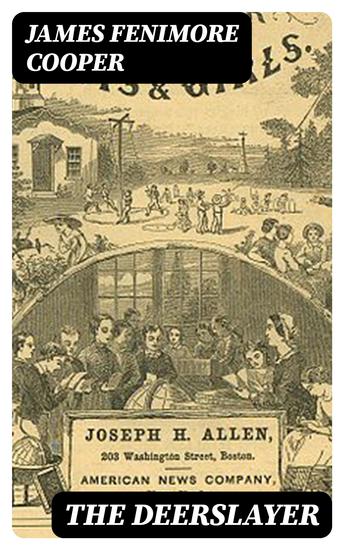
The Deerslayer - cover

The Deerslayer

James Fenimore Cooper

Publisher: DigiCat

  • 0
  • 0
  • 0

Summary

James Fenimore Cooper's "The Deerslayer" is a seminal work in American literature, celebrated for its vivid portrayal of early 18th-century frontier life and its exploration of themes such as honor, nature, and the moral complexities of human relationships. Written in 1841, this novel is renowned for Cooper's signature style, characterized by intricate descriptions, philosophical musings, and richly developed characters against the backdrop of the American wilderness. As the first chronologically in Cooper's Leatherstocking Tales series, it delves into the formative experiences of the protagonist Natty Bumppo, illustrating his evolution from a naive youth to a principled man confronted by the dichotomy of civilization and wilderness. James Fenimore Cooper, often regarded as the father of the American novel, exhibits a deep understanding of frontier America, informed by his life experiences growing up in New York and his interactions with Native American cultures. His background as a naval officer significantly influenced his narrative style and thematic concerns, particularly regarding the clash between European settlers and Indigenous peoples. Through "The Deerslayer," Cooper advances his critique of contemporary societal norms and the values of his time. This novel is not only a gripping adventure but also an insightful commentary on the American spirit. I highly recommend "The Deerslayer" to readers interested in the foundational narratives of American literature, as it poignantly addresses the complexities of identity and morality within the context of a rapidly changing society.
Available since: 09/15/2022.
Print length: 515 pages.
Other books that might interest you

  • Dies Irae - From their pens to your ears genius in every story - cover

    Dies Irae - From their pens to...

    Kenneth Grahame

    • 0
    • 0
    • 0
    Kenneth Grahame was born on 8th March 1859 in Edinburgh. 
    At age 5 his mother succumbed to puerperal fever.  His father, who had a drinking problem, now sent his 4 children to live with their grandmother at her large house in Cookham, Berkshire. Here the children lived in large open grounds next to the river.  These early experiences would in later years, be retold in his writing through a myriad of characters. 
    Grahame loved being a pupil at St Edward's School, Oxford and wanted to enroll at the university there but his guardian demurred on account of the cost. 
    Instead, a banking career was chosen for him, starting in 1879 at the Bank of England, where he rose steadily to the rank of its Secretary until retiring, with a pension, in 1908 due to ill health. 
    Alongside his commercial career Grahame had written and published various stories and essays in several periodicals. Some were anthologized as ‘Pagan Papers’ in 1893, and two years later ‘The Golden Age’ and later still ‘Dream Days’ and its masterpiece ‘The Reluctant Dragon’ became part of many home libraries.  His ability to view life through the lens of a young and curious child was superb, enabling the reader to easily identify with the character.   
    Grahame married Elspeth Thomson in 1899 and they had one child; Alastair, born semi-blind and plagued by health problems.  In a heart-rending tragedy he would later take his own life whilst attending Oxford University in 1920.   
    In 1908 Grahame reworked many of the bedtime stories he had fashioned for his son into the enduring favourite; ‘The Wind in the Willows’, describing the heart-warming adventures of Mr Toad and his friends.   
    Kenneth Grahame died in Pangbourne, Berkshire, on 6th July 1932.
    Show book
  • Strange Case of Dr Jekyll and Mr Hyde The - Audiobook - cover

    Strange Case of Dr Jekyll and Mr...

    Robert Louis Stevenson, Classic...

    • 0
    • 0
    • 0
    The Strange Case of Dr. Jekyll and Mr. Hyde is a dark and gripping novella by Robert Louis Stevenson that explores the duality of human nature. Set in Victorian London, it tells the story of the respectable Dr. Jekyll, who creates a potion to separate the good and evil within himself. The result is the terrifying Mr. Hyde, a man who embodies his darkest impulses. As Hyde begins to take control, Jekyll finds himself in a desperate struggle for his soul.This haunting tale is both a psychological thriller and a moral allegory, raising timeless questions about identity, repression, and the battle between good and evil. Stevenson's masterful storytelling and atmospheric writing make it one of the most enduring classics of Gothic literature.
    Show book
  • A Hero of our Time - Abridged for Intermediate English-Language Students (B1+ B2) - cover

    A Hero of our Time - Abridged...

    Mikhail Lermontov, Gerhard Symons

    • 0
    • 0
    • 0
    This is an abridged audiobook of A Hero of our Time in English. It is intended for intermediate English-language students (CEFR: level B1+/B2). 
    This audiobook is a simplified version of the classic story by nineteenth-century author Mikhail Lermontov (1814-1841). 
    It is abridged and narrated by Gerhard Symons, a native English speaker with a neutral English accent. 
    The audiobook run time is seven hours and five minutes (425 minutes). The audiobook is enhanced with appropriate sound effects throughout. 
    -- 
    A FIGHTER AND A LOVER. A HERO OR A VILLAIN? 
    It is a time of war. A young army officer, Pechorin, has arrived in the Caucasus. Pechorin is a nobleman who is handsome, charming, and rich. He enjoys hunting wild pigs, 16-year-old Circassian princesses, and power. He is also selfish, violent, and rather bored with life. Whoever he meets is changed forever... 
    You will follow him through five stories. You will read his private diary. You will penetrate the secrets of a human soul. And you will ask yourself, “who is Pechorin?” 
    © 2022 Three Thrushes
    Show book
  • Billy Budd - cover

    Billy Budd

    Herman Melville

    • 0
    • 0
    • 0
    Billy Budd is Herman Melville's profound and moving final novella, a masterwork of moral inquiry set against the strict world of an eighteenth-century naval warship. Written in Melville's later years and published posthumously, the story stands as one of the most powerful meditations on innocence, justice, and authority in American literature.
    
    The narrative follows Billy Budd, a young sailor whose natural goodness, physical beauty, and openhearted nature make him beloved by his shipmates. Billy's simplicity and sincerity, however, leave him vulnerable in a world governed by rigid hierarchy and unforgiving law. His presence awakens deep resentment in John Claggart, the ship's master-at-arms, whose cold intellect and moral corruption stand in stark contrast to Billy's unreflective purity.
    
    When Claggart falsely accuses Billy of mutiny, a tragic confrontation ensues—one that forces Captain Edward Fairfax Vere to confront an agonizing moral dilemma. Torn between personal compassion and his duty to uphold naval law, Vere must choose between conscience and command. His decision exposes the harsh realities of institutional justice and the human cost of absolute obedience.
    
    Melville's spare yet philosophical prose transforms this simple narrative into a timeless tragedy. The sea becomes a closed moral universe where good and evil collide, and where mercy struggles to survive under the weight of authority and discipline.
    
    Poignant, philosophical, and deeply unsettling, Billy Budd remains a haunting reflection on the limits of justice and the vulnerability of innocence. It is an essential work of American literature that continues to challenge readers with its moral complexity and tragic power.
    Show book
  • Anna Karenina (Part 3) - cover

    Anna Karenina (Part 3)

    Leo Tolstoy

    • 0
    • 0
    • 0
    Part 3: Kostya continues working on his estate, a setting closely tied to his spiritual thoughts and struggles. He wrestles with the idea of falseness, wondering how he should go about ridding himself of it, and criticizing what he feels is falseness in others. He develops ideas relating to agriculture, and the unique relationship between the agricultural laborer and his native land and culture. He comes to believe that the agricultural reforms of Europe will not work in Russia because of the unique culture and personality of the Russian peasant.
    Anna Karenina is a novel by the Russian author Leo Tolstoy, first published in book form in 1878. Many writers consider Anna Karenina the greatest work of literature ever, and Tolstoy himself called it his first true novel. It was initially released in serial installments from 1873 to 1877 in the periodical The Russian Messenger.
    Show book
  • A Tale of Two Cities - cover

    A Tale of Two Cities

    Charles Dickens

    • 0
    • 0
    • 0
    A Tale of Two Cities is a historical novel published in 1859 by English author Charles Dickens, set in London and Paris before and during the French Revolution. The novel tells the story of the French Doctor Manette, his 18-year-long imprisonment in the Bastille in Paris, and his release to live in London with his daughter Lucie whom he had never met. The story is set against the conditions that led up to the French Revolution and the Reign of Terror.As Dickens's best-known work of historical fiction, A Tale of Two Cities is said to be one of the best-selling novels of all time. In 2003, the novel was ranked 63rd on the BBC's The Big Read poll. The novel has been adapted for film, television, radio, and the stage, and has continued to influence popular culture.
    Show book