Begleiten Sie uns auf eine literarische Weltreise!
Buch zum Bücherregal hinzufügen
Grey
Einen neuen Kommentar schreiben Default profile 50px
Grey
Jetzt das ganze Buch im Abo oder die ersten Seiten gratis lesen!
All characters reduced
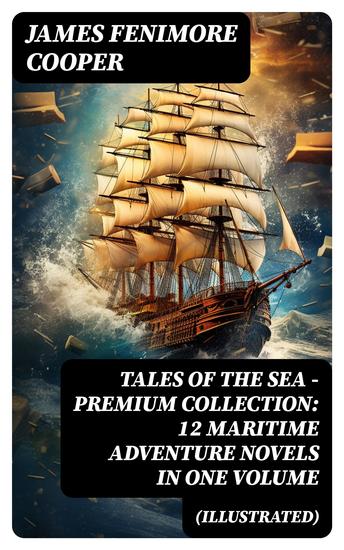
TALES OF THE SEA – Premium Collection: 12 Maritime Adventure Novels in One Volume (Illustrated) - Including the Biography of the Author and His Personal Experiences as a Seaman - cover

TALES OF THE SEA – Premium Collection: 12 Maritime Adventure Novels in One Volume (Illustrated) - Including the Biography of the Author and His Personal Experiences as a Seaman

James Fenimore Cooper

Verlag: DigiCat

  • 0
  • 0
  • 0

Beschreibung

In "TALES OF THE SEA: Premium Collection," James Fenimore Cooper presents a rich tapestry of maritime adventures that explore the early American experience on the high seas. Comprising twelve novels, this illustrated volume showcases Cooper's hallmark literary style—an amalgamation of vivid descriptive prose and meticulous attention to historical detail. The narratives delve into themes of bravery, exploration, and the innate struggle between man and nature, set against the backdrop of a burgeoning nation. These tales reflect the zeitgeist of 19th-century America, capturing both the romanticism and the dangers of seafaring life. James Fenimore Cooper (1789-1851) is celebrated as one of America's first significant novelists and is often regarded as the pioneer of the maritime novel. His extensive maritime experiences, having spent time on ships during his youth, significantly informed his storytelling. This collection serves as both a reflection of Cooper's love for the sea and a commentary on the human condition, as he adeptly intertwines action with philosophical musings about freedom and destiny. For readers drawn to adventure, history, and the complexities of human experience, "TALES OF THE SEA" is an indispensable addition to any literary collection. This beautifully illustrated volume not only captivates with thrilling tales but also offers a profound insight into early American maritime culture, making it a must-read for both enthusiasts of the genre and scholars alike.
Verfügbar seit: 10.12.2023.
Drucklänge: 5079 Seiten.

Weitere Bücher, die Sie mögen werden

  • The Ripening Rubies - cover

    The Ripening Rubies

    Max Pemberton

    • 0
    • 0
    • 0
    In "The Ripening Rubies," an ex-convict makes a rookie mistake--trying to sell a stolen ruby necklace back to the craftsman who made it. The jeweler, Bernard Sutton, soon discovers that a string of high-society women are losing their expensive adornments. Shunning the heavy-handed approach of the police, he sets his own trap to catch the thief.
    Zum Buch
  • Stories To Make You Cry - Sometimes you need a good cry - cover

    Stories To Make You Cry -...

    Anton Chekhov, Stephen Crane,...

    • 0
    • 0
    • 0
    When we read or listen, words can have a transforming effect.  Our mood can alter in the space of a few sentences from joy to sadness.  And not just our mood.  These words can affect us physically, they can engage our emotions and even in their sadness bring a lump to our throat and tears to our eyes.  Sometimes the relief can be palpable. 
     
    Our authors, from Anton Chekhov, Stephen Crane, Willa Cather, Katherine Mansfield and a wealth of others are well aware of what their talents will evoke.   Genius has many names.   
     
    1 - Short Stories To Make You Cry  - An Introduction 
    2 - Vanka by Anton Chekhov 
    3 - A Dark Brown Dog by Stephen Crane 
    4 - Suicides by Guy de Maupassant 
    5 - The Life of Ma Parker by Katherine Mansfield 
    6 - The District Doctor by Ivan Turgenev 
    7 - Paul's Case by Willa Cather 
    8 - Hands by Sherwood Anderson 
    9 - Silence by Leonid Andreyev 
    10 - The Stones of the Village by Alice Dunbar Nelson 
    11 - Hide And Seek or Pliatki by Fyodor Sologub
    Zum Buch
  • Better Dead - From their pens to your ears genius in every story - cover

    Better Dead - From their pens to...

    J M Barrie

    • 0
    • 0
    • 0
    Sir James Matthew Barrie, 1st Baronet, OM, was born in Kirriemuir, Angus on 9th May, 1860.  
    Barrie knew from an early age that he wished to be an author. His family wished otherwise. The compromise was that he would attend university to study literature at the University of Edinburgh. He graduated with an M.A. in April, 1882. 
    His first job was as a staff journalist for the Nottingham Journal. The London editor of the St. James's Gazette "liked that Scotch thing" in Barrie’s work and he wrote several stories for them and later several novels based on his mother’s early life.  
    Barrie though was increasingly drawn to working in the theatre.  His first plays achieved little attention but in 1901 and 1902, Barrie had back-to-back theatre successes with Quality Street and The Admirable Crichton. 
    The character of ‘Peter Pan’ first appeared in The Little White Bird in 1902. This most famous and enduring of his works; Peter Pan, or The Boy Who Wouldn't Grow Up had its first stage performance on December 27th, 1904.  
    Peter Pan would overshadow all his other works.  But his short stories cannot be overlooked.  Indeed, from today’s vantage point they are excellent gems of social manners, of class and the way characters, sometimes in the most mundane of circumstances, react in the most surprising of ways.
    Zum Buch
  • The Short Stories of Arthur Conan Doyle - Creator of Sherlock Holmes who wrote many other equally impressive stories - cover

    The Short Stories of Arthur...

    Arthur Conan Doyle

    • 0
    • 0
    • 0
    Arthur Conan Doyle was born in Edinburgh, Scotland on 22nd May 1859.  His childhood was blighted by his father’s heavy drinking which for some years broke up the family. Fortunately, wealthy uncles were willing to support them by paying for education and clothing.  
     
    He was accepted at the University of Edinburgh to study medicine and also began to write short stories the first, ‘The Haunted Grange of Goresthorpe’, was published in Blackwood’s Magazine.  Despite several other stories and some articles in the British Medical Journal his medical studies took priority. 
     
    When these finished he was appointed as Doctor on the Greenland whaler ‘Hope of Peterhead’ in 1880 and then, after graduation, as ship’s surgeon on the SS Mayumba on its voyage to West Africa. 
     
    1882 saw a move to Plymouth and his own independent practice. With few patients he resumed writing and completed his first novel, ‘The Mystery of Cloomber’, although most of his output was short stories based on his experiences at sea.  
     
    He married Louisa Hawkins in 1885. However, two years later he met and fell in love with Jean Elizabeth Leckie, though they remained platonic out of respect for, and loyalty to, his wife. 
     
    His literary career suddenly burst into life in November 1886 with ‘A Study In Scarlet’, the first of the fabulously successful Sherlock Holmes stories.  
     
    With two children to support he now revisited his haphazard commercial arrangements and curtailed everything save for commissions from the Strand Magazine.  
     
    As a sportsman he was remarkably proficient. He was goalkeeper for Portsmouth Association Football Club and played ten first-class cricket matches for the Marylebone Cricket Club as well as captain of the Crowborough Beacon Golf Club in East Sussex.  
     
    In 1891 tired of writing Holmes stories, he began a series of historical novels and even went so far as to apparently kill off Holmes in a lethal brawl with his arch-nemesis Moriarty. 
     
    Despite heavy and sustained criticism he continued to write in support of the Boer War, a fact he thought contributed to his knighthood in 1902.  The following year to great relief and acclaim he brought Sherlock Holmes back from the dead in his first outing for a decade. 
     
    Sadly, his wife Louisa died from TB in 1906 and, a year later, he at last married Jean.  
     
    During the War and for several years after family deaths had left him depressed. In a search for solace and answers he alighted upon spiritualism and, such was his interest, that he wrote several books on the subject. 
     
    On 7th July 1930 Conan Doyle was discovered in the hall of Windlesham Manor, his house in East Sussex, clutching his chest dying of a heart attack.  He was 71. 
    01 - Arthur Conan Doyle - A Short Story Collection - An Introduction 
    02 - The Striped Chest by Arthur Conan Doyle 
    03 - How It Happened by Arthur Conan Doyle 
    04 - B24 by Arthur Conan Doyle 
    05 - The Cabman's Story. The Mystery of a London Growler by Arthur Conan Doyle 
    06 - The Final Problem by Arthur Conan Doyle
    Zum Buch
  • A Cullenden of Virginia - From their pens to your ears genius in every story - cover

    A Cullenden of Virginia - From...

    Thomas Wolf

    • 0
    • 0
    • 0
    Thomas Clayton Wolfe was born at the family home, 92 Woodfin Street, in Asheville, North Carolina on October 3rd, 1900.  
    Aged 15, Wolfe began his studies at the University of North Carolina at Chapel Hill (UNC) where he enrolled in a playwriting course. Wolfe graduated in 1920 and enrolled at the Graduate School for Arts and Sciences at Harvard. Here he studied playwriting under the tutelage of George Pierce Baker. In 1922 he received his master's degree from Harvard.  
    Wolfe now began the transition from studying to commercial playwright. He went to New York in November, 1923 trying to sell his plays to Broadway.  The Theatre Guild came close to producing Welcome to Our City but in the end declined.  Wolfe now believed his style of writing was more suited to fiction.  Grasping the opportunity this afforded him he sailed to England in October 1924 to write and from there on to France, Italy and Switzerland. 
    In 1926 Wolfe began writing a novel, O Lost. This would eventually become Look Homeward, Angel. It was based on his years in Asheville. The original manuscript of O Lost was over 1100 pages. Maxwell Perkins, one of the great book editors of the age, worked at his publishers, Scribner’s and he began to focus the book, cutting and re-shaping it to center it on the character of Eugene.   
    The novel was published in 1929. It was a success.   
    Wolfe now committed the next 4 years to writing a multi-volume epic entitled The October Fair.  At Scribner’s Perkins once more decided to edit it down to a single volume; Of Time and the River.  It was even more successful than his first. It was hailed as the literary event of 1935 and cemented his reputation as one of America’s foremost novelists.  
    In 1938, after submitting his new opus, which ran to an incredible one million words, to his new editor, Edward Aswell, Wolfe left to tour the West, a part of the country he had never before visited. Whilst travelling Wolfe became ill with pneumonia and spent three weeks in a Seattle hospital. Complications arose. The prognosis was serious.  He was diagnosed with miliary tuberculosis of the brain. 
    On September 6th, he was sent to Baltimore's Johns Hopkins Hospital for treatment. The ensuing operation revealed that the disease had overrun the entire right side of his brain.  
    Thomas Clayton Wolfe never regained consciousness and died shortly before his 38th birthday on September 15th, 1938.
    Zum Buch
  • The Unreliable Nature Writer - cover

    The Unreliable Nature Writer

    Claire Carroll

    • 0
    • 0
    • 0
    The Unreliable Nature Writer is the eagerly-awaited debut collection of exhilarating, macabre and dreamy short stories from Claire Carroll. Shortlisted for The White Review Prize and winner of the Short Fiction Wild Writing Prize, Carroll portrays an unsettlingly hot, vaguely familiar world of humans facing the strain of intimate and global anxieties – trying to live alongside new technologies, failing environments and unknowable natural crises. Delightful to read and unsettling to imagine, these are haunting stories about love, loss, strangely-exposing housing applications and cows.
    Zum Buch