Join us on a literary world trip!
Add this book to bookshelf
Grey
Write a new comment Default profile 50px
Grey
Subscribe to read the full book or read the first pages for free!
All characters reduced
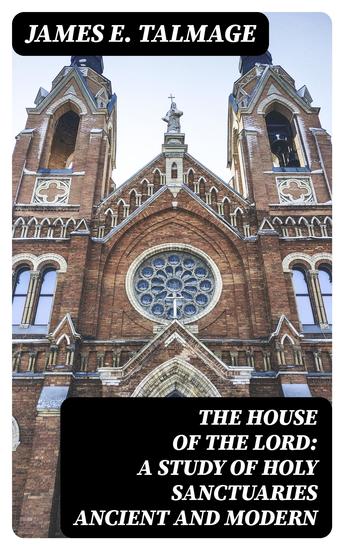
The House of the Lord: A Study of Holy Sanctuaries Ancient and Modern - cover

The House of the Lord: A Study of Holy Sanctuaries Ancient and Modern

James E. Talmage

Publisher: DigiCat

  • 0
  • 0
  • 0

Summary

In 'The House of the Lord: A Study of Holy Sanctuaries Ancient and Modern,' James E. Talmage presents an incisive exploration of the significance of sacred temples throughout history, employing a scholarly approach that synthesizes theological insights with archaeological evidence. Talmage's literary style is characterized by clarity and erudition, deftly intertwining scriptural analysis with architectural descriptions to illuminate the multifaceted relationships between divinity, worship, and physical space. This work situates itself within the broader context of early 20th-century religious scholarship, responding to an era increasingly focused on the intersections of faith and cultural heritage. James E. Talmage, an influential figure in Mormon theology and a member of the Quorum of the Twelve Apostles, draws on his extensive background in geology and philosophy to inform his theological inquiry. His dual expertise as both a scholar and a leader within the Latter-day Saint community provides a unique lens through which he examines how ancient practices inform modern worship, seeking to bridge the past and present in the ongoing dialogue about sacred spaces. This book is highly recommended for scholars of religious studies, architects of sacred spaces, and anyone interested in the interplay between faith and architecture. Talmage's meticulous research and profound insights render this volume an essential resource for understanding the enduring nature of holy sanctuaries across cultures and time periods.
Available since: 07/20/2022.
Print length: 232 pages.
Other books that might interest you

  • Showa Era - Empire War and the Post-War Transformation of Japan - cover

    Showa Era - Empire War and the...

    Rolf Hedger

    • 0
    • 0
    • 0
    The Showa Era began on December 25, 1926, with the ascension of Emperor Hirohito following the death of his father, Emperor Taisho. This period marked a critical turning point in Japan’s history, as the nation transitioned from the political turbulence of the Taisho democracy to a time of increasing militarism and nationalist sentiment. Although the early years of the Showa Era were characterized by economic struggles and political instability, they also set the stage for Japan’s dramatic expansion and eventual involvement in global conflict. 
    Emperor Hirohito’s rise to the throne was met with both hope and uncertainty. Many saw him as a symbol of continuity and strength, while others were concerned about the growing influence of the military in governmental affairs. Unlike his father, whose reign was defined by a parliamentary democracy, Hirohito’s early years as emperor witnessed the gradual erosion of democratic institutions. The shift toward a more authoritarian government was driven by widespread dissatisfaction with the parliamentary system and the belief that Japan needed strong leadership to navigate domestic and international challenges. 
    One of the most pressing issues Japan faced at the beginning of the Showa Era was economic instability. The global economy had already begun to weaken, and in 1929, the Wall Street Crash sent shockwaves through Japan’s financial system. The economic downturn led to mass unemployment, factory closures, and widespread poverty, exacerbating social tensions. Farmers, who made up a significant portion of Japan’s population, suffered greatly as the price of rice plummeted, leading to rural hardships that fueled growing resentment toward the government. In response, nationalist and ultraconservative factions gained popularity, advocating for territorial expansion as a means to secure resources and economic stability.
    Show book
  • Delhi Sultanate - Muslim Dynasties That Shaped Medieval India - cover

    Delhi Sultanate - Muslim...

    Rolf Hedger

    • 0
    • 0
    • 0
    The Delhi Sultanate was a defining era in Indian history, marking the establishment of Muslim rule in northern India. Its rise was shaped by a series of invasions, strategic conquests, and the formation of a centralized administration. The foundation of the Sultanate can be traced back to the late 12th century when Muslim forces, primarily from Central Asia, began making inroads into the Indian subcontinent. These incursions set the stage for a new political order that would influence the region for centuries. 
    One of the earliest significant Muslim invasions was led by Mahmud of Ghazni in the 11th century. Although he did not establish permanent rule, his raids weakened Indian kingdoms and demonstrated the vulnerability of the region. However, it was Muhammad Ghori in the late 12th century who laid the groundwork for the Delhi Sultanate. Unlike Mahmud, Ghori aimed for long-term control rather than mere plundering. His victory over Prithviraj Chauhan at the Second Battle of Tarain in 1192 was a turning point, allowing Muslim forces to establish a foothold in northern India. 
    Following Ghori’s assassination in 1206, his general, Qutb al-Din Aibak, took control of his Indian territories and proclaimed himself the first Sultan of Delhi. Aibak, originally a slave who rose through the ranks, became the founder of the Mamluk or Slave Dynasty. He consolidated his rule by strengthening administrative structures and commissioning architectural marvels like the Qutb Minar, which symbolized the establishment of Muslim rule. However, his reign was short-lived, and his successor, Iltutmish, played a more crucial role in shaping the Delhi Sultanate into a powerful and stable empire.
    Show book
  • The Word of Dog - What Our Canine Companions Can Teach Us About Living a Good Life - cover

    The Word of Dog - What Our...

    Mark Rowlands

    • 0
    • 0
    • 0
    A heartwarming philosophical meditation on how to live a fulfilling life—inspired by the inherent happiness of dogs. 


    If you have spent any part of your life with a dog, you may have found certain questions popping, unbidden, into your mind: Is my dog living a fulfilled life? Is my dog a good dog? Does my dog love me? Addressing these questions compels you to confront not just your dog's life but yours as well—to think about what fulfillment, and meaning, in life really is. 


    In The Word of Dog, philosopher Mark Rowlands explores these questions and suggests that in dogs we can see hints—faint, shrouded, but discernible—of what a better way of living might look like. Perhaps none of us can be happy in the way a dog can, but The Word of Dog shows us we could do a lot better than we're doing simply by listening to the unspoken wisdom our dogs reveal to us every day of their happy, uncomplicated lives.
    Show book
  • American Cookery - cover

    American Cookery

    Amelia Simmons

    • 0
    • 0
    • 0
    American Cookery, by Amelia Simmons, was the first known cookbook written by an American, published in 1796. Until this time, the cookbooks printed and used in what became the United States were British cookbooks, so the importance of this book is obvious to American culinary history, and more generally, to the history of America.
    Show book
  • The Art of Wondering and Wanderlust and Wonder 2-in-1 Bundle - Uncovering Deeper Wisdom in an Anxious World Boldly Charting Your Own Path - cover

    The Art of Wondering and...

    KNOX YANCEY, PHILIP MCCOY, CAM...

    • 0
    • 0
    • 0
    Embark on a captivating journey of self-discovery and exploration. This transformative guide offers a unique blend of introspection and adventure, providing essential tools for unlocking deeper wisdom and boldly charting your own path in an anxious world.What to Expect:The Art of Wondering: Delve into the depths of your own mind and uncover the hidden treasures of wisdom and insight that lie within. Explore the power of curiosity, mindfulness, and contemplation as tools for navigating life's uncertainties and embracing the mysteries of existence.Wanderlust & Wonder: Embark on an exhilarating journey of exploration and adventure as you venture beyond the confines of your comfort zone. From remote landscapes to bustling city streets, learn to embrace the unknown with open arms and a curious heartConnection and Discovery: Cultivate meaningful connections with yourself, others, and the world at large as you journey through life with a sense of wonder and awe.Adaptation and Resilience: Embrace change and uncertainty with resilience and courage as you navigate life's twists and turns. Learn to embrace the unknown as an opportunity for growth and transformation, and develop the resilience needed to overcome challenges and setbacks along the way.Personal Growth and Fulfillment: Harness the power of self-discovery and self-expression to unlock your full potential and lead a life of purpose and fulfillment. 
    Embark on a journey of wonder, wanderlust, and self-discovery . Whether you're seeking deeper wisdom, embracing new adventures, or charting your own path in an anxious world, this comprehensive guide is your roadmap to a life of curiosity, connection, and fulfillment.
    Show book
  • Drawing the Line - What to Do with the Work of Immoral Artists from Museums to the Movies - cover

    Drawing the Line - What to Do...

    Erich Hatala Matthes

    • 0
    • 0
    • 0
    Recent years have proven rife with revelations about the misdeeds, objectional views, and, in some instances, crimes of popular artists. Given more access than ever thanks to social media and the internet in general, the public has turned an alert and critical eye upon the once-hidden lives of previously cherished entertainers. But what should we members of the public do, think, and feel in response to these artists' actions or statements? It's a predicament that many of us face: whether it's possible to disentangle the deeply unsettled feelings we have toward an artist from how we respond to the art they produced. As consumers of art, and especially as fans, we have a host of tricky moral question to navigate: do the moral lives of artists affect the aesthetic quality of their work? Is it morally permissible for us to engage with or enjoy that work? Can we separate an artist from their art? 


    In Drawing the Line, Erich Hatala Matthes offers insight and clarity to the ethical questions that dog us. He argues that it doesn't matter whether we can separate the art from the artist, because we shouldn't. Matthes argues both that the lives of artists can play an important role in shaping our moral and aesthetic relationship to the artworks that we love and that these same artworks offer us powerful resources for grappling with the immorality of their creators.
    Show book