Join us on a literary world trip!
Add this book to bookshelf
Grey
Write a new comment Default profile 50px
Grey
Subscribe to read the full book or read the first pages for free!
All characters reduced
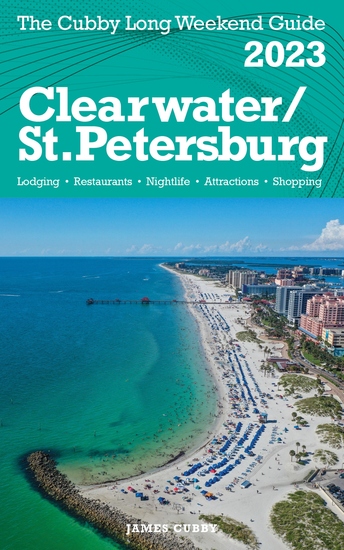
Clearwater StPetersburg - The Cubby 2023 Long Weekend Guide - cover

Clearwater StPetersburg - The Cubby 2023 Long Weekend Guide

James Cubby

Publisher: Gramercy Park Press

  • 0
  • 0
  • 0

Summary

A complete guide for everything you need to experience a great Long Weekend in Clearwater - St. Petersburg area. Updated throughout the year, you'll save a lot of time using this concise guide.
 
“Even though the area is easy to get around, on our second trip we brought this book and found things we hadn’t known about previously.” –Horace G., Wichita


“The Cubby guide books ‘cut to the chase.’ You get what you need and don’t get what you don’t.” –Wilma K., Seattle=LODGINGS, from budget to deluxe= RESTAURANTS, from the finest the area has to offer ranging down to the cheapest (with the highest quality). More than sufficient listings to make your Long Weekend memorable.


= SHOPPING – a few shops you will find interesting
 
=PRINCIPAL ATTRACTIONS -- don't waste your precious time on the lesser ones. We've done all the work for you.
 
 
Available since: 12/10/2022.
Print length: 90 pages.
Other books that might interest you

  • 14 Days & 40 Years - The Little Trip & The Long Journey - cover

    14 Days & 40 Years - The Little...

    Natalie Anderson

    • 0
    • 0
    • 0
    Not all love is the same, which is one of the most peculiar truths in life. Your Love is as unique as the individual you feel it for. I think that’s one of the greatest paradoxes we will live through. It seems to me, there is little choice in how big it is, or how hard it hits. There’s no telling what it will do to you when you enter the arena, and that is why it can be a force we sometimes fight; because it has felt like a battle we’ve lost before. 
    Although it feels like you are powerless in Love, you aren’t powerless at the end of Love. You choose whether or not big Love crushes you, or if it shrinks for you to carry it in your pocket as a reminder of the greatness it once was. The desire to not be destroyed by Love is where I am. 
    This is a story of 14 days that coincided with my 40th birthday and a time I fell in Love. It was through a difficult turn of events that I got to step away from my uncomfortable life to experience turning 40 in Mexico; with someone I didn’t just love, but who I liked. So this is also a story about the importance of falling in Like. 
    For a long time I said if I ever shared this story, I’d have to call it fiction because it feels so personal. But eventually I realized it made more sense to just admit: it’s me. I’m the quiet naive girl in these pages who had barely begun to know herself and didn’t know how to communicate as well as she thought she did. I’m the one who was learning that Love can be complicated; while seeming simple to me. 
    One of the greatest lessons anyone learns, is knowing what it feels like to fall in love and experience connection. That was my greatest benefit; because I have been able to use that measure of connection ever since. One can break and fall apart in many ways, but it’s my opinion that until big love breaks you, a level of innocence remains. After that, you decide whether or not big love heals you. For me, it took this little trip of 14 days to finally benefit from the long journey of 40 years.
    Show book
  • The Cultural Revolution - A Decade of Upheaval - cover

    The Cultural Revolution - A...

    Jun Liu

    • 0
    • 0
    • 0
    The Cultural Revolution, which lasted from 1966 to 1976, was a decade of intense political and social upheaval in China. It was initiated by Mao Zedong, the Chairman of the Chinese Communist Party, as a means to reassert his ideological dominance and eliminate perceived threats within the party and society. The roots of the Cultural Revolution can be traced back to the aftermath of the Great Leap Forward, growing political divisions, and Mao’s desire to reshape China’s ideological landscape. 
    One of the key factors that led to the Cultural Revolution was Mao’s declining influence following the disastrous Great Leap Forward (1958–1962). This economic and social campaign, aimed at transforming China into a communist utopia through rapid industrialization and collectivization, resulted in widespread famine and the deaths of millions. The failures of the Great Leap Forward weakened Mao’s credibility, and he was forced to step back from day-to-day governance, allowing more pragmatic leaders such as Liu Shaoqi and Deng Xiaoping to implement economic reforms. These leaders promoted policies that prioritized economic stability over radical communist ideology, which Mao saw as a betrayal of the revolution’s goals. 
    In response to his diminished authority, Mao sought to reassert control by launching an ideological campaign against those he deemed “capitalist roaders” within the party. By the early 1960s, internal power struggles intensified as Mao and his radical supporters, including Lin Biao and Jiang Qing, clashed with moderate leaders advocating for a more pragmatic approach to governance. Mao viewed the growing influence of his rivals as a direct threat to his vision for China. To counter their policies, he began promoting the idea of a new revolutionary movement that would purify Chinese society and eliminate counterrevolutionary elements.
    Show book
  • Mughal Empire - The Early Modern Islamic Empire in South Asia - cover

    Mughal Empire - The Early Modern...

    Kelly Mass

    • 0
    • 0
    • 0
    The Mughal Empire, also referred to as the Mogul or Moghul Empire, was one of the most powerful and influential early modern Islamic empires in South Asia. Established in the 16th century, it controlled vast regions for over two centuries, encompassing territories from the peripheries of the Indus basin in the west, extending to northern Afghanistan, Kashmir in the north, present-day Bangladesh in the east, and stretching as far south as the Deccan Plateau's uplands.The origins of the Mughal Empire trace back to 1526 when Babur, a warrior chieftain from what is now Uzbekistan, founded the empire. Babur's military strategy combined traditional cavalry tactics with the latest artillery techniques, using matchlock guns and cast cannons acquired with Ottoman assistance. These advancements, alongside his strategic acumen, led him to a decisive victory against the Sultan of Delhi, Ibrahim Lodhi, at the First Battle of Panipat. This battle marked a turning point, allowing Babur to establish his dominance over northern India and subdue rival Rajput and Afghan forces.While Babur laid the foundation of the empire, the true structure of the Mughal state is often attributed to his grandson, Akbar the Great. By the late 16th century, under Akbar's rule, the empire expanded its reach and established a well-organized imperial administration that laid the groundwork for political stability, cultural integration, and economic prosperity. Akbar's reign is particularly noted for promoting a policy of religious tolerance, encouraging a synthesis of Hindu and Muslim cultures, and setting up an efficient centralized bureaucracy.
    Show book
  • Get Lost - Seven Principles for Trekking Life with Grace and Other Life Lessons from Kick-Ass Women's Adventure Travel - cover

    Get Lost - Seven Principles for...

    Erin Leider-Pariser

    • 0
    • 0
    • 0
    For nearly thirty years, Erin Leider-Pariser has designed women's adventure journeys that empower them to push their physical boundaries, bond through ancient rituals, and learn more about themselves than they ever imagined. Get Lost blends the wisdom and personal insights gleaned from these hiking, biking, and climbing trips through some of the world's most breathtaking landscapes with once-in-a-lifetime tales of dramas in the wild. For Leider-Pariser and her travelers, life is never the same after surviving a flash flood on a remote Columbian trail, getting lost in a Cambodian jungle, receiving shamanic healings in Ecuador, beholding the world from a Himalayan peak, and bonding with friends old and new through an ancient talking stick ceremony around the campfire. Through stories and anecdotes, the listener will witness how women's travel is soulful, flipped-out, hysterical fun—an absolute necessity for travel and everyday life. 


    This inspiring volume includes Leider-Pariser's Seven Principles for Trekking Life with Grace, a set of golden rules for navigating toward your best self. Complete with advice for forming your own group travel adventures on any budget, this energizing and at times hilarious book invites women to ignite their adventurous spirit, whether through travels near or far or taking bold new steps toward their dreams.
    Show book
  • Himalaya - Exploring the Roof of the World - cover

    Himalaya - Exploring the Roof of...

    John Keay

    • 0
    • 0
    • 0
    Himalaya is one of the world's most extraordinary geophysical, historical, environmental and social regions.  
     
    Historian John Keay introduces us to the myriad mysteries of this vast, confounding and utterly fascinating corner of the planet, and makes the case that it is one of our most essential – and endangered – wonders. 
     
    More rugged and elevated than any other zone on earth, it embraces all of Tibet, six of the world's eight major mountain ranges and nearly all its highest peaks. It contains around 50,000 glaciers and the most extensive permafrost outside the polar regions. Over an area nearly as big as Europe, the population is scattered, often nomadic and always sparse. Many languages are spoken, some are written and few are related. 
     
    Religious and political affiliations are equally diverse. Borders are disputed, while jealous neighbours shy away from a common strategy for protecting an environment in which desert meets rainforest and temperatures can fluctuate between 30 and -30°C in the course of a single day. 
     
    For centuries, Himalaya has captivated an illustrious succession of admirers, from explorers, surveyors and sportsmen, to botanists and zoologists, ethnologists and geologists, missionaries and mountaineers.
    Show book
  • Topophilia Effect The - How Places Affect Us (Unabridged) - cover

    Topophilia Effect The - How...

    Roberta Rio

    • 0
    • 0
    • 0
    What effect do the places where we live or work have on us? Historian Roberta Rio, who researches the history of buildings, apartments and properties for her clients, regularly comes across astonishing and recurrent patterns.
    
    In this book she reveals what the Etruscans, the Romans and Cathedral architects all knew about the effects of places, what we ourselves should know and how we can find it out.
    
    Rio offers us a refreshingly down-to-earth summary of the findings of her research, and makes it practicable for our own personal use.
    
    How do we know if a place is good or bad for us? Which place is good to rest and which to work in? Why are there places where relationships flourish and others where they are more likely to break up?
    Show book