Join us on a literary world trip!
Add this book to bookshelf
Grey
Write a new comment Default profile 50px
Grey
Subscribe to read the full book or read the first pages for free!
All characters reduced
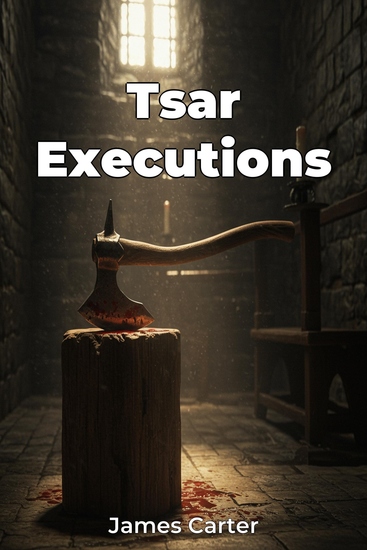
Tsar Executions - cover

Tsar Executions

James Carter

Translator A AI

Publisher: Publifye

  • 0
  • 0
  • 0

Summary

Tsar Executions explores the history of regicide in Russia, from Ivan the Terrible's purges to the Romanov dynasty's tragic end, illuminating the political upheavals that followed. It examines how autocratic power and revolutionary fervor intertwined to define Russia's past. The book highlights that executions of Russian rulers weren't isolated events but symptoms of systemic failures and a volatile relationship between the Tsar and the people. For example, the assassination of Alexander II, driven by revolutionary movements, significantly altered Russia's trajectory.

 
The book progresses chronologically and thematically, starting with the evolution of Russian autocracy and delving into key periods like the Time of Troubles and Peter the Great's reforms. It investigates the circumstances, motivations, and consequences of each execution. This book is unique in its psychological exploration of both rulers who ordered executions and those who carried them out, providing a nuanced understanding of power, fear, and violence.

 
By understanding these historical executions, readers can gain insights into the fragility of power and the consequences of unchecked authority.
Available since: 03/21/2025.
Print length: 59 pages.


Other books that might interest you

  • Tyrone Power: The Life and Legacy of One of Hollywood’s Most Famous Swashbucklers - cover

    Tyrone Power: The Life and...

    Editors Charles River

    • 0
    • 0
    • 0
    Hollywood has never lacked leading men who could captivate viewers with dramatic performances that depict them as suave romantics or dashing heroes, especially during the Golden Age of Hollywood, when stars like Humphrey Bogart, Clark Gable, and Cary Grant graced screens. But in the mid-20th century, one of the most popular stars was a man who’s been frequently overlooked.   
    Some actors were recruited based on their appearance alone, signing contracts before taking screen tests or ever having been on a stage or set. Others became overnight sensations, darlings of the public for decades. Only a few of these turned out to be excellent actors, but one of them was certainly Tyrone Power, one of Hollywood’s leading men from the 1930s into the 1950s. With a career spanning over 50 films, Power did not have to work through the system, rising to the top almost immediately at the age of 22.  
    Power was named “King of the Movies” for three straight years (1939 -1941) by fans, and while critics claimed that his success came from his good looks, today he is acknowledged as a good actor, among the most underestimated of this era. Power starred in a variety of film genres, and at least some contemporaries made note of his “remarkable acting range.” This included several musicals such as Alexander’s Ragtime Band, Second Fiddle, Rose of Washington Square, and The Eddy Duchin Story. He also made appearances in several dramas, including Johnny Apollo, Witness for the Prosecution, Crash Drive, and The Razor’s Edge. Power was even known for a good comedic sense in films like The Luck of the Irish, That Wonderful Urge, and Love is News.
    Show book
  • Ben Pitcher's Elly - Mann delves into the human psyche with great touch in this story of murder and parenting - cover

    Ben Pitcher's Elly - Mann delves...

    Mary E. Mann

    • 0
    • 0
    • 0
    Mary Rackham was born in Norwich on 14th August 1848 to a merchant family.  Little is known of her early life and her biography only re-appears in September 1871 with marriage to Fairman Joseph Mann, a farmer with 800 acres.   
     
    Mary moved to Shropham, Norfolk and became involved with the workhouse, visiting the sick and other unfortunates of the parish, her observations and experiences a valuable source for her later stories.  
     
    She took up writing, partly to offset the dreary village life of her surroundings, in the 1880s and published her first novel, ‘The Parish of Hilby’ (1883) at her own expense. It was well received by the critics.  
     
    Thus began a career that spanning three decades provided thirty-three novels, hundreds of short stories, and fourteen plays.  Her work was largely focused on rural life in Norfolk and centered on the fictional town of Dulditch, with grim but authentic accounts of poverty and deprivation.  
     
    Her marriage produced one boy and three girls. With her husband's death in 1913, she moved to Sheringham.  
     
    She is regarded as a major contributor to East Anglian literature with particular praise given to her short stories. 
     
    Mary E Mann died on 19th May 1929.  She was 80.  Her grave-marker is a carved open book with the epitaph ‘We bring our years to an end, as if it were a tale that is told’. 
     
    Life in ‘Ben Pitcher's Elly’ is degrading, awful and unvarnished.  The chances of this young girl having a happy life are remote but her story must be heard.
    Show book
  • Queer Saints - A Radical Guide to Magic Miracles and Modern Intercession - cover

    Queer Saints - A Radical Guide...

    Antonio Pagliarulo

    • 0
    • 0
    • 0
    Saints are the powerful, benevolent dead. They remain connected to the living to provide assistance, especially in times of need. Everyone has patron saints, even the marginalized who may feel abandoned and removed from these spiritual traditions. Queer Saints: A Radical Guide to Magic, Miracles, and Modern Intercession is a contemporary reimagining of an ancient spiritual practice—the intercessory power of saints. “Intercession” is typically defined as the action of intervening for another. Pagliarulo offers listeners a wide range of saints that includes the traditional, as well as re-envisioned saints specifically for a queer constituency. These include Saint David Bowie, Saint Freddie Mercury, Saint Alexander McQueen, Saint Moms Mabley, and Saint André Leon Talley. Pagliarulo explains why these are queer saints and offers practical information on how to venerate them—from building altars to making offerings. Queer Saints makes change and self-empowerment accessible to listeners of all faiths and belief systems by spotlighting the transformative impact queer saints have had on our world and their burgeoning influence on our spiritual future.
    Show book
  • Dr Heidigger's experiment - From their pens to your ears genius in every story - cover

    Dr Heidigger's experiment - From...

    Nathaniel Hawthorne

    • 0
    • 0
    • 0
    Nathaniel Hawthorne was born on 4th July 1804 in Salem, Massachusetts, a town synonymous with the earlier Salem Witch Trials. It was instrumental in Hawthorne’s later use of American Gothic and dark romanticism in his writing. 
    He was a mere four years old when his father died and his mother took him and his two sisters to live with her family and then on to their own home in Raymond, Maine. The young Hawthorne had a passion for fiction and poetry and voraciously read the works of Ann Radcliffe, Henry Fielding and Lord Byron.  
    He was sent to college at his maternal uncle’s insistence. During these years he met and befriended Henry Wadsworth Longfellow and future U S president Franklin Pierce. These friendships were lifelong and to have a crucial impact on his writings and career.  
    At college Hawthorne had made attempts at writing short stories and essays but without opportunities to publish. It was only in 1828 that he finally published his novel ‘Franshawe’ to little success and so he began work as editor for the American Magazine of Useful and Entertaining Knowledge.  
    Hawthorne’s short stories were first published in magazines but in 1837 were collected and published as ‘Twice-Told Tales’. A steady literary career still did not come his way and so he worked in a good position at Salem’s port and married the love of his life Sophia Peabody. They moved to live in ‘The Old Manse’ at Concord, Massachusetts.   
    Finally. in 1850 came spectacular literary and commercial success with ‘The Scarlet Letter’ followed by ‘The House of the Seven Gables’ the following year.  
    In 1852, Hawthorne published a biography of presidential candidate Franklin Pierce. After Pierce’s victory he was appointed consul in Liverpool, a position that offered prestige, money and fame. At the end of this appointment he returned several times to Europe before settling in Massachusetts and resuming writing and publication. 
    During the early 1860’s his health declined and on 19th May 1864 during a trip to Plymouth, New Hampshire. He was 59 and was buried in Sleepy Hollow Cemetery in Concord, Massachusetts.
    Show book
  • The Universe in Verse - 15 Portals to Wonder through Science & Poetry - cover

    The Universe in Verse - 15...

    Maria Popova

    • 0
    • 0
    • 0
    In this audiobook Maria Popova, creator of The Marginalian, presents a celebration of the human search for truth and beauty through the lenses of science and poetry. Poetry and science, as Popova writes in her introduction, "are instruments for knowing the world more intimately and loving it more deeply." In 15 short essays on subjects ranging from the mystery of dark matter and the infinity of pi to the resilience of trees and the intelligence of octopuses, Popova tells the stories of scientific searching and discovery. These stories are interwoven with details from the very real and human lives of scientists—many of them women, many underrecognized—and poets inspired by the same questions and the beauty they reveal. Each essay is paired with a poem reflecting its subject by poets ranging from Emily Dickinson, W. H. Auden, and Edna St. Vincent Millay to Maya Angelou, Diane Ackerman, and Tracy K. Smith. Together, they wake us to a "reality aglow with wonder."
    Show book
  • Everest - The West Ridge - cover

    Everest - The West Ridge

    Thomas Hornbein, Jon Krakauer

    • 0
    • 0
    • 0
    In 1963, Jim Whittaker became the first American to summit Everest via the South Col route. Roughly two weeks after Whittaker's achievement, Tom Hornbein and Willi Unsoeld, fellow American mountaineers on the same expedition, became the first climbers ever to summit the world's highest peak via the dangerous and forbidding West Ridge—a route on which only a handful of climbers have since succeeded. 


    This special fiftieth anniversary edition reintroduces the adventure in a larger format by members of the expedition, including leader Norman G. Dyhrenfurth and team doctor Jim Lester. In addition to a new foreword by Jon Krakauer, this volume also features a new preface by Hornbein along with a series of prefaces he wrote for earlier editions, including the original from 1965.
    Show book