¡Acompáñanos a viajar por el mundo de los libros!
Añadir este libro a la estantería
Grey
Escribe un nuevo comentario Default profile 50px
Grey
Suscríbete para leer el libro completo o lee las primeras páginas gratis.
All characters reduced
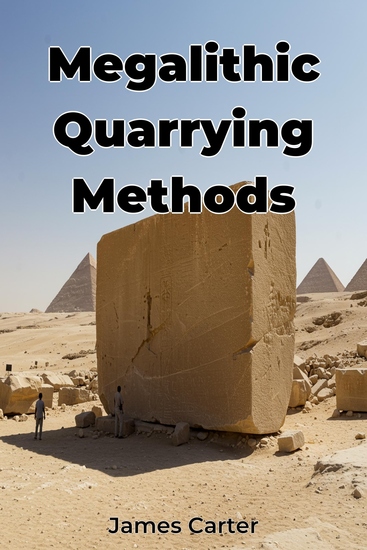
Megalithic Quarrying Methods - cover

Megalithic Quarrying Methods

James Carter

Traductor A AI

Editorial: Publifye

  • 0
  • 0
  • 0

Sinopsis

Megalithic Quarrying Methods explores how ancient civilizations, lacking modern technology, quarried, moved, and erected massive stone structures. It investigates the sophisticated techniques used to extract colossal blocks, often weighing tons, and transport them across vast distances. The book reveals that successful megalithic construction depended on understanding material properties, innovative tool designs, and organized labor, challenging the perception of ancient builders as primitive.

 
The book examines quarrying methods across different regions and geological conditions, using archaeological excavations and geological surveys as evidence. It highlights experimental archaeology, where replicating ancient techniques provides insights into the practical challenges faced by builders. For example, researchers have recreated ancient methods to understand how Egyptians moved massive stones for the Pyramids.

 
The book progresses by first introducing stone types, then detailing quarrying methods, analyzing transportation techniques, and finally examining the societal impacts of megalithic construction. It bridges archaeology, engineering, and history, offering a comprehensive understanding of ancient technology and construction.
Disponible desde: 04/03/2025.
Longitud de impresión: 78 páginas.


Otros libros que te pueden interesar

  • Hacking Deficit Thinking - 8 Reframes That Will Change The Way You Think About Strength-Based Practices and Equity in Schools - cover

    Hacking Deficit Thinking - 8...

    Kelsie Reed, Byron McClure

    • 0
    • 0
    • 0
    Are you focused on what's wrong with your students? Now you can transform learning by reframing your view from what's wrong to what's strong. 


    "At risk." "Low." "Title I kids." If you've worked with students, you've probably heard or said these coded labels that reflect deficit thinking. This focus on weakness is a pervasive, powerful judgment that continues to harm students long after they leave school. It's time for educators to hack deficit thinking, think about SEL and about strength-based teaching, and reframe teaching and learning. 


    Nationally certified school psychologists McClure and Reed show teachers, administrators, and support staff how to unlearn student blame and reframe thinking to focus on students' strengths. When we acknowledge the impact of teaching practices and the broader structural inequities, we can help everyone reach their highest potential. 


    In Hacking Deficit Thinking, you'll learn how to: build on student strengths; think about student empathy; humanize your data; recognize the value of differences; think about teacher empathy; talk about equity in schools; tap into school-wide strengths; flourish as an educator.
    Ver libro
  • Making of Modern India The: The History of India from the Middle Ages to Independence from Britain - cover

    Making of Modern India The: The...

    Editors Charles River

    • 0
    • 0
    • 0
    India has been the location of many different empires throughout its long history. The Indus Valley Civilization was home to one of the world’s first civilizations more than 5,000 years ago, which was followed by the Aryan-Vedic culture and then a host of other kingdoms that flourished across the Sub-Continent. India has also been the birthplace of many religions. The Vedic religion of the Aryans evolved into the Hindu religion, and Buddhism and Jainism were also born in India. By the Middle Ages, India was home to many different religions and ethnic groups, with dozens of languages being spoken, making India less of a single, unified country and more of a land of many countries. Despite India’s tradition of cultural and political pluralism, several rulers attempted to place the entire Sub-Continent under the rule of one dynasty or government with a dominant religion. Most of these would-be rulers were far from successful, although a few came close, setting the template for later conquerors. 
    The Delhi Sultanate was comprised of five dynasties that expanded their borders, and Islam, at sword point, but also through diplomacy and trade. The Delhi Sultanate became known as a state that welcomed the expertise of foreigners, no matter their religion, and promoted the welfare of its citizens through a host of social programs. Eventually, the Delhi Sultanate grafted ideas and inspiration from India’s pre-Islamic past with those of Islam to create a state that was quite unique and powerful. The Delhi sultans were themselves descended from Turks and brought with them ideas from Persia. Furthermore, as their empire grew, they invited scholars from throughout the Islamic world to their country, and as Muslim scholars, scientists, and administrators from the Near East made their way into India, the Delhi sultans also incorporated some of the cultural ideas of the native Hindu Indians to create a state that was as unique as any the world had ever seen.
    Ver libro
  • Subliminal Psychology - Dark Unethical Techniques for Penetrating Someone's Mind to Influence their Behaviour and Actions - cover

    Subliminal Psychology - Dark...

    Christopher Kingler

    • 0
    • 0
    • 0
    Have you ever wished you could penetrate someone's mind? Are you one of those people who are drawn to exploring the depths of the human psyche?Are you tired of being prey to emotional predators and manipulators and want to learn the art of subliminal psychology to fully protect yourself? 
    The relationship between the conscious and the subconscious is like the iceberg floating in the ocean. Consciousness is just the tip of the iceberg we see. The subconscious, however, is where the triggers occur and where the subliminal messages reach us. This is where the outside influence settles. 
    Here is a brief taste of what you will learn: 
    ◆ The truth about subliminal psychology and false myths. 
    ◆ The subliminal messages under X-rays to recognise them immediately and never fall into the trap again. 
    ◆ Deep analysis of the drives and the most hidden desires of human beings to decode their intentions. 
    ◆ Simple and advanced subliminal manipulation techniques to penetrate someone's mind. 
    ◆ Short and long-term effects of subliminal manipulation on decision making. 
    ◆ How to defend yourself from the powerful attacks of subliminal predators. 
    ◆ Subliminal reprogramming for mental health, removing mental blocks that prevent your happiness. 
    ◆ Unlock infinite potential with subliminal learning to acquire whatever knowledge you want.Let me ask you a question.Do you want to influence or be influenced?If you understand, unfortunately you have no choice.If you are tired of constantly being the object of manipulative tactics, this dark art historically reserved for secret societies and big brands is now within everyone's reach, and is about to be in your hands.
    Ver libro
  • The Fallacies of Racism - Understanding How Common Perceptions Uphold White Supremacy 1st Edition - cover

    The Fallacies of Racism -...

    Jennifer Patrice Sims

    • 0
    • 0
    • 0
    Everyone has an opinion on racism. The vast majority of people would vehemently deny that they or those close to them are "racist," yet many of the most common understandings of racism are highly problematic. "If you mean no harm, then it can't be racist." Yes, it can. "There are anti-discrimination laws now, so racism no longer occurs." Incorrect. "Some of my best friends are Black, so I can't be racist." Not true. 


    In this sharp, open-minded, and witty book, sociologist Jennifer Patrice Sims succinctly addresses these problematic perceptions of racism as fallacies. Building on existing academic theories and drawing on her own cross-national research, two decades of teaching, and analyses of contemporary issues, she delves into the most common and insidious fallacies about racism. In revealing them to be rooted in what scholars call an "epistemology of ignorance," she shows how these perceptions justify and uphold white supremacy (inadvertently or otherwise). 


    Accessibly written and full of concrete examples, this book will be of great value to anyone who wants to understand the common misunderstandings about racism that frustrate contemporary politics, classrooms, workplaces, and dinner tables.
    Ver libro
  • Ron DeSantis in Office: An Unauthorized Account of the Florida Republican's Efforts to Uphold the Constitution as a Congressman and Governor - cover

    Ron DeSantis in Office: An...

    Cason Longhurst

    • 0
    • 0
    • 0
    During the COVID-19 pandemic, Governor Ron DeSantis made Florida the freest state in the country. While other politicians advocated lockdowns and masking policies, DeSantis did everything he could to keep businesses open and protect civil liberties. 
    DeSantis began fighting for civil liberties years earlier, though. He launched his political career in the U.S. Congress in 2012. Drawing on his Harvard law school education and military experience, he argued for Constitutional principles. Then, with the endorsement of President Donald Trump, he successfully ran for Governor of Florida. 
    Cason Longhurst recounts Ron DeSantis's political career to date, revealing the principles that guide this conservative rising star.
    Ver libro
  • Summary of Mark Dice’s The True Story of Fake News - cover

    Summary of Mark Dice’s The True...

    Falcon Press

    • 0
    • 0
    • 0
    Buy now to get the main key ideas from Mark Dice’s The True Story of Fake News 
      
    The “age of information” is a paradox that has drowned most people in misinformation, which has become so prevalent that some believe the world is currently going through a “post-truth” era. 
    In The True Story of Fake News (2017), conservative pundit Mark Dice immerses readers in the twisted world of mainstream media. By analyzing the influence of major companies - Facebook, Twitter, Instagram, YouTube, and Google - he aims to expose media manipulation and censorship, and show the real faces of CNN, NBC News, CBS News, and other news networks. The True Story of Fake News is a wake-up call for Americans: Dice warns that we must learn to see past both nonsense and propaganda, stay aware, and make our own educated decisions.
    Ver libro