Unisciti a noi in un viaggio nel mondo dei libri!
Aggiungi questo libro allo scaffale
Grey
Scrivi un nuovo commento Default profile 50px
Grey
Iscriviti per leggere l'intero libro o leggi le prime pagine gratuitamente!
All characters reduced
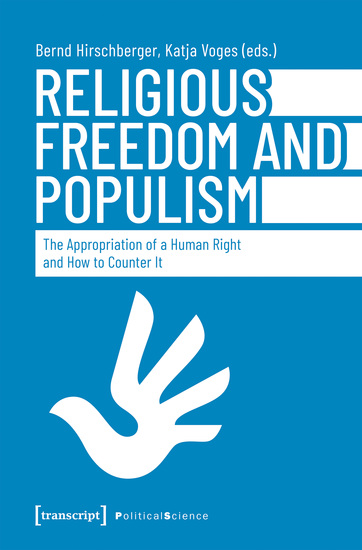
Religious Freedom and Populism - The Appropriation of a Human Right and How to Counter It - cover

Religious Freedom and Populism - The Appropriation of a Human Right and How to Counter It

Bernd Hirschberger, Katja Voges

Casa editrice: transcript Verlag

  • 0
  • 0
  • 0

Sinossi

Populism is a growing threat to human rights. They are appropriated, distorted, turned into empty words or even their opposite. The contributors to this volume examine these practices using the example of freedom of religion or belief, a human right that has become a particular target of right-wing populists and extremists worldwide. The contributions not only show the rhetorical patterns of appropriation and distortion, but also demonstrate for various countries which social dynamics favor the appropriation in each case and propose how to strengthen human rights and the culture of debate in democratic societies.
Disponibile da: 31/03/2024.
Lunghezza di stampa: 371 pagine.

Altri libri che potrebbero interessarti

  • How to Find Happiness - An Ancient Guide to the Good Life - cover

    How to Find Happiness - An...

    Marcus Tullius Cicero, Katharina...

    • 0
    • 0
    • 0
    Does happiness come from the pursuit of pleasure or moral virtue? A vivid new translation of Cicero’s exploration of a timeless question“Of course, we all want to be happy.” So wrote the Roman statesman, orator, and philosopher Marcus Tullius Cicero. He and his fellow Greek and Roman philosophers agreed that the secret to happiness—or what they called the “good life”—is pursuing the “greatest good.” The only problem is that they couldn’t agree on what the greatest good is. Cicero addressed this dilemma by composing a set of dialogues, On the Greatest Good and Evil (De finibus bonorum et malorum), in which he pitted advocates of different philosophical approaches to happiness against one another. Notably, these include the Epicureans (who believe that the greatest good is pleasure) and the Stoics (according to whom it is moral virtue). Rather than choosing sides, Cicero considers the pros and cons of the different philosophies, ultimately leaving it to his readers to make up their own minds. In How to Find Happiness, Katharina Volk offers a vivid new translation of selections from Cicero’s work, complete with an introduction and the original Latin text on facing pages. The result is a lively and engaging debate that invites each of us to discover our own path to happiness.
    Mostra libro
  • Speaking Up without Freaking Out 3rd ed - 50 Techniques for Confident and Compelling Presenting - cover

    Speaking Up without Freaking Out...

    Matt Abrahams

    • 0
    • 0
    • 0
    The Speaking Up without Freaking Out audio book by Matt Abrahams (host of the award-winning Think Fast Talk Smart podcast) contains over 50 anxiety management techniques that are based on scientifically supported theory and evidence that will help you become a more confident and compelling communicator regardless of where you present -- on stage, in a meeting, or virtually. 
    Confident and compelling presenting involves a complicated mix of physiological and psychological factors. In the 3rd edition, this audio book provides specific guidance and opportunities to practice developing the skills you will need to feel more comfortable speaking in front of others in an engaging way. 
    This book is divided into seven chapters: 
    Chapter 1 describes speaking anxiety, how it shows itself, its negative effects, and how you can appear less nervous. 
    Chapter 2 describes the main theories about why people feel anxious when speaking and, importantly, offers you several specific techniques to reduce speaking anxiety and bolster your confidence. 
    Chapter 3 details how you can use your nonverbal presence and voice to not only appear more confident, but also feel more confident. 
    Chapter 4 how focusing on your audience’s needs and connecting your content to them can reduce your anxiety and make your presentations more compelling. 
    Chapter 5 provides techniques and guidance on how to structure your presentations to better help you and your audience remember what you present. 
    Chapter 6 teaches how to resist and stop some self-defeating beliefs and behaviors that perpetuate and exacerbate anxiety. 
    Chapter 7 addresses how to put all this information to work for you by creating your own Anxiety-Management Plan.
    Mostra libro
  • Aristotle on Life Aging and Mortality - On Youth and Old Age On Life and Death On Longevity and Shortness of Life & On Breathing - cover

    Aristotle on Life Aging and...

    Aristotle, Tim Zengerink

    • 0
    • 0
    • 0
    What if you could gain profound insights into every stage of life, from youth to old age, and uncover the keys to a long, fulfilling existence? 
    This illuminating collection brings together Aristotle’s most essential treatises on life and its transitions, adapted for the contemporary reader. With clarity and depth, he examines the nature of growth, vitality, aging, and mortality—offering guidance for those who seek a purpose-driven and enduring life in today’s fast-paced world. 
    What You’ll Discover in This Modern Anthology: 
    - Strategies for embracing the joys and challenges of youth and old age 
    - The science and philosophy behind longevity and vitality 
    - Reflections on the significance of breath as a life-sustaining force 
    - Practical wisdom to enrich every phase of your personal journey 
    Imagine being equipped with the timeless principles of well-being, enabling you to nurture a resilient spirit and savor life’s unfolding chapters. Aristotle’s wisdom transcends centuries, illuminating a path toward a healthier, more meaningful life. 
    Begin the journey toward lifelong vitality. Get your copy now and explore Aristotle’s transformative insights on living well and aging gracefully.
    Mostra libro
  • Zen Buddhism And Its Relation To Art - cover

    Zen Buddhism And Its Relation To...

    Arthur Waley

    • 0
    • 0
    • 0
    A great primer on the history of Japanese art as it evolved under the Buddhist (and later Zen) movements embedding in Japan's culture. Written by the first great populariser of Chinese and Japanese cultural artefacts, including translating a great number of Chinese poems and literary works.
    Mostra libro
  • The Land Is Sung - Zulu Performances and the Politics of Place - cover

    The Land Is Sung - Zulu...

    Thomas M. Pooley

    • 0
    • 0
    • 0
    What does it mean to belong? In The Land is Sung, musicologist Thomas M. Pooley shows how performances of song, dance, and praise poetry connect Zulu communities to their ancestral homes and genealogies. For those without land tenure in the province of KwaZulu-Nata, performances articulate a sense of place. Migrants express their allegiances through performance and spiritual relationships to land are embodied in rituals that invoke ancestral connection while advancing well-being through intergenerational communication. Engaging with justice and environmental ethics, education and indigenous knowledge systems, musical and linguistic analysis, and the ethics of recording practice, Pooley's analysis draws on genres of music and dance recorded in the midlands and borderlands of South Africa, and in Johannesburg's inner city. His detailed sound writing captures the visceral experiences of performances in everyday life. The book is richly illustrated and there is a companion website featuring both video and audio examples.
    Mostra libro
  • Enemy of the People - How Jacob Zuma stole South Africa and how the people fought back - cover

    Enemy of the People - How Jacob...

    Adriaan Basson, Pieter Du Toit

    • 0
    • 0
    • 0
    He swore to serve the people, but Jacob Zuma robbed us blind. 
    This is the first definitive account of Zuma’s catastrophic misrule, offering eyewitness descriptions and cogent analysis of how South Africa was brought to its knees – and how the people fought back.  
    When Jacob Zuma took power of the ANC in December 2007, he inherited a country whose economy was growing and a party that had the support of two-thirds of the electorate. Today, South Africa is caught in the grip of state capture, the economy is moribund and a divided ANC is staring down the barrel of defeat at the 2019 elections. How did we get here? 
    Zuma ruthlessly brought his party to heel, subduing and isolating his political opponents. Then he built a patronage network of family, friends and business associates – powerful, corruptible political tenderpreneurs – who stopped at nothing to take control of state institutions and enterprises. State capture became Zuma’s brand – a maze of corruption so far-reaching that it has replaced many parts of government, causing irreparable damage to institutions, state enterprises, and the ANC itself.  
    But it hasn’t all gone Zuma’s way. In a new era of activism, former political allies, public-minded civil servants, the media and the people have stepped forward to join the anti-Zuma groundswell. In the courts, too, the pressure has mounted against a bad president, who has become an enemy of the people. 
    As a deeply divided ANC squares off for the party’s conference in December, journalists Adriaan Basson and Pieter du Toit offer an insightful, up-to-the-minute account of the Zuma era.
    Mostra libro