Join us on a literary world trip!
Add this book to bookshelf
Grey
Write a new comment Default profile 50px
Grey
Subscribe to read the full book or read the first pages for free!
All characters reduced
Our Government: Local State and National: Idaho - A Comprehensive Exploration of Governance in Idaho and Beyond: Understanding American Civics and Political Dynamics - cover

Our Government: Local State and National: Idaho - A Comprehensive Exploration of Governance in Idaho and Beyond: Understanding American Civics and Political Dynamics

James Alton James, Albert Hart Sanford

Publisher: Good Press

  • 0
  • 0
  • 0

Summary

Our Government: Local, State, and National: Idaho offers a profound exploration into the intricacies of governance across multiple layers within Idaho, showcasing a rich diversity of interpretations and narratives. This anthology navigates through the themes of civic duty, governance evolution, and regional identity, encapsulating a wide range of literary styles, from analytical essays to narrative reflections. The collection provides an illuminating look at how local, state, and national governance structures coexist and function, shedding light on their unique challenges and triumphs. Edited by renowned scholars James Alton James and Albert Hart Sanford, the contributing authors bring a wealth of historical and academic expertise to the anthology, collectively reflecting on the dynamic relationship between state and citizen. This compilation is steeped in the socio-political context of the early 20th century, aligning with movements such as progressivism and reformism. Through their varied lenses, these authors portray a tapestry of perspectives that both critique and celebrate the governmental landscape of Idaho, thereby enriching readers' comprehension of these complex systems. This collection is indispensable for anyone eager to explore the multifaceted perspectives of Idaho's governance. It presents a unique opportunity to engage with the thought-provoking discourse crafted by an array of expert voices. The anthology stands as both an educational resource and a catalyst for deeper understanding, inviting readers to engage with the complexities of governance and the rich dialogue fostered between the diverse contributions. It is an essential read for students, educators, and anyone interested in the sophisticated interplay between government and regional identity.
Available since: 08/12/2023.
Print length: 170 pages.
Other books that might interest you

  • Culture and Society - How Cultural Norms Shape Our Social Reality - cover

    Culture and Society - How...

    Fred Grandsen

    • 0
    • 0
    • 0
    Culture and society are deeply interconnected, shaping human behavior, beliefs, and institutions. Culture encompasses the shared practices, values, symbols, and artifacts that define a group of people, while society refers to the structured interactions and relationships within a community or nation. Culture provides the foundation for social norms, influencing everything from language and customs to laws and moral expectations. At the same time, society determines how culture is transmitted, adapted, and reinforced through institutions such as family, education, and government. 
    One of the key aspects of culture is its learned nature. Unlike biological traits, cultural knowledge is passed down through generations via socialization. From early childhood, individuals absorb cultural norms through interactions with family, peers, and media. These shared understandings create a sense of belonging and cohesion within a group. However, culture is not static; it evolves over time as societies encounter new ideas, technologies, and challenges. The dynamic nature of culture ensures that it remains relevant to the needs and values of the people who uphold it.
    Show book
  • The Eighteenth Brumaire of Louis Bonaparte - cover

    The Eighteenth Brumaire of Louis...

    Karl Marx

    • 0
    • 0
    • 0
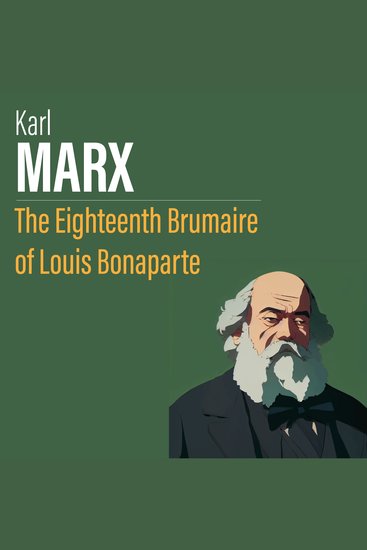
    "The Eighteenth Brumaire of Louis Bonaparte" is a book written by Karl Marx, a German philosopher and economist, in 1852. The book analyzes the political situation in France during the mid-19th century and provides a critique of the bourgeois republicanism that had taken hold there. 
    The title of the book refers to the date of the coup d'état in which Louis Bonaparte, the nephew of Napoleon Bonaparte, seized power in France. Marx used this event as a lens through which to examine the larger historical forces that had led to the rise of Louis Bonaparte and the decline of the bourgeois republic. 
    In the book, Marx argues that the bourgeois republic had failed to address the fundamental economic and social problems facing France, and that this failure had paved the way for the rise of a new form of authoritarian rule. He believed that the only way to truly address these problems was through a proletarian revolution that would overthrow the capitalist system. 
    "The Eighteenth Brumaire of Louis Bonaparte" is considered to be one of Marx's most important works, and it has had a significant impact on the field of political theory. The book's analysis of the relationship between economic and political power has influenced generations of scholars and activists, and it continues to be studied and debated to this day.
    Show book
  • The Eurasian Century - Hot Wars Cold Wars and the Making of the Modern Century - cover

    The Eurasian Century - Hot Wars...

    Hal Brands

    • 0
    • 0
    • 0
    We often think of the modern era as the age of American power. In reality, we're living in a long, violent Eurasian century. That giant, resource-rich landmass possesses the bulk of the global population, industrial might, and potential military power. Eurasia is a strategic prize without equal—which is why the world has been roiled, reshaped, and nearly destroyed by clashes over the supercontinent. 


    Since the early twentieth century, autocratic powers have aspired for dominance by seizing commanding positions in the world's strategic heartland. Offshore sea powers, namely the United Kingdom and America, have sought to make the world safe for democracy by keeping Eurasia in balance. America's rivalries with China, Russia, and Iran are the next round in this geopolitical game. If this new authoritarian axis succeeds in enacting a radically revised international order, America and other democracies will be vulnerable and insecure. 


    Hal Brands argues that a better understanding of Eurasia's strategic geography can illuminate the contours of rivalry and conflict in today's world. The Eurasian Century explains how revolutions in technology and warfare, and the rise of toxic ideologies of conquest, made Eurasia the center of twentieth-century geopolitics—with pressing implications for the struggles that will define the twenty-first.
    Show book
  • Drawing Lines - Why Conservatives Must Begin to Battle Fiercely in the Arena of Ideas - cover

    Drawing Lines - Why...

    Kira Davis

    • 0
    • 0
    • 0
    It is time to draw our lines in the sand as Christians and Conservatives by engaging in public conversations with truth and conviction. 


    Kira Davis has built a brand on reaching out to the other side, on giving people space to be wrong, the space to discuss, the space to tolerate. Unfortunately, the people controlling the public conversations right now will have none of it. We're seeing the lengths they will go to and the lies they let stand in service of crushing 50 percent of this nation. They seek unity through complete elimination of the other side. There are times for compromise and times to draw a line in the sand; the latter has arrived. It is time to draw our lines as Christians and Conservatives.
    Show book
  • What is Property? - cover

    What is Property?

    Pierre-Joseph Proudhon

    • 0
    • 0
    • 0
    "What is Property?" is a book written by Pierre Joseph Proudhon, a French philosopher and political theorist. The book is a critique of property rights and capitalist economic systems, and it argues for a more egalitarian and democratic society. 
    Proudhon's central thesis is that property rights are inherently unjust and that they allow the rich to exploit the poor. He argues that property should be abolished and replaced with a system of communal ownership, in which individuals share and cooperate in the use and distribution of resources. 
    In the book, Proudhon also explores the origins and development of property rights, tracing their history from the earliest human societies to the modern capitalist era. He criticizes the idea that property rights are based on natural law or divine mandate, arguing instead that they are a product of historical and social conditions. 
    Overall, "What is Property?" is a radical critique of capitalism and property rights that has had a significant impact on political theory and social movements. It is considered a foundational text of anarchist and socialist thought and remains a key reference for anyone interested in the history and development of economic and political systems
    Show book
  • Letters To Mikey - Messages of Hope and Optimism for Young Americans - cover

    Letters To Mikey - Messages of...

    Glenn Cort

    • 0
    • 0
    • 0
    In America we have so much, but there is something missing. There is a widespread fear of what we are becoming. Our new normal is indescribable, yet undeniable. Subtle, yet controlling. We can all feel it but we can’t put our finger on what it is. 
    There is a generalized sense of noise and confusion that has dominated our society for years. It’s as if we’ve become unglued from anything — truth or reality — that has formerly held us together. 
    Driven by the fear of the moment, Letters to Mikey (LTM) is the story of a parent and part time teacher who sits down to write a birthday card for his eighteen-year-old son and is at a loss for words for what is happening to society. So, he drops everything, moves to an island and visits a place that he hasn’t been to for years... the local library. What he finds there is truly astonishing! 
    Written for young adults and teenagers, LTM explains truth in a way that kids can rely on to have less frustration and worry about this crazy world we live in. It provides real reasons for optimism for a brighter future as well as coping mechanisms, tools and strategies to enable a future generation to bring an end to terrible disagreement and hate forever. These aren't false promises. It's possible.  
    Geared to start a movement, LTM seeks to tap into our greatest resource — young people.
    Show book