Join us on a literary world trip!
Add this book to bookshelf
Grey
Write a new comment Default profile 50px
Grey
Subscribe to read the full book or read the first pages for free!
All characters reduced
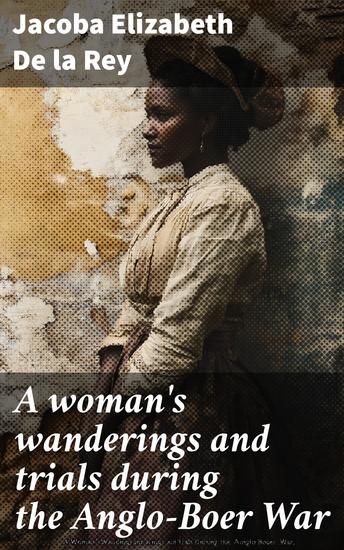
A woman's wanderings and trials during the Anglo-Boer War - cover

A woman's wanderings and trials during the Anglo-Boer War

Jacoba Elizabeth De la Rey

Publisher: Good Press

  • 0
  • 0
  • 0

Summary

In "A Woman's Wanderings and Trials During the Anglo-Boer War," Jacoba Elizabeth De la Rey presents a poignant and personal narrative that intertwines the personal struggles of women with the broader socio-political turmoil of the Anglo-Boer War (1899-1902). This memoir is characterized by its vivid, emotive language and an intimate first-person account, capturing the resilience and fortitude of women amidst the chaos of war. De la Rey not only documents the physical hardships of displacement and loss but also explores the psychological toll of conflict, thereby situating her narrative within the rich tradition of war literature that foregrounds female experiences. Jacoba Elizabeth De la Rey, a member of the prominent Boer family, experienced the dire realities of the war firsthand, which deeply informed her writing. Raised in a conservative society impacted by colonial tensions, her experiences as a wife and mother during this turbulent period motivated her to document the often-overlooked narratives of women. De la Rey's insights reflect her personal convictions and the societal challenges that women faced, promoting a rich understanding of their role in history. This book is highly recommended for readers interested in gender studies, military history, and personal narratives of resilience. De la Rey's unique perspective provides a necessary counterpoint to traditional war accounts, and her literary account serves as an essential resource for understanding the multi-faceted impacts of war on women's lives.
Available since: 03/02/2025.
Print length: 200 pages.
Other books that might interest you

  • 情感话语的多维度研究:以抱怨会话为例(英文版) - cover

    情感话语的多维度研究:以抱怨会话为例(英文版)

    李昊

    • 0
    • 0
    • 0
    内容简介:
    《情感话语的多维度研究——以抱怨会话为例》从社会语言学和语用学角度出发,以抱怨会话为例,对其中蕴含的情感话语进行会话分析,以探究情感话语在交际中的特征、表现,以及与框架和立场密不可分的关系。本书所分析的情感话语指含有情感信息的话语,既包括明确指示情感的情感语言,也包括隐含表达情感的情感性语言。情感话语遍布整个语言系统,是人类交际的必要组成部分。任何会话中都可能有潜在的情感话语,交际者通过情感话语来施行各种言语行为。因此,语言和情感的关系已经引起多方学者的关注,主要涵盖认知语言学、语言人类学、心理语言学、社会语言学、计算语言学、语用学等多个领域。本书选取抱怨会话中存在的大量情感话语作为特定分析对象。所用语料采集自电视剧和真人秀,包括33个不同情景和社会关系中的对话片段。鉴于会话分析在考察话语序列性和交际性方面的优势,本书将结合立场的三个方面,即对立场客体的评价(客观性)、说话主体的定位(主观性)和会话者间定位的比较(主体间性),对抱怨言语行为中的情感话语进行会话分析。
    Show book
  • Social Movements and Change - How Collective Action Shapes the World - cover

    Social Movements and Change -...

    Fred Grandsen

    • 0
    • 0
    • 0
    Social movements have long been a driving force for change, shaping societies and influencing policies across the world. These movements emerge when groups of people collectively organize to challenge existing social, political, or economic conditions. They can be sparked by various grievances, including inequality, injustice, environmental concerns, or human rights violations. Throughout history, social movements have played a critical role in securing rights, shifting cultural attitudes, and restructuring institutions, proving that collective action has the power to transform society. 
    One of the defining features of social movements is their ability to mobilize people around a shared cause. Unlike isolated acts of resistance, social movements are sustained efforts that involve coordination, strategy, and widespread participation. They can take different forms, ranging from peaceful protests and grassroots organizing to legal advocacy and digital activism. Movements may operate at local, national, or even global levels, depending on the scope of their goals and the issues they address. The Civil Rights Movement, the Women’s Suffrage Movement, and modern climate activism are all examples of how collective efforts have led to significant social and political shifts. 
    Social movements can be categorized in various ways based on their objectives and methods. Reform movements seek to change specific laws or policies without overthrowing the existing system, such as labor rights movements advocating for better working conditions. Revolutionary movements, on the other hand, aim for more radical transformation, challenging and replacing entire political or social structures. Other types include resistance movements, which emerge in opposition to certain policies or cultural shifts, and new social movements, which focus on issues like identity, environmental concerns, and globalization.
    Show book
  • The Shock of the Ancient - Literature & History in Early Modern France - cover

    The Shock of the Ancient -...

    Larry F. Norman

    • 0
    • 0
    • 0
    The cultural battle known as the Quarrel of the Ancients and Moderns served as a sly cover for more deeply opposed views about the value of literature and the arts. One of the most public controversies of early modern Europe, the Quarrel has most often been depicted as pitting antiquarian conservatives against the insurgent critics of established authority. The Shock of the Ancient turns the canonical vision of those events on its head by demonstrating how the defenders of Greek literature—rather than clinging to an outmoded tradition—celebrated the radically different practices of the ancient world. At a time when the constraints of decorum and the politics of French absolutism quashed the expression of cultural differences, the ancient world presented a disturbing face of otherness. Larry F. Norman explores how the authoritative status of ancient Greek texts allowed them to justify literary depictions of the scandalous. The Shock of the Ancient surveys the diverse array of aesthetic models presented in these ancient works and considers how they both helped to undermine the rigid codes of neoclassicism and paved the way for the innovative philosophies of the Enlightenment. Broadly appealing to students of European literature, art history, and philosophy, this book is an important contribution to early modern literary and cultural debates.
    Show book
  • Ancient Egyptian Conspiracy Theories: The History of the Most Popular Conspiracy Theories about Egypt in Antiquity - cover

    Ancient Egyptian Conspiracy...

    Editors Charles River

    • 0
    • 0
    • 0
    Given how far back the Egyptian civilization goes, it’s no surprise that Egypt is still full of mystery, and the unknown continues to generate conspiracy theories that attempt to fill in the gaps. For example, generations have viewed Egypt’s pyramids and the Great Sphinx as symbols of a lost past, which in turn leads to Egypt’s portrayal as a world full of romance and mystery. The age and structural integrity of these magnificent structures also make them symbols of longevity and power, which is only fitting because those are two purposes the ancient pharaohs who commissioned them intended them to serve. 
    In fact, while the sphinx was a well-known mythological creature among various ancient civilizations, the Egyptian statue that is now most famously associated with the creature is full of mysteries that have been endlessly debated throughout the centuries and continue to be hotly contested among scholars. The famous “Riddle of the Sphinx”, told by Sophocles in his play Oedipus Rex in the 5th century B.C., characterized the sphinx as a clever and powerful creature, and the mysteries of the Egyptian statue were discussed even among the ancient Romans. Even the source of the damage suffered by the Sphinx has become the stuff of legend, as evidenced by the story of Napoleon’s French soldiers shooting off the Sphinx’s nose. 
    Of course, the Sphinx is merely one object in Egypt that has been the source of endless theories. The discovery of King Tutankhamun’s tomb revived the legends of pharaohs’ curses and mummies, and ancient Egyptian art has been analyzed in seemingly every conceivable way possible as people come up with alternate theories for how the Egyptians built their most famous buildings and forged their enduring civilization.
    Show book
  • Unkindness of Ravens An - cover

    Unkindness of Ravens An

    Sally Cook

    • 0
    • 0
    • 0
    The  power and ancient symbology of the raven carries this story through its  historic presence for centuries at the Tower of London to current landscapes including the sandstone monolith of Mount Arapiles in Western Victoria. The ravens seemingly gloating presence adds to the atmosphere at this ancient Aboriginal rock site where many have taken up the climbing challenge and some have fallen. The story moves from this climbing area to one at Hanging Rock - principal  scene of the famous novel Picnic at Hanging Rock and the hugely successful movie "Picnic At Hanging Rock" made 50 years ago. An Unkindness of  Ravens also looks at the thousands of years of Aboriginal heritage at this former volcanic site and the overall ancient atmospherr of both sites,
    Show book
  • Bradley - cover

    Bradley

    Charles Whiting

    • 0
    • 0
    • 0
    At the age of fifty Bradley was a career officer who had never seen a day of action on the battlefield. Yet, by the end of the war, he had led American soldiers through some of the bloodiest fighting of World War Two—the final defeat of the Germans' Afrika Korps, the invasion of Sicily, and the historic Normandy invasion, before leading the advance across the Rhine. 


    Despite being such an instrumental leader of World War Two he was a modest man, professing only to do the best he could for his calling and his country. 


    How did this quiet and unassuming teacher from West Point rise to become the commander of the Twelfth United States Army Group, which ultimately comprised forty-three divisions and over one million troops, the largest American force ever united under one man's command? And how did he come to be known as 'the G.I.'s General'? 


    Charles Whiting's enthralling overview of Bradley and his career uncovers what he was like as a person, providing insight into his actions and leadership during the course of World War Two, before discussing his post-war career as Chairman of the Joint Chiefs of Staff through the course of the Korean War.
    Show book