Join us on a literary world trip!
Add this book to bookshelf
Grey
Write a new comment Default profile 50px
Grey
Subscribe to read the full book or read the first pages for free!
All characters reduced
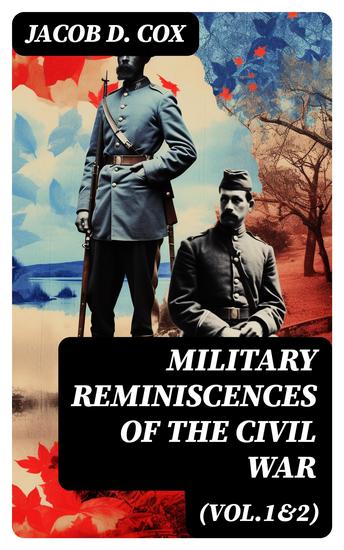
Military Reminiscences of the Civil War (Vol1&2) - An Autobiographical Account by a General of the Union Army (Complete Edition) - cover

Military Reminiscences of the Civil War (Vol1&2) - An Autobiographical Account by a General of the Union Army (Complete Edition)

Jacob D. Cox

Publisher: DigiCat

  • 0
  • 0
  • 0

Summary

In "Military Reminiscences of the Civil War (Vol. 1 & 2)," Jacob D. Cox offers a compelling first-person narrative that captures the complex realities of the American Civil War. Written in a reflective style that combines vivid personal anecdotes with incisive observation, Cox delves into the operational strategies and human dramas of the conflict. This dual-volume work serves not only as a historical account but also as a literary artifact, enriched with meticulous detail and evocative descriptions that illuminate the chaos and camaraderie of wartime experiences. Cox's ability to weave his military experiences with broader themes of duty, courage, and the moral dilemmas faced by soldiers showcases the richly layered fabric of Civil War history. Jacob D. Cox, a notable figure in both military and political spheres, served as a Union general and later became a prominent statesman. His extensive firsthand experience on the battlefield and engagement in key maneuvers during pivotal battles provides him with a unique perspective, shaping his reflections into a narrative that balances advocacy with critical insight. These volumes emerge from his commitment to preserving the memory of those who served, illustrating the profound impact of conflict on individual lives and national identity. For readers interested in understanding the American Civil War through the eyes of those who lived it, Cox's "Military Reminiscences" is an indispensable resource. Scholars, historians, and enthusiasts alike will find value in his thorough analysis of military campaigns and personal reflections. This dual-volume work not only enhances the historical lexicon of the Civil War but also resonates with universal themes of sacrifice and valor, making it a must-read for anyone seeking deeper comprehension of this tumultuous period.
Available since: 11/16/2023.
Print length: 888 pages.

Other books that might interest you

  • Greatest Generals of the Roman Republic The: The History of the Military Leaders Who Led the Rise of Rome - cover

    Greatest Generals of the Roman...

    Charles River Editors

    • 0
    • 0
    • 0
    The Roman army is one of the most famous fighting forces in history. Through its power and prowess, a once obscure Italian city forged an empire that encircled the Mediterranean and covered half of Europe. The physical remains of its presence can be traced from the mountainous borders of Scotland to the arid deserts of Egypt, but its legacy is far greater and more enduring, as Rome's influence continues to shape the political, legal, and cultural landscape of Europe to this very day. 
    While the Roman army is rightly famed as an institution, the image of the individual legionary is also an iconic one. The uniformed, disciplined soldier of the late Republic and early Empire is one of the first things many people imagine when they think of Rome. They are the ultimate image of the ancient soldier, their arms and armor instantly recognizable. Their abilities, not only as warriors but also as engineers and administrators, have made them role models for other soldiers through the centuries. In the same vein, their commanders are still celebrated and studied, and generals the world over have tried to emulate the likes of Julius Caesar. 
    While he remains far less known than his rival Hannibal, Publius Cornelius Scipio, the man who has become known to history as Scipio Africanus, is widely regarded as one of the greatest military leaders of all time. In the space of less than 10 years, the genius of Scipio took Rome from being on the brink of utter destruction to becoming the dominant power in the Mediterranean.  
    Ironically, Gaius Marius’s reforms had made the legions fiercely loyal to their individual generals rather than the state, which allowed his eventual rival Sulla to march his army against Rome and force Marius into exile. With that, Rome’s first civil war was officially underway, but Sulla’s triumph proved short-lived.
    Show book
  • Joker and Philosophy - Why So Serious? - cover

    Joker and Philosophy - Why So...

    George A. Dunn, Jason T. Eberl,...

    • 0
    • 0
    • 0
    A diabolically sinister but clownish villain, Joker is a symbolically rich and philosophically fascinating character. With his enigmatic motivations, infectious irreverence, and selfless devotion to evil, Joker never fails to provoke a host of philosophical questions. 


    Bringing together essays by a diverse panel of acclaimed scholars and philosophers, this engaging book delves into the motivations, psychology, and moral philosophy of the character for whom mayhem and chaos are a source of pure delight. 


    Joker and Philosophy offers deep insights into moral and philosophical questions such as: What is a sane response to a mad world? Can laughter be liberating? Is civilization a thin veneer over our natural lawlessness? Can violence ever be justified in response to an unjust social order? Is one bad day really all it takes to create a villain? 


    Exploring a broad range of timeless issues of human nature, the metaphysics of freedom, the nature of identity, good and evil, political and social philosophy, aesthetics, and much more, Joker and Philosophy: Why So Serious? is a must-listen for all fans of one of the most fascinating villains in the DC comics universe.
    Show book
  • Jewish Family Life - Customs Rituals and Values in Daily Living - cover

    Jewish Family Life - Customs...

    Joseph Arston

    • 0
    • 0
    • 0
    Jewish family life is deeply rooted in tradition, values, and a strong sense of community. The family is not just a social unit but the very foundation of Jewish identity, shaping the faith, customs, and moral principles passed down through generations. Through daily practices, holidays, and shared rituals, Jewish families cultivate a home environment that nurtures both spiritual and ethical development. 
    At the core of Jewish family life is the concept of shalom bayit, or peace in the home. This principle emphasizes harmony, mutual respect, and love among family members. Parents play a crucial role in modeling these values, creating an atmosphere where kindness, patience, and understanding are prioritized. The Torah provides guidance on fostering a household filled with compassion and justice, reinforcing the idea that family is a sacred space where Jewish teachings come to life. 
    Another fundamental aspect of Jewish family life is the observance of Shabbat. The Sabbath is more than just a day of rest—it is a time for families to reconnect, reflect, and step away from the distractions of daily life. The preparation for Shabbat, including lighting the candles, reciting blessings over wine and bread, and sharing a festive meal, strengthens family bonds. Shabbat serves as a reminder of the importance of slowing down, appreciating one another, and finding holiness within the home. It is a time when parents pass down traditions and children absorb the rhythms of Jewish living.
    Show book
  • Stories on Lord Shiva series -18 - From various sources of Shiva Purana - cover

    Stories on Lord Shiva series -18...

    Anusha HS

    • 0
    • 0
    • 0
    Lord shiva is adi and he is only the anthya. He is the sole reason for the happenings in both the movable and immovable worlds. Therefore, it is said that not even a spring of grass will move without his permission. He is the one who has given life to all the creatures. He is also the one who takes away the lives of all the creatures. Sadhus sages and aghoraas practice severe penance without minding day and night on Lord Shiva. He blesses his devotees with boons. He is called Bole Shankar. All recite his five syllabled mantra or panchakshari mantra " om Namah Shivaya" which is the most popular one among all the other mantras. Lord Shiva who is also called Parameswara is the one who has got no birth and death. He is only the beginning and he is the end. Nandi which happens to be the vehicle of Lord Shiva is a bull.
    Show book
  • Tao Te Ching & Siddhartha - cover

    Tao Te Ching & Siddhartha

    Lao Tzu, Herman Hesse

    • 0
    • 0
    • 0
    The philosophies of the East are both complex and enlightening. Their views on human nature, society, and morality have shaped the world for thousands of years. Now, we get a chance to delve deep into the primary texts which are held close to the hearts of millions. 
    In this bundle, you’ll discover the Tao Te Ching, the world-renowned work first written in ancient China, along with the classic Siddhartha, a powerful and spiritually enlightening novel which tells the story of the Buddha. 
    Both these texts have stood the test of time, and paved the way for philosophies which continue to have impact across the ages. From the life of the Buddha and his belief in Samsara and Nirvana, to the secrets of the Tao, this book is a must-listen for anyone interested in spiritual and philosophical enlightenment.
    Show book
  • Expressly Human - Decoding The Language of Emotion - cover

    Expressly Human - Decoding The...

    Mark Changizi, Tim Barber

    • 0
    • 0
    • 0
    Over billions of years of evolution, animals have become increasingly sophisticated and increasingly sentient. In the process, they evolved emotions, which helped improve their odds of survival in complex situations. These emotions were, at first, purely internal. But at some point, social animals began expressing their emotions, in increasingly dramatic ways. These emotional expressions could accurately reflect internal emotions (smiling to express happiness)—or they could be quite different (smiling to cover up that you're actually furious, but can't tell your boss that). 


    Why did once-stone-faced animals evolve to be so emotionally expressive—to be us? The answer, as evolutionary neurobiologist Mark Changizi and mathematician Tim Barber reveal, is that emotional expressions are our first and most important language—one that allows us, as social animals, to engage in highly sophisticated communications and negotiations. 


    Expressly Human introduces an original theory that explains, from first principles, how the broad range of emotional expressions evolved, and provides a Rosetta Stone for human communication. It will revolutionize the way you see every social interaction, from deciding who gets the last slice of pizza to multimillion-dollar business negotiations, and change your definition of what makes us human.
    Show book