Unisciti a noi in un viaggio nel mondo dei libri!
Aggiungi questo libro allo scaffale
Grey
Scrivi un nuovo commento Default profile 50px
Grey
Iscriviti per leggere l'intero libro o leggi le prime pagine gratuitamente!
All characters reduced
Darius the Great - cover

Darius the Great

Jacob Abbott

Casa editrice: Librorium Editions

  • 0
  • 0
  • 0

Sinossi

About five or six hundred years before Christ, almost the whole of the interior of Asia was united in one vast empire. The founder of this empire was Cyrus the Great. He was originally a Persian; and the whole empire is often called the Persian monarchy, taking its name from its founder’s native land.
Cyrus was not contented with having annexed to his dominion all the civilized states of Asia. In the latter part of his life, he conceived the idea that there might possibly be some additional glory and power to be acquired in subduing certain half-savage regions in the north, beyond the Araxes. He accordingly raised an army, and set off on an expedition for this purpose, against a country which was governed by a barbarian queen named Tomyris. He met with a variety of adventures on this expedition, all of which are fully detailed in our history of Cyrus. There is, however, only one occurrence that it is necessary to allude to particularly here. That one relates to a remarkable dream which he had one night, just after he had crossed the river.
Disponibile da: 28/02/2022.
Altri libri che potrebbero interessarti

  • Anglo-Saxons for Kids: A Captivating Guide to the People of Early Medieval England and Their Battles Against the Vikings - cover

    Anglo-Saxons for Kids: A...

    Captivating History

    • 0
    • 0
    • 0
    Embark on an exciting journey to the past to meet the Anglo-Saxons! 
    The Anglo-Saxons were people from Northern Germany who came to Britain in waves and quickly established their own kingdoms between the time of the Romans and the Normans. At first glance, it may seem like the Anglo-Saxons did not contribute much to British history. They didn’t even have a writing system until Christian missionaries arrived!  
    So, why are the Anglo-Saxons so important to British history? Some people may think of this time as a dark time full of feuding kings. Although there were a lot of kings and plenty of fighting, the Anglo-Saxons also laid the foundation for modern English society. They created the structure needed to form one country out of different tribes. When the Normans took over in 1066, they built on top of Anglo-Saxon social and political structures.  
    For years, people have focused on leaders like King Alfred the Great or events like the Norman Conquest. But the Anglo-Saxons were more than just a few leaders or events. They structured a nation that would go on to conquer vast swaths of the modern world, and their ingenuity still structures life as we know it today.  
    It’s time to sail back into history and learn about the many facets of the Anglo-Saxons. In this new and captivating history audiobook, you’ll learn what made the Anglo-Saxons special and how they still shape our lives today. 
    Here are some of the questions you will uncover in this audiobook: 
    Was King Arthur real?  
    What made Wessex so special? 
    Which Germanic tribes came to Britain as the Anglo-Saxons? 
    Who was St. Augustine? 
    Where did the Normans come from? 
    Who was the first King of England? 
    Why did William the Conqueror come to England? 
    What is the difference between modern and Old English? 
    Scroll up and click the “add to cart” button to learn more about the history of the Anglo-Saxons!
    Mostra libro
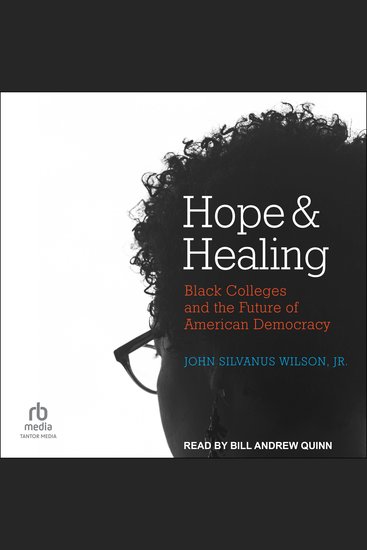
  • Hope and Healing - Black Colleges and the Future of American Democracy - cover

    Hope and Healing - Black...

    Jr. John Silvanus Wilson

    • 0
    • 0
    • 0
    In Hope and Healing, former Morehouse College president John Silvanus Wilson, Jr. looks to Historically Black Colleges and Universities (HBCUs) to examine what it takes not only to survive as a relevant institution of higher education, but to thrive. Wilson draws on pivotal moments in the timelines of HBCUs and the work of past visionaries to yield important perspectives on the future of higher education and the role of HBCUs within it. 


    Wilson documents the strengths of HBCUs, which endure even as factors such as school desegregation, enrollment shifts, and fundraising shortages have deeply affected their operation. These schools have long optimized institutional character, and he encourages their leaders to similarly optimize institutional capital. Wilson emphasizes the indispensable role of educational finance in keeping schools viable and vital to education, discussing funding approaches. Wilson's asset-based framework reveals pathways for all higher education institutions to invest in their long-term futures. 


    Suffused with optimism, the book credits HBCUs as exemplars that consistently demonstrate how all colleges and universities can marshal their institutional resources to shape better citizens, foster civic literacy, and work toward a better tomorrow.
    Mostra libro
  • Romanian Made Easy - Beginner - Volume 2 of 3 - cover

    Romanian Made Easy - Beginner -...

    Lingo Wave

    • 0
    • 0
    • 0
    We broke our new series on learning Romanian down into different learning stages. Start with the "Lower Beginner" books followed by the "Beginner" and "Upper Beginner" books. Next, progress to the "Intermediate" series, then test and reinforce your knowledge with the "Conversations" series. 
    This audiobook is divided into units.While it provides different learning patterns and accommodates various needs, this audiobook focuses on helping you improve your ability to understand, speak, and memorise Romanian.  
    In Unit 1 you will hear Romanian decoded with each syllable spoken very slowly and clearly with repetition. Immediately before each sentence is spoken, you will hear the translation, so you will always understand what is being said. 
    Unit 2 focuses solely on increasing your listening ability, which will improve your abilities to engage in dialogue with a native Romanian speaker. This chapter requires you to listen very carefully to nuances in the language. 
    By Unit 3 you will already notice progress in your abilities to speak and understand Romanian. The spoken translation is followed by two repetitions in Romanian at a completely natural speed. While you are learning to process naturally spoken Romanian, Units 3 and 4 will help you memorise new vocabulary and full sentences. 
    In Unit 5 you can test yourself on how much you have learned. If you are having difficulties, we suggest you revisit the listening, speaking, or memorisation section of Units 1, 2 3 or 4, according to what you need more help with. 
    Topics covered in this book: 
    1. Asking about family 
    2. Asking about relationship status 
    3. Expressing frequency 
    4. Talking about spare time activities and hobbies 
    5. Using quantifiers/determiners 
    6. Talking about preference 
    7. Talking about abilities 
    8. Talking about location of places 
    9. Describing appearance 
    10. Talking about personality 
    ...
    Mostra libro
  • Dark Triad - A Group of Personality Traits including Narcissism Machiavellianism and Psychopathy - cover

    Dark Triad - A Group of...

    Cito Harder

    • 0
    • 0
    • 0
    The Dark Triad is a psychological framework that encompasses three distinct but interrelated personality traits: narcissism, Machiavellianism, and psychopathy. These traits are often associated with manipulation, lack of empathy, and a self-serving approach to relationships and social interactions. While each trait has its own characteristics, they share a common theme of emotional coldness, deceit, and a tendency to prioritize personal gain over ethical considerations. 
    Narcissism is characterized by an inflated sense of self-importance, a deep need for admiration, and a lack of empathy for others. Narcissists often believe they are superior to those around them and expect constant validation. While some level of narcissism can be beneficial—such as having confidence and ambition—extreme narcissism can lead to entitlement, arrogance, and exploitative behavior in relationships. 
    Machiavellianism is defined by manipulation, cunning, and a willingness to deceive others for personal gain. Individuals high in Machiavellianism are strategic in their interactions, often using flattery, deception, or calculated charm to achieve their goals. Unlike narcissists, who crave attention, Machiavellians are primarily concerned with power and control. They are pragmatic and often view morality as an obstacle rather than a guiding principle.
    Mostra libro
  • Taming the Octopus - The Long Battle for the Soul of the Corporation - cover

    Taming the Octopus - The Long...

    Kyle Edward Williams

    • 0
    • 0
    • 0
    The untold story of how efforts to hold big business accountable changed American capitalism. 


    In this vivid and surprising history, we meet twentieth-century activists, investors, executives, and workers who fought over a simple question: Is the role of the corporation to deliver profits to shareholders, or something more? On one side were "business statesmen" who believed corporate largess could solve social problems. On the other were libertarian intellectuals such as Milton Friedman and his oft-forgotten contemporary, Henry Manne, whose theories justified the ruthless tactics of a growing class of corporate raiders. But Kyle Edward Williams reveals that before the "activist investor" emerged as a capitalist archetype, Civil Rights groups used a similar playbook for different ends, buying shares to change a company from within. 


    As a rising tide of activists pushed corporations to account for societal harms from napalm to environmental pollution to inequitable hiring, a new idea emerged: that managers could maximize value for society while still turning a maximal profit. This elusive ideal, "stakeholder capitalism," still dominates our headlines today. Williams's necessary history equips us to reconsider democracy's tangled relationship with capitalism.
    Mostra libro
  • American Indian Symbolism - cover

    American Indian Symbolism

    Manly Palmer Hall

    • 0
    • 0
    • 0
    The North American Indian is by nature a symbolist, a mystic, and a philosopher. Like most: aboriginal peoples, his soul was en rapport with the cosmic agencies manifesting about him. Not only did his Manidos control creation from their exalted seats above the clouds, but they also descended into the world of men and mingled with their red children. The gray clouds hanging over the horizon were the smoke from the calumets of the gods, who could build fires of petrified wood and use a comet for a flame. The American Indian peopled the forests, rivers, and sky with myriads of superphysical and invisible beings. There are legends of entire tribes of Indians who lived in lake bottoms; of races who were never seen in the daytime but who, coming forth from their hidden caves, roamed the earth at night and waylaid unwary travelers; also of Bat Indians, with human bodies and batlike wings, who lived in gloomy forests and inaccessible cliffs and who slept hanging head downward from great branches and outcroppings of rock. The red man's philosophy of elemental creatures is apparently the outcome of his intimate contact with Nature, whose inexplicable wonders become the generating cause of such metaphysical speculations.
    Mostra libro