Join us on a literary world trip!
Add this book to bookshelf
Grey
Write a new comment Default profile 50px
Grey
Subscribe to read the full book or read the first pages for free!
All characters reduced
Out of Mulberry Street: Stories of Tenement life in New York City - Enriched edition - cover

Out of Mulberry Street: Stories of Tenement life in New York City - Enriched edition

Jacob A. Riis

Publisher: DigiCat

  • 0
  • 0
  • 0

Summary

In "Out of Mulberry Street: Stories of Tenement Life in New York City," Jacob A. Riis employs a journalistic yet evocative literary style to illuminate the harsh realities faced by immigrants and the urban poor in late 19th-century New York City. Through vivid anecdotes and compelling narratives, Riis captures the struggles and resilience of tenement dwellers while also critiquing the socio-economic structures that perpetuate their plight. His work sits at the intersection of social reform literature and photojournalism, a precursor to modern documentary storytelling, as Riis blends rich descriptions with powerful photographs to compellingly portray life in these densely populated neighborhoods. Jacob A. Riis, a Danish immigrant himself, was influenced by his personal experiences of poverty and marginalization, which fueled his desire to expose societal injustices. His work as a social reformer and a pioneer in the field of social photography gave him unique insight into the tenement experience, fostering a passionate commitment to advocating for urban reform and improved living conditions. "Out of Mulberry Street" is an essential read for those interested in social history, urban studies, and immigrant narratives. Riis's poignant storytelling not only enlightens readers about the past but also serves as a call to action for addressing the ongoing challenges of urban poverty in contemporary society.

In this enriched edition, we have carefully created added value for your reading experience:
- A comprehensive Introduction outlines these selected works' unifying features, themes, or stylistic evolutions.
- The Author Biography highlights personal milestones and literary influences that shape the entire body of writing.
- A Historical Context section situates the works in their broader era—social currents, cultural trends, and key events that underpin their creation.
- A concise Synopsis (Selection) offers an accessible overview of the included texts, helping readers navigate plotlines and main ideas without revealing critical twists.
- A unified Analysis examines recurring motifs and stylistic hallmarks across the collection, tying the stories together while spotlighting the different work's strengths.
- Reflection questions inspire deeper contemplation of the author's overarching message, inviting readers to draw connections among different texts and relate them to modern contexts.
- Lastly, our hand‐picked Memorable Quotes distill pivotal lines and turning points, serving as touchstones for the collection's central themes.
Available since: 05/28/2022.
Print length: 128 pages.

Other books that might interest you

  • Technology Turned Us Into Zombies - cover

    Technology Turned Us Into Zombies

    Raphael Terra

    • 0
    • 0
    • 0
    This audiobook has been recorded using Text to speech (TTS). 
     
    Generations blame each other for the state of the world. Kids eat a daily course of mobile phone apps and social media burgers. News is reduced to fake edible sound bites. Television and movie stars are modern day photoshopped gods. Illusion and delusion are all around us. Marketing magic created to control and manipulate the stupid masses. 
     
    Reality TV stars are elected and glorified to greater heights as charity and care workers are forgotten. Zombies walk the streets desperate to find a Wi-Fi hotspot and an awesome place to take a selfie. Kids today need to find safe havens from social media attacks where their grandparents needed to find bunkers to save them from bombs. Hard times no longer means poverty and starvation, it means not having the latest fashion, mobile phone, game console and followers. An older generation wonder what all these new gender designations mean and how anybody can be fluid. They wonder why these youngsters don't want to work for a living and despair should we ever have another world war. 
     
    Today the last generation look upon the so-called Millennials and wonder where they went wrong. In this book, we are going to find out that we are all Millennials and how to change.
    Show book
  • Reimagine Education: Empowering Minds for a Just Future - "Unlock your potential! Dive into engaging audio lessons that inspire a just future in education" - cover

    Reimagine Education: Empowering...

    Kellan Verity

    • 0
    • 0
    • 0
    Reimagine Education: Empowering Minds for a Just Future 
    ⭐⭐ Simplified Guide & Explanations Included ⭐⭐  
    Are you eager to advance in your career while enhancing your knowledge to unlock your potential and create impactful change for all?  
    Looking for a thorough guide that covers everything you need to succeed?  
    Your search ends here!  
    This guide acts as your ultimate resource for deepening your comprehension, applying your skills, and engaging in practical exercises, setting you on a path to success. 
    Updated for the latest 2024-2025 framework.  
    Highlights of this comprehensive guide include: 
    - In-depth insights into unlocking potential and creating impactful change for all. 
    - Comprehensive explanations surrounding the concept of empowerment through education. 
    - Effective strategies for preparation and execution. 
    Our guide stands out due to its thorough coverage, which is crucial for your success. Concepts are explored in depth rather than being glossed over.  
    Please note that this guide operates independently and is not affiliated with any official body, aiming purely to benefit you.  
    Crafted with a clear structure and accessible language, our guide ensures smooth transitions between topics. Say farewell to convoluted terminology and embrace clear, precise, and technically sound content. 
    So, why delay any longer? Click the BUY NOW button, secure your guide, and embark on your journey towards success in unlocking potential and creating impactful change for all!
    Show book
  • Stephen King's Maine - A History & Guide - cover

    Stephen King's Maine - A History...

    Sharon Kitchens

    • 0
    • 0
    • 0
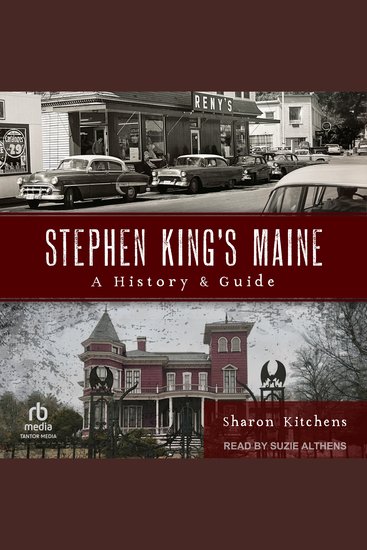
    Much of Western Maine reads like a Stephen King novel. 


    The dense dark woods and backcountry ponds. The century-old houses with gravel driveways and immense flower gardens, acres of farmland miles from a highway. Serpentine country roads dotted with farmstands, and picturesque main streets lined with battered pickups. Places where—especially during the dark and rainy days of October and November—things can get downright spooky. 


    Author Sharon Kitchens identifies the locations that serve as the basis for King's fictional towns of Castle Rock, Jerusalem's Lot, Derry, and Haven. Drawing on historical materials and conversations with locals and people who know King, the author sheds light on daily life in places that would become the settings for Carrie, Salem's Lot, The Dead Zone, Cujo, IT, and 11/22/63.
    Show book
  • A Brief History of the Countryside in 100 Objects - cover

    A Brief History of the...

    Sally Coulthard

    • 0
    • 0
    • 0
    A Waterstones Best Book of 2024: Nature Writing 
    The untold story of rural Britain revealed through its artefacts 
    'A really lovely, fascinating book. I dived straight into this clever, joyous, celebration of nature, history, and – of course – the countryside.' Charles Spencer, author of The White Ship 
    For most of human history, we were rural folk.  
    Our daily lives were bound up with working the land, living within the rhythm of the seasons. We poured our energies into growing food, tending to animals and watching the weather. Family, friends and neighbours were often one and the same. Life revolved around the village and its key spaces and places – the church, the green, the school and the marketplace. 
    And yet rural life is oddly invisible our historical records. The daily routine of the peasant, the farmer or the craftsperson could never compete with the glamour of city life, war and royal drama. Lives went unrecorded, stories untold. 
    There is, though, one way in which we can learn about our rural past. The things we have left behind provide a connection that no document can match; physical artefacts are touchstones that breathe life into its history. From farming tools to children’s toys, domestic objects and strange curios, the everyday items of the past reveal fascinating insights into an often-forgotten way of life. Birth, death, celebration, work, crime, play, medicine, beliefs, diet and our relationship with nature can all be read from these remnants of our past. 
    From ancient artefacts to modern-day memorabilia, this startling book weaves a rich tapestry from the fragments of our rural past. 
    In her non-fiction book A Brief History of the Countryside in 100 Objects, Sally Coulthard explores the social and cultural dynamics of rural life in Europe. The book, steeped in anthropology and environmental conservation, emphasises the importance of regional studies and the protection of our environment. 
    For fans of Jane Cooper (The Lost Flock), Charles King (Every Valley), Lee Alan Dugatkin (Mr. Jefferson and the Giant Moose), James Rebanks (The Shepherd's View), and Clara Parkes (Vanishing Fleece). 
    HarperCollins 2024
    Show book
  • Mayan Astronomy: The History of the Maya’s Measurements of the Planets and Stars - cover

    Mayan Astronomy: The History of...

    Editors Charles River

    • 0
    • 0
    • 0
    Many ancient civilizations have influenced and inspired people in the 21st century, and the Greeks and Romans continue to fascinate the West today, but of all the world’s civilizations, none have intrigued people more than the Mayans, whose culture, astronomy, language, and mysterious disappearance all continue to captivate people. In the past decade especially, there has been a renewed focus on the Mayans, whose advanced calendar led many to speculate the world would end on the same date the Mayan calendar ended in 2012.  
    	For the Maya, astronomy was not a purely scientific pursuit but intimately linked to religious, mythological, and ideological elements that were of the highest importance. The celestial realm held a sacred nature, as did the many gods and goddesses that dwelt there, so for all Mesoamerican cultures, astronomy was a fundamental part of their everyday lives. Thus, astronomy was present in their calendars, religion, and even agriculture, and in close relation to astronomy, the concept of time was also an essential part of their worldview. The Maya recorded time on almost every surface they could, including lintels, cornices, panels, stelae, friezes, ceramics, and paper. This insistence on capturing dates has led many scholars to suggest the Maya were obsessed with time. 
    The Maya had some of the most advanced astronomical measurements in the world, and their work built upon thousands of years, spanning from around 2500 BCE until the the arrival of the Spanish in 1519. Thanks to their hieroglyphic writing, archaeologists have been able to learn a wealth of information about the way they lived and their complex system of beliefs.
    Show book
  • The Urban Experience - Living Working and Thriving in Cities (4 in 1) - cover

    The Urban Experience - Living...

    Lyric Vale

    • 0
    • 0
    • 0
    The city is humanity's most profound expression of collective living—an intricate tapestry of buildings, spaces, interactions, and institutions that shapes not only how we navigate physical environments but fundamentally influences how we learn, connect, work, and find meaning. This comprehensive exploration delves into the multifaceted reality of The Urban Experience, examining how architectural expression, growth patterns, spatial forms, and educational systems converge to create the distinctive character and quality of metropolitan life. From the most intimate scale of building design to the expansive dynamics of regional development, this book illuminates the interconnected dimensions that define how human existence unfolds within urban contexts. 
    The narrative of urban experience transcends descriptive analysis; it encompasses the lived reality of city dwellers navigating environments that simultaneously constrain and liberate, challenge and inspire. By examining the complex interplay between architectural innovation, urban morphology, educational systems, and human perception, this book reveals how cities function as both physical environments and experiential landscapes where collective memory, individual aspiration, and institutional structures intersect. Readers will journey through diverse dimensions of urban life—from the phenomenological impact of architectural space to the evolutionary patterns of urban form and the transformative potential of metropolitan educational systems—discovering how these elements collectively shape opportunities, constraints, and quality of life for billions of urban inhabitants. Through interdisciplinary analysis, theoretical frameworks, and real-world case studies, we provide urban scholars, design professionals, educators, and civic leaders with integrated perspectives on creating cities that not only accommodate human activity but nurture human potential, creativity, learning, and collective well-being.
    Show book