Join us on a literary world trip!
Add this book to bookshelf
Grey
Write a new comment Default profile 50px
Grey
Subscribe to read the full book or read the first pages for free!
All characters reduced
The Mutiny of the Elsinore (Annotated) - cover

The Mutiny of the Elsinore (Annotated)

Jack London

Publisher: ePembaBooks

  • 0
  • 0
  • 0

Summary

This edition includes the following editor's introduction: Jack London, an infinite passion for adventure that drove all his work


First published in 1914, "The Mutiny of the Elsinore" is a maritime adventure novel by American author Jack London partially based on his voyage around Cape Horn on the Dirigo in 1912. The novel has been adapted into films three times.

"The Mutiny of the Elsinore" narrates the story of John Pathurst, a rich and famous author suffering from depression and ennui who has lost his taste for life. New York, fame, women, and the arts have all become tedious. Searching for excitement, he books passage on a cargo vessel sailing from Baltimore to Seattle on a route that travels around the treacherous Cape Horn. Pathurst encounters more than he ever expected in rough seas, turbulent storms, and a mutinous crew. His epic struggles aboard the sailing ship Elsinore have given him a new love for life, but will he survive to profit from it?
Available since: 07/18/2022.

Other books that might interest you

  • Primordium - cover

    Primordium

    Lucas Schrader

    • 0
    • 0
    • 0
    A New Myth for a New Age!Enjoy the origins of the universe from a new perspective, combining aspects of Christian, Norse, Egyptian, and Greek cosmology.*Primordium, Latin for the first beginning and used in Biology to mean the earliest developmental stage for an organic substructure. These same Latin roots are combined to describe the theoretical swamp where life first began, the primordial soup.
    Show book
  • The Eyes Have It - cover

    The Eyes Have It

    Philip K. Dick

    • 0
    • 0
    • 0
    What if ordinary language hid extraordinary secrets? 
    Philip K. Dick’s delightfully strange short story The Eyes Have It takes a single misunderstanding and spirals it into full-blown paranoia in the way only Dick can. 
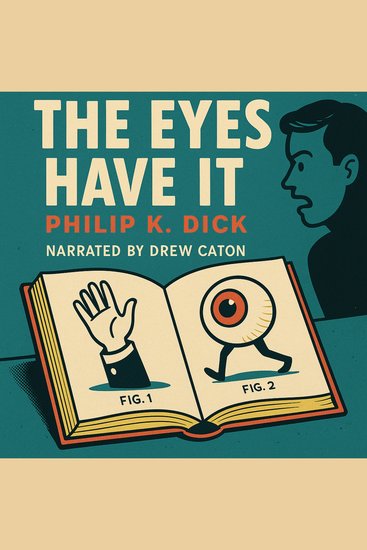
    When an unsuspecting reader opens a simple paperback, he discovers bizarre phrases that seem to describe humans casually removing eyes, hands, and limbs as if it were nothing. Horrified, he becomes convinced he has stumbled onto a hidden truth: alien beings who can detach their body parts walk among us — and the book is their confession. 
    What follows is a hilarious and unsettling descent into misunderstanding, speculation, and fear. With Dick’s trademark mix of satire, sci-fi curiosity, and slippery reality, the story skewers the way we interpret the world around us — and how easily imagination can outrun truth. 
    Narrated with sharp wit and perfect comic timing by Drew Caton, this short tale delivers a punch of classic speculative weirdness in just minutes. A must-listen for fans of retro sci-fi, humor with a paranoid twist, and the early works of Philip K. Dick.
    Show book
  • A Legend - From their pens to your ears genius in every story - cover

    A Legend - From their pens to...

    Alexander Kuprin

    • 0
    • 0
    • 0
    Alexander Kuprin was born in Narovchat, Penza in Russia on 7th September 1870. 
    At 3 his Father died and he and mother moved to Moscow. By 10 he was enrolled at the Second Moscow Military High School and there his interest in literature began. The Alexander Military Academy followed and two years later he was a sub-lieutenant and posted to an Infantry Regiment for a further four years. 
    Despite his duties he was a now a keen writer and published his first short story at this time. His military duties also garnered him experiences for his breakthrough work ‘The Duel’.  Leaving the military he left for Kiev to work for local newspapers.  He continued to publish both stories and novels and by 1901 he was in St Petersburg becoming part of a group that included Chekhov, Ivan Bunin, Maxim Gorky and Leonid Andreyev.  
    In the years that followed further controversial works and acclaim followed.  His comments on the regime meant he was also put under secret police surveillance.   
    As World War I erupted, Kuprin opened a military hospital but was then given command of an infantry company in Finland. He was soon discharged on grounds of ill health.  
    The October Revolution saw him praise Lenin, but he warned that the Bolsheviks threatened Russian culture and might cause further widespread suffering to the peasants.  As Civil War raged he took his family to Helsinki and then on to Paris. 
    Exile saw his talents decline further and his succumbing to alcoholism. He became lonely and withdrawn. The family's poverty increased his malaise.   
    In May 1937, the Kuprin’s returned to Moscow.  He now saw his work published but wrote almost nothing new.  In 1938 his health rapidly deteriorated.  Already suffering from a kidney problems and sclerosis, he had now developed cancer of the oesophagus.  
    Alexander Kuprin died on 25th August 1938.
    Show book
  • After Twenty years - From their pens to your ears genius in every story - cover

    After Twenty years - From their...

    O Henry

    • 0
    • 0
    • 0
    William Sydney Porter was born on 11th September 1862 in Greensboro, North Carolina. At age 3 his mother died from tuberculosis. From an early age it was clear Porter had a large appetite for reading as he absorbed the world around him. 
    He first attended at a school run by his aunt before enrolling at the Lindsey Street High School and then worked at his uncle’s drugstore and gained a pharmacists’ license in 1881.  
    A persistent cough took him to Texas in the hope that a change of climate would help his symptoms. He took on various types of work, initially from ranch hand and cook and then as varied as pharmacist, draftsman, bank teller and journalist. He also began to write, though for now, purely as a hobby. 
    He was a member of several singing and dramatic groups when he met 17 year old Athol Estes, daughter of a wealthy Austin family. Despite her mother’s objection owing to Athol’s tuberculosis, they began courting and in July 1887, they eloped and soon married. 
    Athol, impressed by his writing, encouraged him to get them published. A job as a draftsman at the Texas General Land Office paid a healthy $100 dollars per month and life was good. 
    But then life turned cruel. His son died a few hours after birth although a daughter, Margaret, came the following year.  His job had to be vacated but another was found at the First National Bank of Austin. The bank operated informally and Porter was careless in keeping the books. He lost that job but began writing for the humourous weekly The Rolling Stone and the Houston Post. Some time later the federal Bank auditors went through his former accounts and he was arrested on charges of embezzlement. 
    Porter fled the day before his trial to Honduras. Holed up for several months he began to write.  Athol had become too ill to travel to meet him and learning that her health was deteriorating he surrendered to the court in February 1897.  Bail was obtained so that he could stay with Athol during her final days.  
    Porter was sentenced to five years at the Ohio Penitentiary in Columbus. His pharmacy qualifications got him the job of night druggist.  His sentence also gave him time to write and publish fourteen short stories. In December 1899 in McClure’s Magazine he published a short story as O Henry.  
    He was released two years early in July 1901, and reunited with Margaret, now 11, in Pittsburgh.  He now began his most prolific period of writing; a short story per week for the New York World, while also publishing works in other magazines.  Eventually over 600 of his short stories were published. 
    Porter was a heavy drinker and in 1908 his health, which had deteriorated for several years, took a dramatic turn for the worse, as did his writing. 
    O Henry died of cirrhosis of the liver complicated by diabetes and an enlarged heart on 5th June 1910.<
    Show book
  • Poems In Prose - cover

    Poems In Prose

    Oscar Wilde

    • 0
    • 0
    • 0
    "Poems in Prose" is the collection of six prose poems  by Oscar Wilde published in 1894, including, in order: "The Artist," "The Doer of Good," "The Disciple," "The Master," "The House of Judgment" and "The Teacher of Wisdom."
     
    Oscar Wilde (October 16, 1854 - November 30, 1900) was an Irish poet and playwright. After writing in different forms throughout the 1880s, he became one of the most popular playwrights in London in the early 1890s. He is best remembered for his epigrams, plays, short stories, and his novel The Picture of Dorian Gray.
    Show book
  • Diary of a Lunatic - From their pens to your ears genius in every story - cover

    Diary of a Lunatic - From their...

    Leo Tolstoy

    • 0
    • 0
    • 0
    Leo Tolstoy was born in 1828 in the Russian province of Tula to a wealthy noble family. As a child, he had private tutors but he showed little interest in any formal education. When he went to the University of Kazan in 1843 to study oriental languages and law, he left without completing his courses.  Life now was relaxed and idle but with some writing also taking place.  Gambling debts forced an abrupt change of path and he joined the army to fight in the Crimean War.  He was commended for his bravery and promoted but was appalled at the brutality and loss of life.  He recorded these and other earlier experiences in his diaries which formed the basis of several of his works. 
    In 1852 ‘Childhood’ was published to immediate success and was followed by ‘Boyhood’ and ‘Youth’. 
    His experience in the army and the horrors he witnessed resulted in ‘The Cossacks’ in 1862 and the trilogy ‘Sevastopol Tales’. After the war he travelled around Europe, visiting London and Paris and meeting such luminaries as Victor Hugo and Charles Darwin.  
    It was now that Tolstoy began his masterpiece, ‘War and Peace’. Published in 1869 it was an epic work that changed literature. He quickly followed this with ‘Anna Karenina’.  
    These successes made Tolstoy rich and helped him accomplish many of his dreams but also brought problems as he grappled with his faith and the lot of the oppressed poor. These revolutionary views became so popular that the authorities now kept him under surveillance.  
    He led a life of asceticism and vegetarianism and put his socialist ideals into practice by establishing numerous schools for the poor and food programmes. He also believed in giving away his wealth, which caused much discord with his wife.  
    His writing continued to bring forth classics such as ‘The Death of Ivan Ilyich’ and many brilliant and incisive short stories such as ‘How Much Land Does A Man Need’.  
    In 1901 Tolstoy was excommunicated from the Church and controversially deselected for the Nobel Prize for Literature. 
    Whilst undertaking a pilgrimage by train in October 1910 with his daughter Aleksandra he caught pneumonia in the nearby town of Astapovo.  Leo Tolstoy died on November 9th, 1910, he was 82.
    Show book