Join us on a literary world trip!
Add this book to bookshelf
Grey
Write a new comment Default profile 50px
Grey
Subscribe to read the full book or read the first pages for free!
All characters reduced
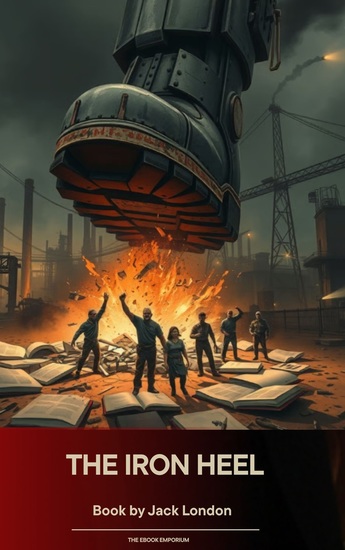
The Iron Heel - cover

The Iron Heel

Jack London

Publisher: The Ebook Emporium

  • 0
  • 0
  • 0

Summary

"The Iron Heel will walk upon our faces... and yet we must dream of the Brotherhood of Man."

Presented as the "Everhard Manuscript," a document discovered seven centuries in the future, The Iron Heel tells the story of the 20th-century collapse of democracy. The narrative follows Ernest Everhard, a charismatic labor leader, as he challenges the "Oligarchy"—a ruthless cabal of industrial titans who seize control of the United States. As the Oligarchy (the "Iron Heel") crushes dissent with private armies and secret police, Everhard and his wife Avis are driven into a violent underground resistance. This is a visceral, high-stakes exploration of class warfare, revolutionary fervor, and the terrifying resilience of absolute power.

A Blueprint for Dystopia: London's vision is unique because it doesn't just show the fall; it explains the mechanics of how a superpower turns into a police state. From the manipulation of the press to the creation of "Labor Castes" designed to divide the working class, London's political insights remain startlingly relevant to the modern age.

The "People of the Abyss": The novel's climax, featuring the "Chicago Commune," is one of the most intense sequences in political fiction. London portrays the raw, desperate fury of the downtrodden as they face the high-tech weaponry of the state. It is a sobering reminder of the human cost of systemic inequality and the enduring hope for a more just world.

Read the book that inspired the masters of dystopia. Purchase "The Iron Heel" today.
Available since: 01/09/2026.
Print length: 218 pages.

Other books that might interest you

  • End of the Young Family Feud The (Unabridged) - cover

    End of the Young Family Feud The...

    L. M. Montgomery

    • 0
    • 0
    • 0
    Lucy Maud Montgomery (November 30, 1874 - April 24, 1942), published as L. M. Montgomery, was a Canadian author best known for a series of novels beginning in 1908 with Anne of Green Gables. The book was an immediate success. The title character, orphan Anne Shirley, made Montgomery famous in her lifetime and gave her an international following.
    The End of the Young Family Feud: A week before Christmas, Aunt Jean wrote to Elizabeth, inviting her and Alberta and me to eat our Christmas dinner at Monkshead. We accepted with delight. Aunt Jean and Uncle Norman were delightful people, and we knew we should have a jolly time at their house.
    Show book
  • The Island of Doctor Moreau - cover

    The Island of Doctor Moreau

    H. G. Wells

    • 0
    • 0
    • 0
    "Not to go on all-fours; that is the Law. Are we not Men?"
    
    After being shipwrecked in the South Pacific, Edward Prendick is rescued and brought to a remote island inhabited by the brilliant, exiled physiologist Dr. Moreau. There, Prendick discovers a nightmare beyond his wildest imagination: a population of grotesque "Beast Folk"—animals transformed into humanoid shapes through the agony of vivisection and surgical grafting. As Moreau attempts to "carve" the animal out of the beast, the primal instincts of his creations begin to resurface. This chilling masterpiece is a foundational text of biological horror that questions what truly separates humanity from the beasts of the field.
    
    The "Law" and the Divine Surgeon: At the heart of the novel is the "Law"—a series of chanted prohibitions meant to suppress the animal instincts of the Beast Folk. Moreau acts as a cruel, indifferent god, using pain as a tool for "civilization." Wells uses this premise to satirize religion, social conditioning, and the Victorian belief that science alone could perfect human nature.
    
    A Critique of Scientific Hubris: Dr. Moreau is the ultimate "mad scientist," driven by a cold, intellectual curiosity that completely ignores the suffering of his subjects. The novel remains startlingly relevant in the age of genetic engineering and organ transplantation, serving as a cautionary tale about the ethics of "playing God" with the building blocks of life.
    
    A Descent into the Primal: As the social order of the island collapses, Prendick is forced to confront the beast within himself. The novel's haunting conclusion, where the protagonist returns to London only to see the animal eyes and instincts in his fellow humans, is one of the most powerful and unsettling endings in English literature.
    
    Enter the House of Pain. Purchase "The Island of Doctor Moreau" today and discover the animal truth.
    Show book
  • The First Men in The Moon - cover

    The First Men in The Moon

    H. G. Wells

    • 0
    • 0
    • 0
    Britain won the Moon Race! Decades before Neal Armstrong took his "giant leap for mankind" two intrepid adventurers from Lympne, England, journeyed there using not a rocket, but an antigravity coating. Mr. Bedford, who narrates the tale, tells of how he fell in with eccentric inventor Mr. Cavor, grew to believe in his research, helped him build a sphere for traveling in space, and then partnered with him in an expedition to the Moon. What they found was fantastic! There was not only air and water but the Moon was honeycombed with caverns and tunnels in which lived an advanced civilization of insect-like beings. While Bedford is frightened by them and bolts home, Cavor stays and is treated with great respect. So why didn't Armstrong and later astronauts find the evidence of all this? Well, according to broadcasts by Cavor over the newly-discovered radio technology, he told the Selenites too much about mankind, and apparently, they removed the welcome mat! Herbert George Wells was an English writer. Prolific in many genres, he wrote more than fifty novels and dozens of short stories. His non-fiction output included works of social commentary, politics, history, popular science, satire, biography, and autobiography.
    Show book
  • The Ghost in the Cupboard Room - From their pens to your ears genius in every story - cover

    The Ghost in the Cupboard Room -...

    Wilkie Collins

    • 0
    • 0
    • 0
    Wilkie Collins was born on 8th January 1824 in Marylebone, London.  
    The family moved several times in his early years before, at 12, they travelled to France and Italy for 2 years where the sights and atmosphere made a deep and lasting impression on him. 
    He resumed his education at Mr Cole’s private boarding school in Highbury, Islington.  Here, he began his literary career under unusual circumstances: the school bully would give him no peace until he had been told a bedtime story.  This ‘little brute’ helped create one of England’s greatest writers.  
    On leaving school, in 1841, he became a clerk at a tea merchant before, 2 years later, publishing his first short story.  However, his first novel was rejected and remained so during his lifetime.  
    A brief stint at Lincoln’s Inn to please his father and to acquire a steady income was halted by his father’s death.  Collins then wrote and published his fathers’ memoirs.  He then completed his legal education though he would never practice.  
    In March 1851, he was introduced to Charles Dickens and there now started a period of sustained literary output and a remarkable lifelong friendship.  His stories were published in Dicken’s magazines, and he toured with Dicken’s theatrical before the two of them travelled to the Continent. 
    By the early 1860’s worrying signs of ill-health appeared with rheumatic gout.  As it worsened, he sought respite and cures in German spa towns and gave up writing to help his recuperation. 
    His personal life had become very complicated.  He was living with the widowed Caroline Graves and conducting an affair with a much younger Martha Rudd.  With the serialised release of ‘The Moonstone’ and vicious attacks of gout Caroline left him and married another.  Collins was now prescribed opium and was soon its lifelong dependent.  Martha bore him two children and with the return of a now divorced Caroline Graves he now divided his time between the two women. 
    In 1874 he set aside writing to tour North America on a reading tour. 
    Throughout his later years he continued to write and publish.  In all 30 novels, 14 plays, 60 short stories and over a 100 non-fiction essays as well as many more collaborations with Dickens. 
    In 1884 the Society of Authors elected him as it’s Vice-President. 
    Wilkie Collins died from a paralytic stroke on September 23rd, 1889, in London. He was 65.
    Show book
  • The Old Man in the Corner - cover

    The Old Man in the Corner

    Baroness Emma Orczy

    • 0
    • 0
    • 0
    Written by the author of The Scarlet Pimpernel, The Old Man in the Corner is a series of short detective stories centered in england. ""Mysteries!" he commented. "There is no such thing as a mystery in connection with any crime, provided intelligence is brought to bear upon its investigation."" and so begin Polly Burtons encounters with the mysterious old man in the corner of the ABC Cafe in Norfolk Street, who talks of murders and mysteries with such insight and always with admiration for the clever criminal. First published in 1908, these short stories, originally published seperately for Royal Magazine, are collected into a single anthology here.  
    Narrated by Michael Ward.
    Show book
  • Temptation of Harringay The (Unabridged) - cover

    Temptation of Harringay The...

    H. G. Wells

    • 0
    • 0
    • 0
    Herbert George Wells (21 September 1866 - 13 August 1946) was an English writer. Prolific in many genres, he wrote dozens of novels, short stories, and works of social commentary, history, satire, biography and autobiography. His work also included two books on recreational war games. Wells is now best remembered for his science fiction novels and is often called the "father of science fiction", along with Jules Verne and the publisher Hugo Gernsback.
    THE TEMPTATION OF HARRINGAY: It is quite impossible to say whether this thing really happened. It depends entirely on the word of R.M. Harringay, who is an artist.
    Show book