Join us on a literary world trip!
Add this book to bookshelf
Grey
Write a new comment Default profile 50px
Grey
Subscribe to read the full book or read the first pages for free!
All characters reduced
A Constitutional League of Peace in the Stone Age of America - Enriched edition The League of the Iroquois and Its Constitution - cover

A Constitutional League of Peace in the Stone Age of America - Enriched edition The League of the Iroquois and Its Constitution

J. N. B. Hewitt

Publisher: Good Press

  • 0
  • 0
  • 0

Summary

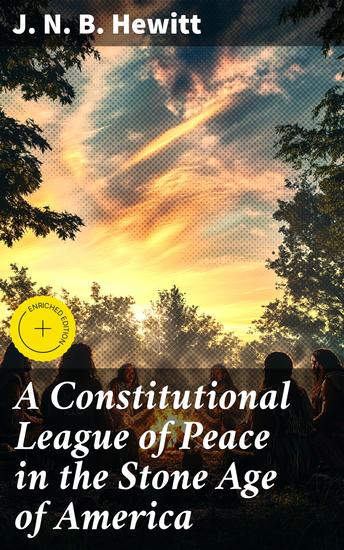
In "A Constitutional League of Peace in the Stone Age of America," J. N. B. Hewitt embarks on a profound exploration of social order and governance amidst prehistoric contexts. Through a unique blend of anthropological insight and imaginative speculation, Hewitt constructs a narrative that examines the foundational principles of democracy and collective governance as they might have existed in a society devoid of modern technology. His use of a vivid and allegorical literary style intertwines historical facts with ethereal musings, making the text both thought-provoking and accessible. As a work situated at the intersection of political theory and cultural anthropology, it invites readers to contemplate the evolution of human cooperation and conflict resolution long before the advent of writing and complex societal structures. J. N. B. Hewitt, an esteemed anthropologist and scholar, draws upon his extensive research into Native American cultures and their governance practices. His experiences studying tribal communities have undoubtedly shaped his understanding of political structures and their cultural implications, leading him to envision this striking hypothetical society. Hewitt's adept incorporation of folklore, cultural norms, and political philosophy serves to illustrate his vision of peace and harmony as foundational aspects of human interaction. This book is an essential read for scholars and general readers alike, illuminating the deep roots of democratic principles through a fascinating, speculative lens. "A Constitutional League of Peace in the Stone Age of America" invites you to ponder the universal quest for order and collaboration, urging readers to reflect on how these ancient ideals resonate in our contemporary world.

In this enriched edition, we have carefully created added value for your reading experience:
- Hand‐picked Memorable Quotes shine a spotlight on moments of literary brilliance.
- Interactive footnotes clarify unusual references, historical allusions, and archaic phrases for an effortless, more informed read.
Available since: 07/10/2023.
Print length: 25 pages.
Other books that might interest you

  • The Iron Cage - The Story of the Palestinian Struggle for Statehood - cover

    The Iron Cage - The Story of the...

    Rashid Khalidi

    • 0
    • 0
    • 0
    At a time when a lasting peace between the Palestinians and the Israelis seems unattainable, understanding the roots of their conflict is an essential step in restoring hope to the region. In The Iron Cage, Rashid Khalidi provides a lucid context for the realities on the ground today, a context that has been, until now, notably lacking in our discourse. 


    The story of the Palestinian search to establish a state begins in the mandate period immediately following the breakup of the Ottoman Empire, when fledgling Arab states were established by the colonial powers with assurances of eventual independence. But the British had already begun to construct an iron cage to hem in the Palestinians. The Palestinians' struggle intensified in the stretch before and after WWII, when colonial control of the region became increasingly unpopular, population shifts began with heavy Jewish immigration from Eastern Europe, and power began to devolve to the US. In this crucial period, Palestinian leaders continued to run up against the walls of the ever-constricting iron cage. They proved unable to achieve their long-cherished goal of establishing an independent state—a critical failure that set a course for the decades that followed. Rashid Khalidi's engrossing narrative of this torturous history offers much-needed perspective for anyone concerned about peace in the Middle East.
    Show book
  • Socrates: A short biography - 5 Minutes: Short on time - long on info! - cover

    Socrates: A short biography - 5...

    5 Minutes, 5 Minute Biographies,...

    • 0
    • 0
    • 0
    Socrates, Greek philosopher: Life and works in a short biography! Everything you need to know, brief and concise. Infotainment, education and entertainment at its best!
    Show book
  • The Shocking Truth about Educational Equity - cover

    The Shocking Truth about...

    Zoey Fraisers

    • 0
    • 0
    • 0
    Educational inequity remains one of the most pressing challenges facing modern society. Despite decades of effort to create equal opportunities for all students, disparities persist, especially along lines of race, socioeconomic status, and geography. These inequities are not merely abstract concepts but realities that shape the educational experiences of millions of children worldwide, with long-lasting effects on their futures. 
      
    At its core, educational inequity refers to the unequal distribution of resources, opportunities, and outcomes within the education system. It manifests in various forms, such as disparities in school funding, access to qualified teachers, availability of educational materials, and differences in academic performance across different student groups. For example, students from low-income families or rural areas often face additional barriers, including overcrowded classrooms, outdated textbooks, and limited access to extracurricular activities. Meanwhile, students from wealthier backgrounds tend to attend schools with better facilities, more advanced technology, and more specialized support. 
      
    The impact of these disparities is profound. Research shows that students who attend underfunded schools are more likely to experience lower academic achievement, higher dropout rates, and limited access to higher education. Additionally, the long-term effects of these inequities extend beyond the classroom, influencing future employment opportunities, income levels, and overall life outcomes. For marginalized communities, the cycle of inequality can be difficult to break, perpetuating systemic disadvantages that span generations.
    Show book
  • Meno - cover

    Meno

    Plato

    • 0
    • 0
    • 0
    Meno is a Platonic dialogue which addresses the question of whether virtue can be taught, and examines the concept of anamnesis. Through Socrates' questioning of Meno's slave, the dialogue suggests that knowledge is innate, with Socrates suggesting that all learning occurs through recollection of our prior knowledge rather than through instruction. Read in English, unabridged.
    Show book
  • The Mediatization of the OJ Simpson Case - From Reality Television to Filmic Adaptation - cover

    The Mediatization of the OJ...

    Tatjana Neubauer

    • 0
    • 0
    • 0
    F. Scott Fitzgerald once said: »Show me a hero, and I'll write you a tragedy.« In the 1990s, nobody fell deeper than O.J. Simpson. Once considered a national treasure, the athlete was accused of brutally slaying his ex-wife Nicole Brown and her friend Ronald Goldman on June 12, 1994. Within days, the media and public developed an unprecedented obsession with the story, turning a murder investigation and trial into a sensationalized reality show. Tatjana Neubauer examines the mediatization, deliberate manipulation, and the simplification of popular criminal trials for profit on television. She demonstrates that TV conflated legal proceedings into entertainment programming by commodifying events, people, and places.
    Show book
  • Slave Girls: The Cutting Girl - cover

    Slave Girls: The Cutting Girl

    Louise Allen

    • 0
    • 0
    • 0
    Slave Girls, a new series by bestselling author Louise Allen, reveals a shocking modern-day scandal of County Lines – the single most dangerous form of systematic child abuse prevalent today. 
     
    Charlotte - The Cutting Girl - comes from a family of high achievers. Her father is a politician, and her mother is a senior medical officer. 
     
    When she moves from her prestigious boarding school she is groomed by a girl two years her senior, spiralling into a cycle of drugs, self-harm and sexual abuse. 
     
    When she goes missing, five other girls do, too. A nationwide media campaign sets out to track them down, but can Charlotte ever escape the gang behind the abduction and abuse?
    Show book