Join us on a literary world trip!
Add this book to bookshelf
Grey
Write a new comment Default profile 50px
Grey
Subscribe to read the full book or read the first pages for free!
All characters reduced
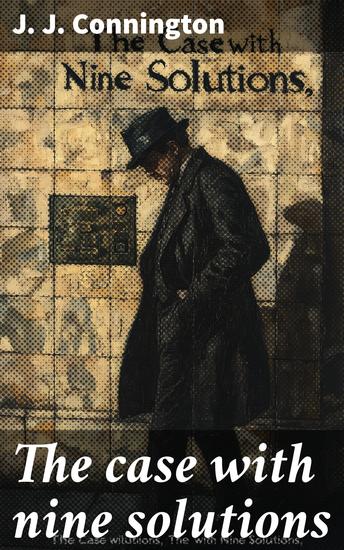
The case with nine solutions - cover

The case with nine solutions

J. J. Connington

Publisher: Good Press

  • 0
  • 0
  • 0

Summary

In "The Case with Nine Solutions," J. J. Connington skillfully weaves a complex narrative that challenges the reader to engage with intricate puzzles and deductive reasoning. Set against the backdrop of early 20th-century England, this detective novel employs a blend of clever misdirection and intellectual rigor, capturing the conventions of golden age crime fiction. The book's unique structure, featuring multiple solutions to a singular mystery, invites readers to explore the nuances of justice and morality while reveling in the clever characterizations typical of Connington's work. J. J. Connington, the pen name of the British author Alfred Walter Stewart, was a noted chemist as well as a writer, which greatly influenced his methodical approach to solving crimes in his novels. His academic background imbued his writing with a logical precision and a fascination for puzzles and mechanisms. These elements are at the forefront of "The Case with Nine Solutions," showcasing how Connington's dual passions informed a rich narrative worthy of scholarly investigation. This book is highly recommended for both fans of classic detective fiction and newcomers alike, as it not only offers a compelling story but also engages the reader's intellect. Dive into this literary puzzle, and experience the thrill of conspiracy and deduction as you uncover the 'nine solutions' for yourself.
Available since: 03/02/2025.
Print length: 110 pages.

Other books that might interest you

  • The History of Rasselas - cover

    The History of Rasselas

    Samuel Johnson

    • 0
    • 0
    • 0
    Above all, Samuel Johnson’s Rasselas (1759) is concerned with the nature of happiness. Rasselas and his companions remove themselves from the pleasure of the ‘happy valley’ so that they can make their ‘choice of life’. In the course of their travels they come across scholars, astronomers, shepherds, hermits and poets, explore their way of life. Rasselas finds that complete happiness is elusive and, in the words of his mentor Imlac, ‘while you are making the choice of life, you neglect to live’.In his treatment of this popular tale from the Orient, Johnson deploys his customary wit and perspicacity. Popular in its own day, Rasselas is a journey of the mind and soul, raising important questions concerning the human condition, which remain pertinent today.
    Show book
  • Miss Santa Claus - cover

    Miss Santa Claus

    Annie Fellows Johnston

    • 0
    • 0
    • 0
    We all know that Santa Claus has a large family in which to help him in the delivery of presents, peace, and good cheer. So what would you do if you were Miss Santa Claus and met two children on Christmas Eve traveling to a strange town to be reunited with their father and new stepmother? Why, naturally you would tell them the story of Princess Ina and a powerful charm they could use to turn their feared stepmother into a real mother. Follow the children as they learn to pick starflowers of obedience and kindness to make a mantle of love and become a real family. 
     
    A delightful Christmas book for children of all ages!
    Show book
  • Knulp - cover

    Knulp

    Hermann Hesse

    • 0
    • 0
    • 0
    Wandering from town to town, Knulp is the eternal vagabond who just does not want to settle down. Even in an aimless life, he realises, he has some purpose... 
    Knulp was Hesse's most popular book when it first came out. It remains one of his classic works: evocative, subtle and moving.
    Show book
  • Allan Quatermain - cover

    Allan Quatermain

    H. Rider Haggard

    • 0
    • 0
    • 0
    "Allan Quatermain" is an 1887 novel by H. Rider Haggard, featuring his recurring character Allan Quatermain. This adventure novel serves as the sequel to Haggard's earlier work, "King Solomon's Mines". Let's delve into the plot of this captivating tale:    Background:  Haggard wrote "Allan Quatermain" during his summer holiday in 1885, immediately after completing "King Solomon's Mines".  The novel was first serialized in Longman's Magazine before being published as a complete work.  Plot Summary:  At the beginning of the book, Allan Quatermain mourns the loss of his only son and longs to return to the wilderness.  He persuades his friends—Sir Henry Curtis, Captain John Good, and the Zulu chief Umslopogaas—to accompany him on an expedition.  Their journey takes them from the east coast of Africa into the territory of the Maasai.  While staying with a Scottish missionary named Mr. Mackenzie, they encounter a group of Maasai who kidnap Mr. Mackenzie's daughter.  The Maasai demand a life as ransom, but instead, the group launches a surprise attack, defeating the Maasai.  The adventurers then travel by canoe along an underground river to a sacred lake in the kingdom of Zu-Vendis.  In Zu-Vendis, they encounter a warlike race of white-skinned people ruled by two sisters, Nyleptha and Sorais.  Both sisters fall in love with Sir Henry Curtis, leading to a civil war.  After a victorious battle, Queen Nyleptha becomes the ruler, while Quatermain dies from a wound sustained in the fight.  Reception:  "Allan Quatermain" is considered one of Haggard's most successful works.  It exemplifies the lost-race novel genre, setting the stage for many subsequent works in this subgenre.  In this thrilling adventure, Allan Quatermain's courage and loyalty are put to the test as he navigates treacherous lands and encounters powerful queens. "
    Show book
  • New Machiavelli The (Unabridged) - cover

    New Machiavelli The (Unabridged)

    H. G. Wells

    • 0
    • 0
    • 0
    This work has been selected by scholars as being culturally important, and is part of the knowledge base of civilization as we know it. This work was reproduced from the original artifact, and remains as true to the original work as possible. Therefore, you will see the original copyright references, library stamps (as most of these works have been housed in our most important libraries around the world), and other notations in the work. This work is in the public domain in the United States of America, and possibly other nations. Within the United States, you may freely copy and distribute this work, as no entity (individual or corporate) has a copyright on the body of the work.As a reproduction of a historical artifact, this work may contain missing or blurred pages, poor pictures, errant marks, etc. Scholars believe, and we concur, that this work is important enough to be preserved, reproduced, and made generally available to the public. We appreciate your support of the preservation process, and thank you for being an important part of keeping this knowledge alive and relevant.
    Show book
  • In Our Time - cover

    In Our Time

    Ernest Hemingway

    • 0
    • 0
    • 0
    "In Our Time" is a collection of short stories by Ernest Hemingway, first published in 1925. The book is divided into two parts: the first consists of short vignettes, often referred to as "interchapters," while the second contains longer stories.  
    Set against the backdrop of World War I and the aftermath of the war, the collection explores themes of disillusionment, loss, and the struggle to find meaning in a chaotic world. Hemingway's spare, economical prose style, known for its understatement and minimalism, is on full display throughout the book. 
    The interchapters serve as interludes between the longer stories, providing glimpses into the lives of ordinary people and capturing moments of everyday existence. These vignettes offer insights into the human condition, often with a sense of detachment and stoicism. 
    The longer stories delve deeper into the lives of characters grappling with the effects of war, both physical and psychological. From soldiers coping with trauma to expatriates navigating the complexities of love and relationships, Hemingway paints a vivid portrait of individuals struggling to find their place in a world marked by violence and uncertainty. 
    "In Our Time" showcases Hemingway's mastery of the short story form and his ability to capture the essence of the human experience with precision and clarity. Through its exploration of themes such as war, trauma, and resilience, the collection remains a timeless work of literature that continues to resonate with readers today.
    Show book