Join us on a literary world trip!
Add this book to bookshelf
Grey
Write a new comment Default profile 50px
Grey
Subscribe to read the full book or read the first pages for free!
All characters reduced
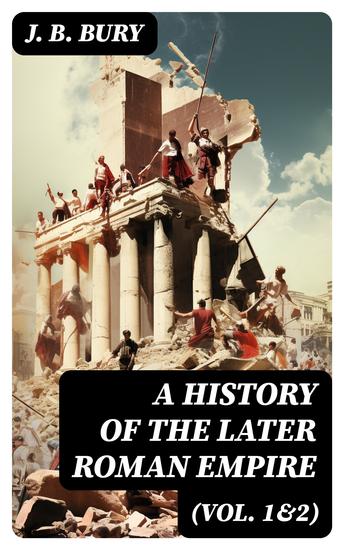
A History of the Later Roman Empire (Vol 1&2) - Enriched edition From the Death of Theodosius I to the Death of Justinian - German Conquest of Western Europe & the Age of Justinian - cover

A History of the Later Roman Empire (Vol 1&2) - Enriched edition From the Death of Theodosius I to the Death of Justinian - German Conquest of Western Europe & the Age of Justinian

J. B. Bury

Publisher: DigiCat

  • 0
  • 0
  • 0

Summary

In "A History of the Later Roman Empire," J. B. Bury delivers a meticulously researched and engaging narrative that explores the complexities of the Roman Empire during its transformative years from AD 284 to the fall of Constantinople in 1453. Bury's literary style is marked by a profound analytical approach, seamlessly weaving together political, social, and cultural dimensions of the period. He situates his study within the broader context of early 20th-century historiography, where the interplay of momentous events and figures—such as the reign of Emperor Diocletian and the rise of Byzantine influence—are examined with clarity and depth, offering readers a nuanced understanding of this critical juncture in history. J. B. Bury was a prominent historian and philologist whose scholarly work reflected a deep-seated interest in the dynamics of power and identity in the ancient world. His academic background and extensive travels across Europe enriched his understanding of the Roman Empire's legacy, allowing him to draw insightful connections between the past and contemporary issues. His engagement with classical literature and history informed his profound views on the evolution of civilization, making his analyses particularly poignant and relevant. I highly recommend "A History of the Later Roman Empire" to both historians and general readers alike. Bury's work not only serves as an essential reference for scholars but also provides an accessible yet profound exploration for those eager to understand the complexities of the Roman Empire's later phases. This seminal text remains a cornerstone for anyone seeking to grasp the intricate tapestry of history that shaped modern Europe.

In this enriched edition, we have carefully created added value for your reading experience:
- A succinct Introduction situates the work's timeless appeal and themes.
- The Synopsis outlines the central plot, highlighting key developments without spoiling critical twists.
- A detailed Historical Context immerses you in the era's events and influences that shaped the writing.
- A thorough Analysis dissects symbols, motifs, and character arcs to unearth underlying meanings.
- Reflection questions prompt you to engage personally with the work's messages, connecting them to modern life.
- Hand‐picked Memorable Quotes shine a spotlight on moments of literary brilliance.
- Interactive footnotes clarify unusual references, historical allusions, and archaic phrases for an effortless, more informed read.
Available since: 12/27/2023.
Print length: 992 pages.

Other books that might interest you

  • On Guerrilla Warfare - cover

    On Guerrilla Warfare

    Mao Tse-Tung

    • 0
    • 0
    • 0
    "On Guerrilla Warfare" by Mao Tse Tung is a foundational text that elaborates on the strategies and philosophies behind guerrilla warfare, authored by the revolutionary leader during the tumultuous period of the Chinese Civil War and the Japanese invasion of China in the 20th century. Mao's work is not just a military manual but a profound treatise on the application of guerrilla tactics as a form of irregular warfare by a smaller, mobile force against a larger, more conventionally equipped enemy. Through this work, Mao emphasizes the importance of political ideology, the support of the local population, and the use of the terrain to the guerrilla fighter's advantage. His insights into the interplay between politics and military strategy have made this work a staple reference in the study of revolutionary warfare and insurgency movements globally, influencing numerous conflicts and shaping the tactics of various liberation movements.
    Show book
  • A Rare Recording of Israeli Prime Minister Golda Meir - cover

    A Rare Recording of Israeli...

    Golda Meir

    • 0
    • 0
    • 0
    Golda Mabovitch Meir (May 3, 1898 - December 8, 1978) was an Israeli politician who served as the fourth prime minister of Israel from 1969 to 1974. She was Israel's first and only female head of government, the first female head of government in the Middle East, and the fourth elected female head of government or state in the world. Born in Kiev in the Russian Empire to Jewish parents, Meir immigrated as a child with her family to the United States in 1906. She graduated from the Milwaukee State Normal School and found work as a teacher. While in Milwaukee, she embraced the Labor Zionist movement and, in 1921, Meir and her husband emigrated to Mandatory Palestine. She was a signatory of the Israeli Declaration of Independence in 1948, and was elected to the Knesset in 1949. She served as Labor Minister until 1956, when she was appointed Foreign Minister by Prime Minister David Ben-Gurion. A controversial figure in Israel, Meir has been lionized as a founder of the state and described as the "Iron Lady" of Israeli politics, but also widely blamed for the country being caught by surprise during the war of 1973. 
     
    In this 1970 recording, Meir answers questions shortly after a Swissair Flight 330 from Zurich to Hong Kong, with a planned stopover in Tel Aviv, was brought down by a bomb planted by two PLO members soon after takeoff, killing all 47 passengers and crew.
    Show book
  • Hypnosis and Dark Psychology - How to Use Hypnosis Techniques to Analyze Influence and Persuade People With Manipulation Brainwashing and Mind Control Secrets That Only 1% of the Population Knows - cover

    Hypnosis and Dark Psychology -...

    Scott Habits

    • 0
    • 0
    • 0
    Do you want to drastically improve your persuasion skills, subtly influence the opinions of others, and build rapport effortlessly? Are you looking for an in-depth analysis of common hypnosis and dark psychology techniques, including mirroring, anchoring, and more? Then keep reading. 
    Hypnosis and dark psychology are used around us every day, whether we know it or not. Far from being a fringe practice that finds itself limited to therapy and stage hypnotists, the subtle psychological tricks used in hypnosis can be applied to your life to make you instantly more persuasive and influential. 
    This ultimate guide explores the foundations of hypnosis, offering you a practical look at how altering your words, body language, and subconscious cues can help you build rapport, become a better leader, and learn to read anybody you meet. 
    Here’s just a little of what you’ll discover inside:Why This Psychological Art Has The Potential To Transform Your LifeUnderstanding The Fundamentals of Hypnosis and Dark PsychologyThe Secret Behind Why Hypnosis Is So Effective13 Powerful Yet Simple Strategies For IMMEDIATELY Making Yourself More PersuasiveWays To Build Rapport and Become More Likeable16 Tips and Tricks For Direct Suggestion HypnosisTop Things To Avoid When Practicing Hypnosis!Hypnotherapy and Self-HypnosisAnd Much More! 
    Whether you want to become a master of the mind, rewire your own subconscious, or succeed in your career and professional life, the power of hypnosis is an often-overlooked yet highly effective way of transforming your social skills and persuasive abilities. Don’t let this opportunity pass you by – it’s time for you to discover how hypnosis will change your life. 
    So what are you waiting for? Download this audiobook now and become a master hypnotist today!
    Show book
  • Learning To Be Grateful - cover

    Learning To Be Grateful

    Jim Colajuta

    • 0
    • 0
    • 0
    According to the World Health Organization (WHO), mental health is a condition of well-being. Individuals recognize their own strengths, cope with daily challenges, work well, and contribute to their community.Gratitude has long been recognized as a desirable attribute that can improve one's well-being, from ancient religious texts to modern scientific evidence-based study. According to the evidence, the advantages of gratitude practice can be grouped into the following categories: increased happiness and life satisfaction; successful dealing with hardship; strengthened social relationships; improved health; and broadening civic, moral, and spiritual dimensions. On the other hand, gratitude is not an innate response to life conditions. It must be intentionally nurtured through gratitude-inducing activities.It's simple to see why focusing on what you have rather than what you don't is a good idea. Developing an appreciation for all of life's great qualities that you may have neglected allows you to focus on feelings of fulfillment, happiness, and abundance rather than longing, frustration, and bitterness. People who constantly reflect on their blessings are happier, better equipped to make decisions to improve their condition, and less prone to depression. People who start keeping a thankfulness journal regularly generally notice an improvement in their attitude. It's because gratitude lists are so popular. After all, they're a simple act that involves minimal effort yet yields tremendous effects.Most of us understand the importance of thanking those who assist us or simply acknowledging what we are grateful for in life. Gratitude has been connected to various benefits, including enhancing your immune system and sleep patterns, feeling more hopeful and experiencing more joy and pleasure, being more helpful and generous, and feeling less lonely and alienated, according to research. Gratitude is a means for people to appreciate what they already have rather than con
    Show book
  • Egyptian Science and Mathematics - Innovations of an Ancient Civilization - cover

    Egyptian Science and Mathematics...

    Omar Khalil

    • 0
    • 0
    • 0
    Egyptian civilization, one of the oldest in human history, made extraordinary contributions to various fields of knowledge, particularly science and mathematics. These innovations, which spanned thousands of years, helped shape the development of ancient society and continue to influence modern science and mathematics. In ancient Egypt, knowledge was not merely a tool for survival but an integral part of their spiritual and practical lives. From monumental structures like the pyramids to advancements in medicine and astronomy, Egyptian science and mathematics were not just theoretical pursuits; they were embedded in the daily lives of the people and their understanding of the world around them. 
    The ancient Egyptians developed a deep understanding of the natural world, building complex systems of mathematics and science that were essential for both practical and religious purposes. The sciences of astronomy, engineering, and medicine, along with an elaborate system of mathematics, formed the backbone of their civilization. These scientific endeavors were often linked to the Egyptians' strong religious beliefs, which saw the cosmos, time, and the earth as interconnected and governed by divine forces. This understanding led to the creation of highly sophisticated technologies and systems, such as the construction of the pyramids, the development of early medicine, and the creation of accurate calendars for agricultural and religious purposes.
    Show book
  • Self-Esteem - Reclaiming Confidence and Overcoming Self-Doubt (2 in 1) - cover

    Self-Esteem - Reclaiming...

    Anna Bridges

    • 0
    • 0
    • 0
    This book contains the following books:  
    Mirror, Mirror - The mirror, both literal and figurative, serves as a powerful symbol in this context. It is where we first encounter our reflection, yet it can also distort our sense of self, making us question whether we truly see who we are or merely a distorted version of reality. Body image—the way we perceive and feel about our physical appearance—often influences our thoughts, behaviors, and emotions. When this perception becomes negative, it can trigger harmful behaviors, such as restrictive eating, excessive exercising, or binge eating, leading to eating disorders like anorexia, bulimia, and binge eating disorder. 
    You’re Worth It - Believing in your own value is not an act of arrogance; it is an act of self-respect. When you truly believe in your worth, you stop settling for less than you deserve and start making choices that reflect the greatness within you. It is the foundation of every success, every achievement, and every meaningful connection you will make along the way. This belief becomes your driving force, propelling you through challenges and helping you navigate the inevitable obstacles life presents.
    Show book