Join us on a literary world trip!
Add this book to bookshelf
Grey
Write a new comment Default profile 50px
Grey
Subscribe to read the full book or read the first pages for free!
All characters reduced
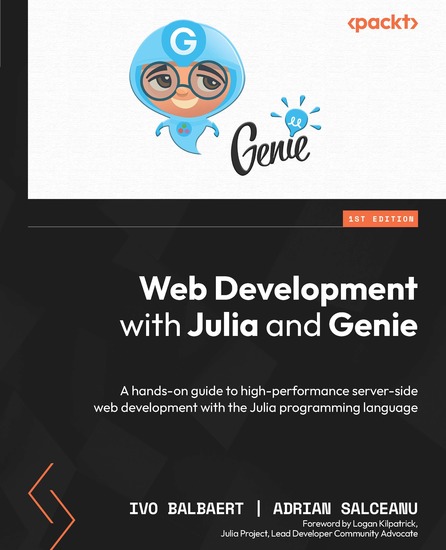
Web Development with Julia and Genie - A hands-on guide to high-performance server-side web development with the Julia programming language - cover

Web Development with Julia and Genie - A hands-on guide to high-performance server-side web development with the Julia programming language

Ivo Balbaert, Adrian Salceanu

Publisher: Packt Publishing

  • 0
  • 0
  • 0

Summary

Julia’s high-performance and scalability characteristics and its extensive number of packages for visualizing data make it an excellent fit for developing web apps, web services, and web dashboards. The two parts of this book provide complete coverage to build your skills in web development.
First, you'll refresh your knowledge of the main concepts in Julia that will further be used in web development. Then, you’ll use Julia’s standard web packages and examine how the building blocks of the web such as TCP-IP, web sockets, HTTP protocol, and so on are implemented in Julia’s standard library. Each topic is discussed and developed into code that you can apply in new projects, from static websites to dashboards. You’ll also understand how to choose the right Julia framework for a project. The second part of the book talks about the Genie framework. You’ll learn how to build a traditional to do app following the MVC design pattern. Next, you’ll add a REST API to this project, including testing and documentation. Later, you’ll explore the various ways of deploying an app in production, including authentication functionality. Finally, you’ll work on an interactive data dashboard, making various chart types and filters.
By the end of this book, you’ll be able to build interactive web solutions on a large scale with a Julia-based web framework.
Available since: 11/29/2022.
Print length: 254 pages.


Other books that might interest you

  • Does Coffee Cause Cancer? - And 8 More Myths About the Food We Eat - cover

    Does Coffee Cause Cancer? - And...

    Dr. Christopher Labos

    • 0
    • 0
    • 0
    In this fascinating, refreshingly clarifying book about food, food myths, and how sloppy science perpetuates misconceptions about food, a medical doctor on his way to a conference gets drawn into conversations that answer the following questions: Does vitamin C prevent the common cold? And if it works, why does it only work in Canadian soldiers, ultramarathon runners, and skiers? Was red meat really declared a carcinogen by the WHO? Does that mean I should become a vegetarian? And who decides what gets labeled as red meat and white meat? Is salt really not that bad for you and did a group of researchers really want to experiment on prisoners to prove the point? Does coffee cause cancer or heart attacks? Why did a California court say coffee needed a warning label? Is red wine really good for your heart, and what makes the French Paradox such a paradox? Why did the New England Journal of Medicine link eating chocolate with winning a Nobel Prize? Why were eggs once bad for you but now good for you again? Does that mean I don't need to worry about cholesterol? Should I be taking vitamin D?
    Show book
  • Data Cleaning and Preprocessing - The Foundation of Data Analysis - cover

    Data Cleaning and Preprocessing...

    Simon Winston

    • 0
    • 0
    • 0
    In the age of data-driven decision-making, the quality of your data is the foundation upon which all your insights and analyses are built. "Data Cleaning and Preprocessing: The Foundation of Data Analysis" is your essential guide to mastering the crucial yet often underestimated processes of cleaning and preparing data for meaningful analysis. 
    From data scientists and analysts to business professionals and researchers, anyone working with data can benefit from this comprehensive and accessible book. It demystifies the complex world of data cleaning and preprocessing, making it accessible to both beginners and experienced practitioners. 
    Discover the fundamental principles of data quality and learn how to identify and address common data issues, such as missing values, outliers, and inconsistent records. Dive into essential techniques for handling data imperfections, from data imputation to outlier detection, and explore the art of feature engineering and dimensionality reduction to enhance the predictive power of your data. 
    The book provides hands-on guidance for implementing data cleaning and preprocessing techniques using popular programming languages like Python, R, and SQL, with practical examples and code samples. You'll also gain insights into best practices, data quality assessment, and the latest trends in the field, including ethical considerations and the application of AI and machine learning to automate data cleaning. 
    "Data Cleaning and Preprocessing: The Foundation of Data Analysis" is the go-to resource for harnessing the true potential of your data. It's a must-read for anyone who understands that quality data is not a luxury but a necessity in the data-driven world we live in. Take control of your data, unlock its potential, and transform the way you approach data analysis with this indispensable guide. 
     
    Show book
  • Crimes Against Nature: Book Summary & Analysis - cover

    Crimes Against Nature: Book...

    Briefly Summaries

    • 0
    • 0
    • 0
    This is a concise summary and analysis of Crimes Against Nature, by  Robert F. Kennedy Jr.
    It is not the original book and is not affiliated with or endorsed by 
    Robert F. Kennedy Jr.
     
    Ideal those seeking a quick and insightful overview.
     
    Crimes Against Nature reveals the devastating effects of corporate greed and governmental corruption on the environment and public health. With a sharp focus on the collusion between powerful industries and regulatory agencies, this compelling exposé uncovers how environmental policies have been dismantled to prioritize profits over people and ecosystems. From polluted waterways to endangered wildlife, the book offers an urgent call to action for citizens to reclaim their rights and protect the planet for future generations.
    Show book
  • In Praise of Floods - The Untamed River and the Life It Bring - cover

    In Praise of Floods - The...

    James C. Scott

    • 0
    • 0
    • 0
    James C. Scott reframes rivers as alive and dynamic, revealing the consequences of treating them as resources for our profit Rivers, on a long view, are alive. They are born; they change; they shift their channels; they forge new routes to the sea; they move both gradually and violently; they can teem (usually) with life; they may die a quasi-natural death; they are frequently maimed and even murdered. It is the annual flood pulse—the brief time when the river occupies the floodplain—that gives a river its vitality, but it is human engineering that kills it, suppressing the flood pulse with dams, irrigation, siltation, dikes, and levees. In demonstrating these threats to the riverine world, award-winning author James C. Scott examines the life history of a particular river, the Ayeyarwady (Irrawaddy) of Burma, the heartland and superhighway of Burman culture. Scott opens our understanding of rivers to encompass their entirety—tributaries, wetlands, floodplains, backwaters, eddies, periodic marshlands, and the assemblage of life forms dependent on rivers for their existence and well-being. For anyone interested in the Anthropocene and the Great Acceleration, rivers offer a striking example of the consequences of human intervention in trying to control and domesticate a natural process, the complexity and variability of which we barely understand.
    Show book
  • Mastering Python: From Basics to Expert-Level Programming - Learn Python Step-by-Step with Practical Projects - cover

    Mastering Python: From Basics to...

    Amelia Hartman

    • 0
    • 0
    • 0
    "Mastering Python: From Basics to Expert-Level Programming: Learn Python Step-by-Step with Practical Projects" will help you unleash the potential of Python and advance your programming abilities. This thorough manual is intended to assist seasoned developers in advancing their skills and turning novices into competent programmers.  
    This book lays a solid foundation for your journey by guiding you through Python's syntax, variables, and control structures, starting with the foundations. As you advance, you will study intermediate subjects, including dealing with modules, handling errors, and object-oriented programming. Advanced ideas like decorators, APIs, and concurrency are explained in an easy-to-understand, step-by-step fashion for individuals who want to push themselves.  
    This book is unique since it takes a hands-on, project-based approach. You'll put your knowledge to use in practical situations by designing a web scraper, an API-based weather app, and a budget tracker. In addition to strengthening your comprehension, these practical assignments get you ready to tackle actual problems in work environments.  
    This book gives you the skills and information you need to succeed, whether your career goal is to become a data scientist, software developer, or someone who wants to automate processes and improve workflows. "Mastering Python" will help you become proficient in Python, not just learn it. Begin your adventure now and explore the countless potentialities of this potent programming language!
    Show book
  • Tyrannosaurus Rex The: The History of the World’s Most Famous Dinosaur - cover

    Tyrannosaurus Rex The: The...

    Editors Charles River

    • 0
    • 0
    • 0
    The massively popular 1990 novel Jurassic Park by Michael Crichton and its subsequent movie adaptations led to a huge resurgence in interest in dinosaurs and the prehistoric world. That interest continues to the present day, even though most of the dinosaurs in Jurassic Park weren’t actually from the Jurassic period. Triceratops, Velociraptor, Tyrannosaurus Rex and the huge sauropods such as Brachiosaurus that feature in the book and movies all actually belong to the Late Cretaceous period, more than 40 million years after the end of the Jurassic. Regardless, certain kinds of dinosaurs remain instantly recognizable, and among them, the “king” is undoubtedly the Tyrannosaurus.  
    	The first discovery of a Tyrannosaurus was made in 1902 and the largest carnivorous dinosaur ever found at the time quickly gripped the popular imagination. Even its name was dramatic - Tyrannosaurus Rex means “King of the Tyrant Lizards.” The T-Rex as it quickly became known didn’t appear until the last age of the Late Cretaceous period, the Maastrichtian, but when it did, it was the biggest and most terrifying of all the theropod predators. The T-Rex was around 13 feet tall at the hips (its tallest point since it isn’t believe to have stood upright), it was over 35 feet long, and it weighed about nine metric tons. Like most therapods, it had very powerful hind legs and much smaller fore legs, so the front legs look almost comically small. This dinosaur also had a large and powerful tail to counterbalance its very large head (some T-Rex skulls are nearly five feet long). Within the skull was a massive jaw lined with teeth up to a foot long. A reconstructive study has estimated that a T-Rex jaw was capable of exerting a pressure of over 55,000 Newtons; the equivalent of almost six tons of pressure. It was fast too, possibly capable of moving at speeds of up to 25 miles per hour. 
    Show book