Join us on a literary world trip!
Add this book to bookshelf
Grey
Write a new comment Default profile 50px
Grey
Subscribe to read the full book or read the first pages for free!
All characters reduced
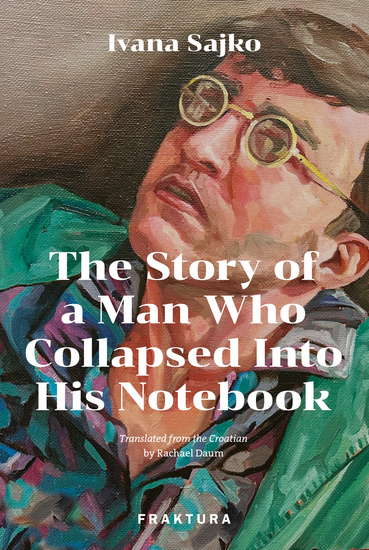
The Story of a Man Who Collapsed Into His Notebook - cover

The Story of a Man Who Collapsed Into His Notebook

Ivana Sajko

Publisher: Fraktura

  • 0
  • 2
  • 0

Summary

. . . I’ve forgotten how to travel, how to surrender to the favor and misfortune of the rails, how one says goodbye, how long one actually stands facing backward watching Point A swiftlydisappearing, and after that how long does he continue standing standing standing . . . I open my notebook, but I have no answer, I write: “traveling from Point A to Point B, from a littleseaside town to Berlin, I gaze out the window at the unfinished houses on the outskirts, warehouses in the industrial zone, stunted trees along the river with plastic bags hanging fromtheir branches like bats . . .”
 
Sajko teases out the mental state and personal history of the protagonist, posing departure as a major theme that serves as a touchstone not only for our region [of Southeastern Europe] but also for the times we are living in. —Antonela Marušić, Novosti
 
This is a stylistically superb novel, very readable. . . . And although this is a deeply personal text, it functions much more broadly, giving expression to the experiences, doubts, fears and all things encountered not only by this one, but a whole series of generations. —Matija Prica, booksa.hr
 
The Story of a Man Who Collapsed Into His Notebook is about departures, childhood, the end of a relationship and the vanishing possibility in today’s world of fleeing to a better place. Written in the first person, each chapter a single sentence, the novel is an internal soliloquy of self-examination, an excavation of a life punctuated by upheaval and loss, hope and disillusionment, ambition and failure. The reader joins the narrator on his journey, both on the train and in his mind—from disjointed memories triggered by his departure from home, through attempts to put his relationships and experiences in some kind of order to find meaning in them and perhaps assign blame, to confronting his most painful memories—finally arriving with him at his destination with a sense of clarity and the possibility of a new beginning.
Available since: 01/11/2024.
Print length: 128 pages.

Other books that might interest you

  • Cymbeline King of Britain - cover

    Cymbeline King of Britain

    William Shakespeare

    • 0
    • 0
    • 0
    Cymbeline, also known as The Tragedie of Cymbeline or Cymbeline, King of Britain, is a play by William Shakespeare set in Ancient Britain (c. 10–14)[a] and based on legends that formed part of the Matter of Britain concerning the early Celtic British King Cunobeline. Although listed as a tragedy in the First Folio, modern critics often classify Cymbeline as a romance or even a comedy. Like Othello and The Winter's Tale, it deals with the themes of innocence and jealousy. While the precise date of composition remains unknown, the play was certainly produced as early as 1611.
    Cymbeline, the Roman Empire's vassal king of Britain, once had two sons, Guiderius and Arvirargus, but they were stolen twenty years earlier as infants by an exiled traitor named Belarius. Cymbeline discovers that his only child left, his daughter Imogen (or Innogen), has secretly married her lover Posthumus Leonatus, a member of Cymbeline's court. The lovers have exchanged jewellery as tokens: Imogen with a bracelet, and Posthumus with a ring. Cymbeline dismisses the marriage and banishes Posthumus since Imogen — as Cymbeline's only child — must produce a fully royal-blooded heir to succeed to the British throne. In the meantime, Cymbeline's Queen is conspiring to have Cloten (her cloddish and arrogant son by an earlier marriage) married to Imogen to secure her bloodline. The Queen is also plotting to murder both Imogen and Cymbeline, procuring what she believes to be deadly poison from the court doctor. The doctor, Cornelius, is suspicious and switches the poison with a harmless sleeping potion. The Queen passes the "poison" along to Pisanio, Posthumus and Imogen's loving servant — the latter is led to believe it is a medicinal drug. No longer able to be with her banished Posthumus, Imogen secludes herself in her chambers, away from Cloten's aggressive advances.
    Although the play is named Julius Caesar, Brutus speaks more than four times as many lines as the title character; and the central psychological drama of the play focuses on Brutus' struggle between the conflicting demands of honour, patriotism, and friendship. 
    Among the most significant works William Shakespeare: Hamlet, Othello, King Lear, Macbeth, Orpheus, Romeo and Juliet, Julius Caesar, Troilus and Cressida, The Tempest, Venus and Adonis, Antony and Cleopatra, Measure for Measure, The Winter's Tale and many more.
    Show book
  • Rilke - Selected Poems - cover

    Rilke - Selected Poems

    Rainer Maria Rilke

    • 0
    • 0
    • 0
    Rainer Maria Rilke has been called the most significant and compelling poet of spiritual experience of the 20th century. His exploration of the struggle between life and art and the supremacy of divine love over personal love has touched the hearts of men and women everywhere. The poems in this reading are from the selected poetry of Rainer Maria Rilke, edited and translated by Stephen Mitchell.
    Show book
  • Power of Poetry The - Poems for Inner Peace - Calm your mind with insightful advice from our greatest wordsmiths - cover

    Power of Poetry The - Poems for...

    William Wordsworth

    • 0
    • 0
    • 0
    Life is frenetic.  Everything is running faster which usually means we are running later.  Everything should have been done 5 minutes ago or better still yesterday.  We are slowly falling behind, overwhelmed by busy lives in an ever-exacting world. 
     
    In these more modern times, time is everything.  There’s never enough of it. 
     
    So how do we slow down and become more comfortable with our lives, how do we find a balance?  Life shouldn’t just be one task after another.  Yes, a good life has to be worked for, found time for, but life should also be enjoyed and savoured. 
     
    One answer may lie in the past.  Classic poets down the decades and centuries have wisely observed that there are many things, both great and small, that bring a sense of stillness, an aura of calm, a chance to re-engage with our feelings and emotions purely by taking time for moments that matter.   
     
    With verse and poems from the likes of William Shakespeare, Alexander Pope, Mirabai, Tagore, Rumi and the calming balms of many others that soothe the soul and bring the inner peace we all need.
    Show book
  • The Top 10 Poets – The Scottish - Five poems each from some of the best poets ever born in Scotland - cover

    The Top 10 Poets – The Scottish...

    Robert Burns, Sir Walter Scott,...

    • 0
    • 0
    • 0
    The language of Poetry is an art that most of us attempt at some point in our lives.  Although its commonplace exposure has been somewhat marginalised in today’s often fast-paced lives we all recognise good verse that can empathise with our thoughts or open us up to experience new things in new ways, to better understand and to enjoy the many strands of our lives. 
    But finding a starting point can be overwhelming, even off-putting, so in this series we offer up our Top 10 classic poets, who brim with talent and verse, on a range of subjects and themes that we can all enjoy. 
    The wild, beautiful landscape and enduring history of Scotland has witnessed much over the centuries, from moments of great beauty to acts of wanton savagery.  These 10 poets are both testament and reflection of that history.
    Show book
  • Poets of the Early 20th Century The - Volume 2 - Find beauty and hope in a period ravaged worldwide by war - cover

    Poets of the Early 20th Century...

    Edna St Vincent Millay, TS...

    • 0
    • 0
    • 0
    In England the Victorian Age was about to become the past and a new age of worldwide wars of horror and slaughter would envelop and decimate generations, forever staining mankind.   
     
    The Century would see the World discover strengths. The Democracies would stand firm against Fascism and later Communism yet still keep its own elite and privileged in power and the rest of us underfoot. 
     
    The World was more connected than ever before.  Culture accelerated its kaleidoscopic and interwoven journey. Transport delivered people by car and train and then aeroplane to far flung corners of the globe.  Empires were at their zenith and ready to fragment with new nations, many troubled, rising from their decay. 
     
    The natural world continued to be plundered and pillaged for its resources by industries who pledged ‘more’ and ‘better’ and would clothe and feed a growing world yet sow the seeds now ready to devastate us in our current times. 
     
    The globe was as vibrant and violent as troubled and tarnished as it ever was.  But new ideas, new political systems, new times changed everything once again. 
     1 - The Poets of the Early Twentieth Century  - Volume 2 - An Introduction 
    2 - The Lions by Joseph Mary Plunkett 
    3 - 1841-1891 by Joseph Mary Plunkett 
    4 - If We Return by F W Harvey 
    5 - The Soldier Speaks by F W Harvey 
    6 - The Negro Soldiers by Roscoe C Jamison 
    7 - Into Battle by Julian Grenfell 
    8 - Prayer For Those on the Staff by Julian Grenfell 
    9 - Hymn by Fenton Johnson 
    10 - Tired by Fenton Johnson 
    11 - Sonnet I by Fernando Pessoa 
    12 - If, After I Die by Fernando Pessoa  
    13 - I Have A Rendezvous with Death by Alan Seeger 
    14 - All Thats Not Love by Alan Seeger 
    15 - Maktoob by Alan Seeger 
    16 - The Unseen Planets by Raymond Chandler 
    17 - The Poet's Knowledge by Raymond Chandler 
    18 - I Saw A Man This Morning by Patrick Shaw Stewart 
    19 - Whispers of Immortality by T S Eliot 
    20 - The Love Song of J Alfred Prufrock by T S Eliot 
    21 - Preludes by T S Eliot 
    22 - The Wounded Bird by Katherine Mansfield 
    23 - Stars by Katharine Mansfield 
    24 - A Fine Day by Katherine Mansfield 
    25 - I Taught Myself To Live Simply by Anna Akhmatova 
    26 - When I Write Poems by Anna Akhmatova 
    27 - Poetry by Claude McKay 
    28 - The White House by Claude McKay 
    29 - The Lynching by Claude McKay 
    30 - Strange Hells by Ivor Gurney 
    31 - Crucifix Corner by Ivor Gurney 
    32 - Serenade by Ivor Gurney 
    33 - Break of Day in the Trenches by Isaac Rosenberg 
    34 - Dead Man's Dump by Isaac Rosenberg 
    35 - August 1914 by Isaac Rosenberg 
    36 - Journey's End by Zora Neale Hurston 
    37 - The Dog Tupman by Stella Benson 
    38 - The Ballad of the Harp-Weaver by Edna St Vincent Millay 
    39 - My Heart Being Hungry by Edna St Vincent Millay 
    40 - What Lips My Lips Have Kissed, And Where, And Why by Edna St Vincent Millay 
    41 - Sonnet XVIII - I, Being Born a Woman by Edna St Vincent Millay 
    42 - Unity by Cesar Vallejo 
    43 - Love by Edith Sodergran 
    44 - On Foot I Had to Cross the Solar System by Edith Sodergran 
    45 - Insouciance by Richard Aldington 
    46 - Goodbye by Richard Aldington 
    47 - Grey Hairs by Marina Ivanova Tsvetaeva 
    48 - Lady with Camelias by Marina Ivanova Tsvetaeva 
    49 - To Mother by Marina Ivanova Tsvetaeva 
    50 - Back To Rest by Lietenant William Noel Hodgson MC 
    51 - Before Action  by Lieutenant William Noel Hodgson MC 
    52 - Past One O'Clock by Vladimir Mayakovsky 
    53 - So This Is How I Turned into a Dog by Vladamir Mayakovsky 
    54 - Verse for a Certain Dog by Dorothy Parker 
    55 - A Dream Lies Dead by Dorothy Parker<p
    Show book
  • Quber Wisdom - cover

    Quber Wisdom

    Yvette A. Gagnon

    • 0
    • 0
    • 0
    From best selling author Yvette Gagnon, author of Don’t Let Anyone Steal Your Light, comes Quber Wisdom. A collection of stories from her experiences as a rideshare driver. You will feel like you are in the passenger seat as you take a journey with Yvette through some of her most memorable rides. You’ll laugh, cry and be on the edge of your seat as you read through the fun, inspirational, uncertain and even life changing accounts. Buckle your seatbelt and come along for the ride!
    Show book