Join us on a literary world trip!
Add this book to bookshelf
Grey
Write a new comment Default profile 50px
Grey
Subscribe to read the full book or read the first pages for free!
All characters reduced
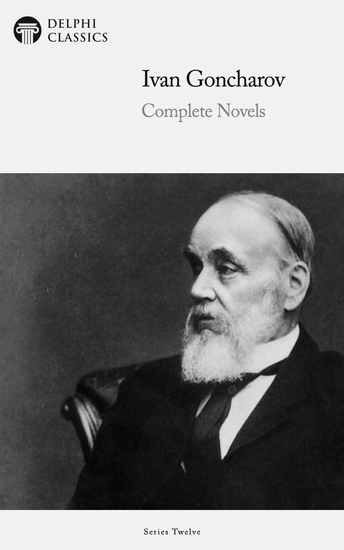
Delphi Complete Novels of Ivan Goncharov (Illustrated) - cover

Delphi Complete Novels of Ivan Goncharov (Illustrated)

Ivan Goncharov

Publisher: Delphi Publishing Ltd

  • 0
  • 0
  • 0

Summary

The Russian master Ivan Goncharov wrote highly esteemed novels that dramatise social change in Russia and feature vivid and memorable characters. His masterpiece ‘Oblomov’ (1859) is widely regarded as one of the most important Russian novels, drawing a powerful contrast between the aristocratic and capitalistic classes and attacking the way of life based on serfdom. The hero, Oblomov, a generous but indecisive young nobleman, is one of the most celebrated nineteenth century characters of world literature. This eBook presents Goncharov’s complete novels, with numerous illustrations and informative introductions. (Version 1)
 
* Beautifully illustrated with images relating to Goncharov’s life and works* Concise introductions to the novels and other texts* All the novels, with individual contents tables* Images of how the books were first published, giving your eReader a taste of the original texts* Excellent formatting of the texts* Features a brief biography
 
Please note: sadly, there are no available translations of Goncharov’s short stories or non-fiction.
 
CONTENTS:
 
The NovelsA Common Story (1847) (Translated by Constance Garnett, 1894)Oblomov (1859) (Translated by C. J. Hogarth, 1915)The Precipice (1869) (Translated by M. Bryant, 1914)
 
The BiographyBrief Biography of Ivan Goncharov (1911)
 
Please visit www.delphiclassics.com to browse through our range of exciting titles or to purchase this eBook as a Parts Edition of individual eBooks
Available since: 03/19/2022.

Other books that might interest you

  • Cohen of Trinity - From their pens to your ears genius in every story - cover

    Cohen of Trinity - From their...

    Amy Levy

    • 0
    • 0
    • 0
    Amy Levy was born in London, England in 1861, the second of seven in a fairly wealthy Anglo-Jewish family. The children read and participated in secular literary activities and became firmly integrated into Victorian life. 
    Her education was at Brighton High School, Brighton, before studies at Newnham College, Cambridge; she was the first Jewish student when she arrived in 1879, but left after four terms. 
    Amy’s writing career began early; her poem ‘Ida Grey’ appeared when she was only fourteen. Her acclaimed short stories ‘Cohen of Trinity’ and ‘Wise in Their Generation,’ were published by Oscar Wilde in his magazine ‘Women's World’. 
    Her poetic writings reveal feminist concerns; ‘Xantippe and Other Verses’, from 1881 includes a poem in the voice of Socrates's wife. ‘A Minor Poet and Other Verse’ from 1884 comprises of dramatic monologues and lyric poems. 
    In 1886, Amy began a series of essays on Jewish culture and literature for the Jewish Chronicle, including ‘The Ghetto at Florence’, ‘The Jew in Fiction’, ‘Jewish Humour’ and ‘Jewish Children’. 
    That same year while travelling in Florence she met the writer Vernon Lee. It is generally assumed they fell in love and this inspired the poem ‘To Vernon Lee’. 
    Her first novel ‘Romance of a Shop’, written in 1888 is based on four sisters who experience the pleasures and hardships of running a London business during the 1880s. This was followed by Reuben Sachs (also 1888) and concerned with Jewish identity and mores in the England of her time and was somewhat controversial. 
    Her final book of poems, ‘A London Plane-Tree’ from 1889, shows the beginnings of the influence of French symbolism. 
    Despite many friendships and an active life, Amy suffered for many years with serious depressions and this, together with her growing deafness, led her to commit suicide by inhaling carbon monoxide on September 10th, 1889. She was 27.
    Show book
  • The Call of the Wild - cover

    The Call of the Wild

    Jack London

    • 0
    • 0
    • 0
    A stolen dog. A frozen wilderness. A primal call he can't ignore.
    When Buck is torn from his comfortable home and thrust into the brutal world of the Klondike, he must learn to fight, lead, and survive amid savage cold, ruthless men, and rival dogs. Each trial awakens something ancient within him—the instinct to run free, to hunt, to answer the wild's irresistible song.
    
    Praised as "one of the most powerful adventure novels ever written," Jack London's masterpiece explores loyalty, instinct, transformation, and the fierce beauty of nature. Its emotional intensity and unforgettable imagery continue to captivate readers of all ages.
    
    If you love gripping wilderness survival, animal-centered storytelling, and journeys that reveal the heart's deepest truths, this classic will stay with you long after the last page.
    
    Open the book—and follow Buck as he discovers who he was always meant to be.
    Show book
  • Tom Sawyer Detective - cover

    Tom Sawyer Detective

    Mark Twain

    • 0
    • 0
    • 0
    In Tom Sawyer, Detective, Tom attempts to solve a mysterious murder in this satirical take on the immensely popular detective novels of the 1800s. Like The Adventures of Huckleberry Finn, the story is told in the first-person narrative voice of Huck Finn.
    
    Mark Twain, whose real name was Samuel Clemens, was the celebrated author of several novels, including two major classics of American literature: The Adventures of Tom Sawyer and Adventures of Huckleberry Finn. He was also a riverboat pilot, journalist, lecturer, entrepreneur, and inventor.
    Show book
  • Death in the Woods - From their pens to your ears genius in every story - cover

    Death in the Woods - From their...

    Sherwood Anderson

    • 0
    • 0
    • 0
    Sherwood Anderson was born on 13th September 1876 in Camden, Ohio. 
    When his father’s business failed the family was forced to move on a regular basis before finally settling in Clyde, Ohio.   
    Anderson, one of 7 children, left school at 14 to take a number of jobs to help with the family finances. These were difficult years. 
    He moved to Chicago in search of opportunities before joining the Army for the US-Spanish War of 1898.  He then entered Wittenberg Academy in Springfield, Ohio to complete his education before moving back to Chicago to take up a writing job. 
    In 1904 he married Cornelia Lane, her family had resources and Anderson was keen, with this family backing, to run a business. 
    The early years of their marriage produced 3 children but a nervous breakdown in 1907 and another in 1912, despite his success as a business entrepreneur, resulted in him abandoning his family and deciding that a literary career would be best for him.   
    A move back to Chicago resulted in a job in advertising, a divorce from Cornelia and marriage to Tennessee Mitchell.  
    That same year his first book ‘Windy McPherson’s Son’ was released and in 1919, his most famous book, ‘Winesburg, Ohio’, a collection of short stories about life in an Ohio town was released. 
    Anderson continued to write short stories, novels and non-fiction but his only true bestseller came with ‘Dark Laughter’.  His influence on writers that followed, from Faulkner to Hemingway, was immense. He also married a further two times.   
    Sherwood Anderson died in in Colón, Panama, on the 8th March, 1941. He was 64. An autopsy revealed that a swallowed toothpick had resulted in peritonitis. 
    His headstone epitaph reads ‘Life, Not Death is the Great Adventure.’
    Show book
  • Henry James - A Short Story Collection - American born British author James was nominated for a Nobel Prize three times here we have an amazing short story collection of his - cover

    Henry James - A Short Story...

    Henry James

    • 0
    • 0
    • 0
    Henry James was born 15th April 1843 in New York City. 
     
    His youth was spent travelling with his family receiving what was an "extraordinarily haphazard and promiscuous" education as they journeyed through London, Paris, Geneva, Boulogne-sur-Mer and Newport, Rhode Island, according to the father's current interests and publishing ventures. James studied primarily with tutors and only briefly attended schools.    
     
    Undoubtedly the quality of his writing has ensured his name is enshrined in the American literary tradition.  
     
    James was a committed Anglophile and spent most of his adult life as an expatriate in Europe.  Many of his novels juxtapose the Old World with the New World. Classics such as ‘The Portrait of a Lady’, ‘Daisy Miller’ and ‘The Ambassadors’, display the entanglement between American and European cultures and mentalities. They highlight the differences between the two worlds through following the experiences of American expatriates in Europe.  
     
    A prolific author he was able to easily move across genres to create vivid and totally real worlds and situations and to offer sophisticated observations of human relations as well as realistic, social criticism. 
    As a critic James was unafraid to venture into reviews and essays of those other literary giants around him.  These together with his short stories and, of course, classic novels, make Henry James an author to be not only admired but read, and read often.  
     
    In 1915 Henry James became a British citizen. 
     
    On 28th February 1916, at the age of 72, Henry James died in Chelsea, London. 
     
    He was nominated for the Nobel Prize in Literature in 1911, 1912 and 1916. He never won.
    Show book
  • The Mysterious Stranger and Other Stories - cover

    The Mysterious Stranger and...

    Mark Twain

    • 0
    • 0
    • 0
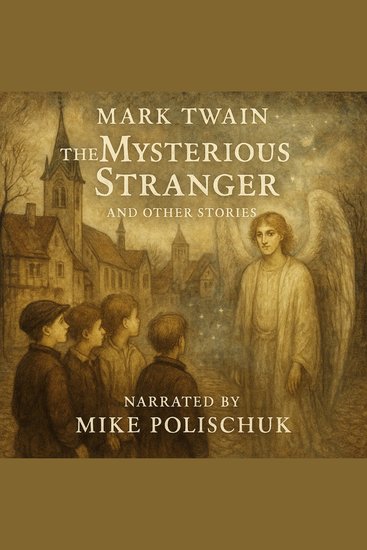
    Step into a world where innocence meets the infinite, and the everyday collides with the supernatural. The Mysterious Stranger and Other Stories represents Mark Twain at his most philosophical, daring, and haunting. Far removed from his lighthearted tales of riverboats and boyhood adventures, Twain here explores the mysteries of existence, morality, and the fragile nature of human belief. 
    Set in a secluded medieval Austrian village, the title story follows young Theodor Fischer and his friends as they encounter a mysterious visitor—an ethereal being calling himself “Satan.” What begins as childlike fascination soon spirals into a confrontation with unsettling truths about humanity, faith, suffering, and the illusions that bind us. 
    Alongside this profound tale, Twain’s accompanying stories further probe the absurdity, beauty, and cruelty of the world, blending satire, spirituality, and dark humor in only the way Twain can. 
    Narrated with thoughtful depth by Mike Polischuk, this audiobook invites listeners into a quiet, eerie, and unforgettable meditation on what it means to be human—seen through Twain’s final and most provocative lens. 
    Prepare for a journey that is mesmerizing, unsettling, and impossible to shake.
    Show book