Join us on a literary world trip!
Add this book to bookshelf
Grey
Write a new comment Default profile 50px
Grey
Subscribe to read the full book or read the first pages for free!
All characters reduced
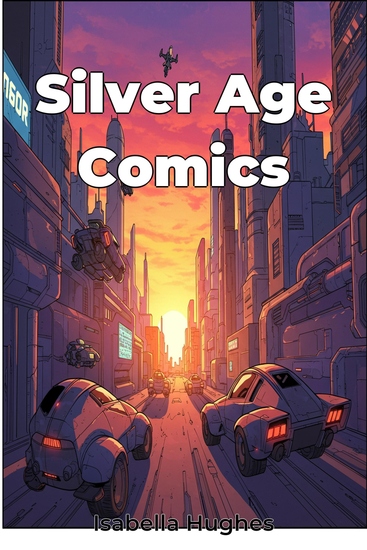
Silver Age Comics - cover

Silver Age Comics

Isabella Hughes

Translator A AI

Publisher: Publifye

  • 0
  • 0
  • 0

Summary

"Silver Age Comics" explores the revitalization of superhero comics during the 1950s and 1960s, a period marked by innovative storytelling and artistic evolution. This era saw the reinvention of the superhero genre, reflecting the anxieties of the Cold War and the social shifts of the time. The book highlights how publishers like Marvel and DC introduced complex characters grappling with personal struggles, moving away from the one-dimensional heroes of the Golden Age.

 
The book examines narrative innovation, character development, and artistic evolution across its chapters. It analyzes the shift to intricate storylines, serialized storytelling, and shared universes, enhancing reader engagement.

 
The artistic evolution section dives into the influence of pop art, increased realism, and innovative use of color, demonstrating how artists pushed creative boundaries.

 
Ultimately, "Silver Age Comics" underscores the lasting influence of this period on contemporary comic book storytelling, film adaptations, and visual culture, offering a comprehensive view of a pivotal era.
Available since: 03/10/2025.
Print length: 57 pages.

Other books that might interest you

  • Science and Politics - cover

    Science and Politics

    Ian Boyd

    • 0
    • 0
    • 0
    The recent coronavirus pandemic proved that the time-old notion seems now truer than ever: that science and politics represent a clash of cultures. But why should scientists simply "stick to the facts" and leave politics to the politicians when the world seems to be falling down around us? 


    Drawing on his experience as both a research scientist and an expert advisor at the center of government, Ian Boyd takes an empirical approach to examining the current state of the relationship between science and politics. He argues that the way politicians and scientists work together today results in a science that is on tap for ideological (mis)use, and governance that fails to serve humanity's most fundamental needs. Justice is unlikely—perhaps impossible—while science is not a fully integrated part of the systems for collective decision-making across society. 


    In Science and Politics, Boyd presents an impassioned argument for a series of conceptual and structural innovations that could resolve this fundamental tension, revealing how a radical intermingling of these (apparently contradictory) professions might provide the world with better politics and better science.
    Show book
  • The One-Idea Rule - An Efficient Way to Improve Your Writing at School and Work - cover

    The One-Idea Rule - An Efficient...

    PhD Mark Rennella

    • 0
    • 0
    • 0
    After a thirty-year career as a writer, instructor, and editor, Mark Rennella has crafted a battle-tested method to help students and young professionals who want to improve their writing: the One-Idea Rule, anchored on the assertion that every component of a successful piece of writing should express only one idea. 


    With The One-Idea Rule, writers embarking on their adult lives and professional journeys will have a reliable methodology they can easily remember and count on for all of their writing tasks, as well as increased confidence about the cogency of their writing and its potential for impact in the public sphere. 


    Most advice about writing looks like a long laundry list of dos and don'ts. For those already accomplished as writers, these lists can be a helpful addition to an already-developed communication style. But for teens starting college and young professionals entering the workforce, it can be challenging to wield such complex advice to tackle increasingly demanding writing assignments. 


    The One-Idea Rule is a writing primer aligned and empathetic with any young writer's needs.
    Show book
  • Biggest Tank Battles of the World Wars The: Tank Warfare in History’s Deadliest Conflicts - cover

    Biggest Tank Battles of the...

    Charles River Editors

    • 0
    • 0
    • 0
    World War I was the first truly industrial war, and it created a paradigm which reached its zenith with World War II and towards which virtually all equipment, innovation and training were dedicated throughout the Cold War and the remainder of the 20th century. To this day, modern warfare remains synonymous with tanks and mass infantry battles, although a confrontation of this nature has not occurred (except briefly during Operation Desert Storm) since World War II.  
    	One of the most important breakthroughs in military technology associated with World War I, and certainly the one that continues to capture the public imagination, was the introduction of a war machine that came to dominate the face of land battles throughout most of the 20th century: the tank. As a concept, it was not revolutionary; in fact, it harkened back to classical antiquity and to the Middle Ages, such as the covered battering rams and testudos which had made frequent appearances on ancient battlefields. In essence, it was designed to solve the age-old problem of protecting infantry from enemy projectiles while remaining mobile.  
    	The development of both modern artillery and machine guns, as well as the stalemate engendered by heavy fortifications and entrenchments, had hamstrung the mobility of infantry and cavalry and also left them both utterly vulnerable to defensive firepower. Since they were incapable of replying in kind, the tank was designed to bridge that gap. The tank’s armor, thick enough to withstand lateral fragmentation from exploding shells (although not direct hits) also made it virtually invulnerable to enemy rifle and machine gun fire, and its large tread meant that it could bridge trenches which would, at the very least, have delayed infantry substantially. As for the barbed wire entanglements and obstacles that severely delayed infantry and exposed them to enemy fire, tanks could simply drive right through it. 
    Show book
  • Summary: Hidden Potential - The Science of Achieving Greater Things By Adam Grant: Key Takeaways Summary and Analysis - cover

    Summary: Hidden Potential - The...

    Brooks Bryant

    • 0
    • 0
    • 0
    DISCLAIMER: THIS IS NOT THE OFFICIAL BOOK. 
    This is a summary, and it does not accompany the official 
    "Hidden Potential: The Science of Achieving Greater Things" by Adam Grant challenges the notion of talent worship in our society. While we often celebrate those with innate advantages, Grant reminds us of our capacity for growth and skill development. He presents a fresh perspective on raising aspirations and exceeding expectations, emphasizing that progress is more about effective learning than sheer effort. Grant's book draws on compelling evidence and stories from various contexts, illustrating that our potential is not determined solely by our innate genius but by the character we cultivate. He explores how to develop the character skills and motivations necessary to unlock our hidden potential and design systems that offer opportunities to those who have been underrated or overlooked. Ultimately, the book inspires readers to focus on the journey of personal growth rather than fixating on the peak they aim to reach.
    Show book
  • GED Study Guide - Elevate your GED Study Guide prep with dynamic audio lessons crafted for peak test success! - cover

    GED Study Guide - Elevate your...

    Marius Brackenmere

    • 0
    • 0
    • 0
    GED Study Guide 
     ⭐⭐ Simplified Guide & Explanations Included  ⭐⭐ 
    Are you aspiring to advance in your career and reinforce your knowledge by successfully passing the GED Exam? 
    Looking for a thorough resource that covers all the necessary aspects to excel in the GED Exam? 
    Your search ends here! 
    This guide is your ultimate companion for enhancing your understanding, applying your skills, and participating in practical exercises. With this guide in hand, you're on the path to success. 
    Updated for the GED Exam Structure. 
    Key Highlights of this Comprehensive Guide: 
    - In-depth insights into the GED Exam Certification 
    - Clear and detailed breakdown of the GED 
    - Effective strategies for exam preparation and problem-solving 
    Our guide stands out due to its extensive coverage, which is critical for your exam success. Concepts are explored in depth rather than merely brushed over. 
    Please note, this guide is an independent resource and has no affiliation with any official GED entity. 
    Crafted with a logical structure and user-friendly language, our GED Exam Guide ensures smooth transitions between topics. Say farewell to complicated jargon and embrace clear, precise, and accurate content. 
    So, what are you waiting for? Click the BUY NOW button, secure your guide, and embark on your journey to GED Exam success! 
    This guide is designed to empower you with meaningful insights for genuine growth and connections.
    Show book
  • Telling Lies - Clues to Deceit in the Marketplace Politics and Marriage - cover

    Telling Lies - Clues to Deceit...

    Paul Ekman

    • 0
    • 0
    • 0
    From breaking the law to breaking a promise, how do people lie and how can they be caught? 


    In this revised edition, Paul Ekman, a renowned expert in emotions research and nonverbal communication, adds a new chapter to present his latest research on his groundbreaking inquiry into lying and the methods for uncovering lies. Ekman has figured out the most important behavioral clues to deceit; he has developed a one-hour self-instructional program that trains people to observe and understand "micro expressions"; and he has done research that identifies the facial expressions that show whether someone is likely to become violent—a self-instructional program to train recognition of these dangerous signals has also been developed. 


    Telling Lies describes how lies vary in form and how they can differ from other types of misinformation that can reveal untruths. It discusses how a person's body language, voice, and facial expressions can give away a lie but still fool professional lie hunters—even judges, police officers, drug enforcement agents, and Secret Service agents.
    Show book