

¡Acompáñanos a viajar por el mundo de los libros!
Añadir este libro a la estantería
Grey
Escribe un nuevo comentario Default profile 50px
Grey
Suscríbete para leer el libro completo o lee las primeras páginas gratis.
All characters reduced
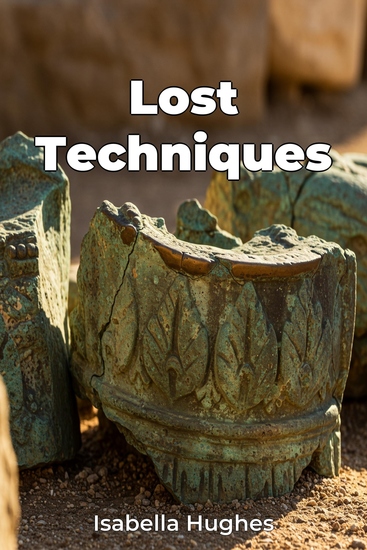
Lost Techniques - cover

Lost Techniques

Isabella Hughes

Traductor A AI

Editorial: Publifye

  • 0
  • 0
  • 0

Sinopsis

Lost Techniques explores the fascinating world of ancient sculpting methods and their surprising revival by modern artists. It argues that re-engaging with these historical techniques provides a bridge to innovation, offering a deeper understanding of form and artistic intention. The book highlights intriguing facts, such as the intricate indirect lost-wax casting perfected by the Greeks and the Romans' ambitious methods for crafting colossal bronze statues.

 
The book begins by establishing a historical context, tracing sculpting's evolution from early civilizations to the Renaissance. It then delves into specific lost techniques, examining materials, tools, and processes. Through case studies and artist interviews, Lost Techniques demonstrates how modern sculptors blend ancient knowledge with contemporary technology. It connects archaeology, materials science, and art history, offering a comprehensive yet accessible look at these rediscovered methods and their impact on contemporary art.
Disponible desde: 26/02/2025.
Longitud de impresión: 51 páginas.

Otros libros que te pueden interesar

  • Noachic & Flood Traditions: Enoch Giants and the Great Deluge Across Apocrypha - Ancient Jewish & Christian Retellings That Expand Genesis’ Flood and the Watcher Myth - cover

    Noachic & Flood Traditions:...

    Various Ancient Writers, Tim...

    • 0
    • 0
    • 0
    What if the Great Flood was only the beginning—echoing a clash of angels, giants, and divine decrees hidden in lost scriptures? 
    From the caves of Qumran to the monasteries of medieval Ethiopia, ancient writers retold the flood saga with breath-taking scope.  
    This collection unites those voices so readers can experience the full epic for the first time. 
    What You’ll Discover Inside: 
    •	1 Enoch (“Book of the Watchers”) – The descent of 200 angels, their forbidden unions, and Enoch’s celestial intercession. 
    •	Book of Giants – Fragmentary but thrilling accounts of Nephilim dreams and doom. 
    •	2 Enoch & 3 Enoch – Enoch’s elevation to the angel Metatron and panoramic tours through ten heavens. 
    •	Jubilees – Chronological retelling of creation to Sinai, detailing the ark’s construction and covenantal rainbow. 
    •	Genesis Apocryphon – Dead Sea Scroll narrative expanding Noah’s birth and adventures. 
    •	Testament of Amram & Related Watcher Texts – Glimpses of angelic warfare shaping Israel’s destiny. 
    Rich with mythology, moral warning, and apocalyptic hope, these texts invite you to witness a world on the brink—and the divine rescue that reshaped humanity’s future.
    Ver libro
  • The Holodomor - Stalin's Famine Genocide - cover

    The Holodomor - Stalin's Famine...

    Sarah Willards

    • 0
    • 0
    • 0
    The Holodomor, one of the most tragic events in Ukrainian history, refers to the man-made famine that devastated Ukraine from 1932 to 1933. The name "Holodomor" itself is derived from two Ukrainian words: "holod," meaning hunger, and "moryty," meaning extermination. This term emphasizes the belief that the famine was deliberately engineered by Joseph Stalin's Soviet government as part of a broader effort to suppress Ukrainian nationalism and enforce Soviet control. 
    The historical context of the Holodomor is deeply intertwined with the policies of Soviet Russia during the early 20th century. Under Stalin’s rule, the Soviet Union sought rapid industrialization and forced collectivization of agriculture, a process that involved the consolidation of individual farms into large collective ones. These policies were highly disruptive and led to widespread resistance, especially in Ukraine, where peasants valued their land and traditional agricultural practices. 
    In response to this resistance, Stalin imposed harsh measures on Ukraine, including the confiscation of grain, livestock, and other foodstuffs, which were sent to feed other parts of the Soviet Union. This created a devastating shortage of food in Ukraine, which was compounded by the harsh climate and poor harvests. Despite the widespread suffering and starvation, the Soviet government did little to alleviate the crisis and instead imposed strict controls on food distribution. In some cases, officials even enforced internal borders, preventing starving people from fleeing to neighboring regions in search of food.
    Ver libro
  • The Fallacy of Freedom - cover

    The Fallacy of Freedom

    Gregory Heary

    • 0
    • 0
    • 0
    How can you achieve true freedom in a society laden with diverse and often conflicting beliefs? This book cuts through the noise, offering clarity on what it means to be free in a world governed by ideologies.Exploring the notion of freedom, this book presents a riveting analysis of its impact on society and individual minds. It highlights the tension between the advocates of free speech and expression and those who perceive these freedoms as threats. By dissecting the actions and motivations of both supporters and critics of freedom, the book provides a unique lens through which to view our own beliefs. The book delves deep into the battleground of ideologies where freedom clashes with traditional and modern beliefs. Proponents of freedom argue for its necessity in expression and innovation, while its opponents criticize its potential for leading to chaos and moral decay. Through a detailed analysis of these conflicting viewpoints, this book illuminates the complexities of freedom in society. It examines how historical and religious teachings shape our understanding and practice of freedom, advocating for a balanced mental hygiene that aligns with divine guidance. By embracing this approach, you're not just informed but transformed, equipped to use your freedom wisely and in ways that contribute to personal and communal well-being. This astute analysis not only clarifies what it means to be truly free but also challenges you to examine your own beliefs and the societal norms that shape them. It navigates the intricate dynamics of freedom and control, offering you a path to a more enlightened, purpose-driven life.Unlock the path to true freedom and mental clarity by picking up this book today!
    Ver libro
  • The Republic - cover

    The Republic

    Plato

    • 0
    • 0
    • 0
    The Republic (Greek: Politeia) is a Socratic dialogue, written by Plato around 380 BC, concerning the definition of (justice), the order and character of the just city-state and the just man, reason by which ancient readers used the name On Justice as an alternative title (not to be confused with the spurious dialogue also titled On Justice). The dramatic date of the dialogue has been much debated and though it must take place some time during the Peloponnesian War, "there would be jarring anachronisms if any of the candidate specific dates between 432 and 404 were assigned".    It is Plato's best-known work and has proven to be one of the most intellectually and historically influential works of philosophy and political theory. In it, Socrates along with various Athenians and foreigners discuss the meaning of justice and examine whether or not the just man is happier than the unjust man by considering a series of different cities coming into existence "in speech", culminating in a city (Kallipolis) ruled by philosopher-kings; and by examining the nature of existing regimes.    The participants also discuss the theory of forms, the immortality of the soul, and the roles of the philosopher and of poetry in society. Short Summary (Epilogue): X.1—X.8. 595a—608b. Rejection of Mimetic Art X.9—X.11. 608c—612a. Immortality of the Soul X.12. 612a—613e. Rewards of Justice in Life X.13—X.16. 613e—621d. Judgment of the Dead The paradigm of the city — the idea of the Good, the Agathon — has manifold historical embodiments, undertaken by those who have seen the Agathon, and are ordered via the vision. The centre piece of the Republic, Part II, nos. 2–3, discusses the rule of the philosopher, and the vision of the Agathon with the allegory of the cave, which is clarified in the theory of forms.    The centre piece is preceded and followed by the discussion of the means that will secure a well-ordered polis (City). Part II, no. 1, concerns marriage, the community of people and goods for the Guardians, and the restraints on warfare among the Hellenes. It describes a partially communistic polis. Part II, no. 4, deals with the philosophical education of the rulers who will preserve the order and character of the city-state. In Part II, the Embodiment of the Idea, is preceded by the establishment of the economic and social orders of a polis (Part I), followed by an analysis (Part III) of the decline the order must traverse. The three parts compose the main body of the dialogues, with their discussions of the "paradigm", its embodiment, its genesis, and its decline. The Introduction and the Conclusion are the frame for the body of the Republic.    The discussion of right order is occasioned by the questions: "Is Justice better than Injustice?" and "Will an Unjust man fare better than a Just man?" The introductory question is balanced by the concluding answer: "Justice is preferable to Injustice". In turn, the foregoing are framed with the Prologue (Book I) and the Epilogue (Book X). The prologue is a short dialogue about the common public doxai (opinions) about "Justice". Based upon faith, and not reason, the Epilogue describes the new arts and the immortality of the soul.
    Ver libro
  • Summary: The Artist's Way - A Spiritual Path to Higher Creativity by Julia Cameron: Key Takeaways Summary & Analysis Included - cover

    Summary: The Artist's Way - A...

    Brooks Bryant

    • 0
    • 0
    • 0
    Disclaimer: This is not the official book; it is a summary & it does not accompany the official. 
    Drawing upon her own experiences as a writer, Cameron employs a compassionate and encouraging voice to guide readers through a transformative twelve-week program that aims to recover and unleash their creativity. Centered on the basic principle that creative expression is the natural direction of life, it embarks on a spiritual expedition into the self, urging readers to undertake a deep exploration to overcome the inner hurdles that impede their artistic journeys. 
    Each week unveils a new set of explorative tasks, thought-provoking questions, and exercises, all meticulously designed to ignite the dormant creativity in individuals. The journey is accompanied by the establishment of foundational routines such as “Morning Pages,” a practice involving daily free-writing that navigates one’s stream of consciousness, and “Artist Dates,” which encourage the exploration of stimulating activities to fuel one’s imagination. 
    As you delve into your summary of this revered handbook, consider accentuating the spiritual elements that intertwine with creativity. Showcase how Cameron bridges the gap between the creative self and the spiritual self, paving the way for an enriching journey that is not just about nurturing creativity but also about reclaiming the self.
    Ver libro
  • Elevate Your Memory: Secrets to Retaining What Matters - "Unlock your memory potential! Dive into transformative audio lessons to retain what truly matters" - cover

    Elevate Your Memory: Secrets to...

    Orson Vexley

    • 0
    • 0
    • 0
    Elevate Your Memory: Secrets to Retaining What Matters 
    ⭐⭐ Simplified Guide & Explanations Included ⭐⭐ 
    Are you on a quest to advance in your career while deepening your knowledge and successfully preserving meaningful moments?  
    Do you seek a comprehensive resource that provides all the essential elements for cherishing and retaining what truly matters?  
    Your search ends here!  
    This guide is your ultimate companion for enhancing your understanding, applying effective techniques, and engaging in practical exercises. With this resource, you're set for success.  
    Updated to reflect current best practices for memory retention.  
    Key features of this enriching guide: 
    - In-depth insights into memory retention techniques  
    - Clear explanations on how to cherish meaningful moments  
    - Effective strategies for memory enhancement and practice 
    Our guide stands out through its thorough coverage, making it indispensable for your success. Concepts are not just touched upon; they are explored with clarity and depth.  
    Please note that this guide is not linked to any official memory retention entities and serves as an independent resource for your benefit.  
    Crafted with a clear structure and straightforward language, our guide ensures easy navigation through topics. Say farewell to convoluted jargon and embrace concise, precise, and technically accurate content.  
    So, why delay? Click the BUY NOW button, secure your guide, and embark on your journey to mastering the art of memory retention! 
    Ver libro
