Join us on a literary world trip!
Add this book to bookshelf
Grey
Write a new comment Default profile 50px
Grey
Subscribe to read the full book or read the first pages for free!
All characters reduced
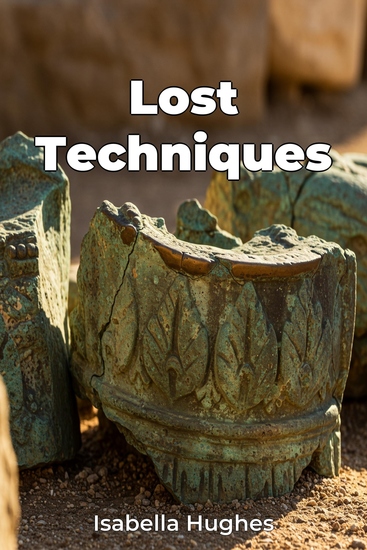
Lost Techniques - cover

Lost Techniques

Isabella Hughes

Translator A AI

Publisher: Publifye

  • 0
  • 0
  • 0

Summary

Lost Techniques explores the fascinating world of ancient sculpting methods and their surprising revival by modern artists. It argues that re-engaging with these historical techniques provides a bridge to innovation, offering a deeper understanding of form and artistic intention. The book highlights intriguing facts, such as the intricate indirect lost-wax casting perfected by the Greeks and the Romans' ambitious methods for crafting colossal bronze statues.

 
The book begins by establishing a historical context, tracing sculpting's evolution from early civilizations to the Renaissance. It then delves into specific lost techniques, examining materials, tools, and processes. Through case studies and artist interviews, Lost Techniques demonstrates how modern sculptors blend ancient knowledge with contemporary technology. It connects archaeology, materials science, and art history, offering a comprehensive yet accessible look at these rediscovered methods and their impact on contemporary art.
Available since: 02/26/2025.
Print length: 51 pages.

Other books that might interest you

  • Rare Recording of Joan Didion Reading Her Novel A Book of Common Prayer A - Part 2 - cover

    Rare Recording of Joan Didion...

    Joan Didion

    • 0
    • 0
    • 0
    Joan Didion (December 5, 1934 - December 23, 2021), born in Sacramento, California, was an American author, screenwriter, and journalist. Her writing during the 1960s through the late 1970s engaged audiences in the realities of the counterculture of the 1960s, the Hollywood lifestyle, and the history and culture of California. She is considered one of the pioneers of New Journalism, along with Gay Talese, Truman Capote, Norman Mailer, Hunter S. Thompson, and Tom Wolfe. In the following audio recording, Didion reads from her novel, A Book of Common Prayer.
    Show book
  • Pounded for Her Pleasure - MM Gay Wife Voyeur - cover

    Pounded for Her Pleasure - MM...

    Randy Manners

    • 0
    • 0
    • 0
    I could never have imagined what desires lie beneath. 
      
    He was an old friend of my wife’s from her college. He was in town for just a few days. A lavish night out for my wife and I turned into a mini reunion. I hadn’t realized our date night was engineered to throw us together—not until he made his move. I was taken off guard by my body’s reaction—and by my wife. She had wanted this to happen all along. She had wanted to see my body intertwined with his. She’d wanted to watch as I was taken. And, God help me, I wanted it too. 
      
    The rest of the dinner went on without much of a hitch. Dylan behaved himself—for the most part—sending only the occasional lustful appraisal my way. I assured myself that my growing discomfort and arousal were in anticipation of the hotel room that Sonia and I would be retiring to after the dinner. If this was the kind of tension I would be feeling whenever Dylan was around, I hoped that the two old friends would not include me in their social life anymore. The way Sonia continued to revisit our shared interest in football and video games, it didn’t appear I was getting my wish. My nerves were on edge, and I couldn’t decide if I wanted to get to know my wife’s eccentric friend better or never see him again.
    Show book
  • Germanic Tribes in Antiquity The: The History and Legacy of the Ancient Peoples Who Spread across Europe - cover

    Germanic Tribes in Antiquity...

    Editors Charles River

    • 0
    • 0
    • 0
    Despite all the accomplishments and widespread victories and conquests that the ancient Romans accrued over the centuries, one of their most critical failures was the inability to subjugate Germany. Indeed, historians have singled out this one failure as central to the ultimate downfall of Rome, as the constant wars against the Germanic tribes and the need to defend the frontier on the Rhine helped bring the Roman Empire to its knees. 
    There are elements of truth in such a conclusion, but the reality was far more fluid than is often realized. From the 1st century BCE until the collapse of the Western Roman Empire in the 5th century CE, the relationships between the Romans and those living in what is now modern Germany were extremely complicated, involving much more than simple warfare. As a Roman territory, Germania at one point included significant areas of land east of the Rhine, all the way up to the Elbe. The Romans would maintain a significant force on this eastern side until the 3rd century CE, but eventually a Frankish invasion ended that presence, and the term Germania came to refer specifically to the territory west of the Rhine, which included the two provinces of Germania Superior and Germania Inferior, or Upper and Lower Germany. Those provinces were key to the defense of the empire, so much so that Triers provided the location of one of the four seats of government near the end of Rome’s reign. 
    The people that came to be known as Germans originally came from Scandinavia and were mainly shepherds and hunters, but they comprised a number of distinct groups. Within each group, there were separate tribes, and as their populations grew, the land they occupied in Scandinavia was unable to support them, so they began migrating south, settling outside the borders of the Roman Empire. The Germans were fierce warriors who employed rather crude but effective tactics in battle.
    Show book
  • The How to Win at Work Book - An empowering career guide for today's working women - cover

    The How to Win at Work Book - An...

    Gill Whitty-Collins

    • 0
    • 0
    • 0
    Why is it that every book about winning in business seems to be written by a male CEO? Probably because over 90% of the leadership positions in the world are held by men.
    Women are not winning at work – but Gill Whitty-Collins wants to change that. Women represent 50% of the world's population, intelligence and competence: why should they not represent 50% of its leadership?
    My goal is that one day you will be one of the women in a room of leaders that is 50% women.
    I know what women need to do to win at work. I share it in keynotes, in workshops, in coaching – now I'm going to share it with you all here.
    In this empowering book, Gill Whitty-Collins builds on her first acclaimed book Why Men Win at Work…and how we can make inequality history and fearlessly tackles all the invisible, unconscious forces that create the male dominant workplace that holds women back.
    Gill draws on her extensive knowledge and experience as a leader, manager, workshop facilitator, coach mentor to equip working women to overcome the career barriers they face. She combines insights, strategies, action plans exercises that will empower and enable you to unleash your full potential and to win at work.
    Think of The How to Win at Work Book as your personal Coaching Manual. Clear, practical and genuinely empowering, it is the career guide that belongs on every professional woman's desk.
    Show book
  • The Broken Mirror - Adapting in the Abyss of Simulation - cover

    The Broken Mirror - Adapting in...

    Halasius Bradford

    • 0
    • 0
    • 0
    In an age where connectivity has reached unprecedented heights, humanity paradoxically experiences intensified solitude. The Internet, social media, and digital communication tools promise constant interaction, yet beneath the veneer of perpetual engagement lies a profound sense of detachment. We have woven an expansive digital web, intricately threading through every dimension of our lives. Yet, far from binding us together in deeper and more meaningful ways, this net has fragmented our relationships, distorted our sense of self, and left us lonelier than ever. 
    Indeed, the irony of our modern era is that as connectivity increases, isolation intensifies. Rather than fostering intimacy, the digital world frequently reduces interactions to hollow performances, substituting genuine human connection with a relentless pursuit of validation. We inhabit a world where messages traverse the globe instantaneously, yet conversations grow superficial; friendships are quantified by follower counts rather than measured by emotional depth; and love becomes mediated through glowing screens, stripped of warmth, tactile presence, and vulnerable authenticity.
    Show book
  • Ancient Greek Holidays - cover

    Ancient Greek Holidays

    Mab Borden

    • 0
    • 0
    • 0
    Ancient Greek Holidays is a remarkable book that explores the ancient seasons and religious observance practices of the ancient Greeks. Mab Borden’s meticulous research paints a vivid picture of the interconnectedness between mankind and the Gods. This book is invaluable for those interested in the religious traditions of ancient Greece.Ancient Greek Holidays is an immersive book delving deeply into the sacred days, months, and seasons, offering profound insights into the significance of the ancient Greeks. Meticulously detailed, each sacred day unfolds before the reader, revealing the honored deity and the intricacies of the associated social and ritual activities. Comprehensive explanations of the ancient Greek calendar within Ancient Greek Holidays allow readers to grasp the interconnectedness between celestial rhythms and religious observances. The appendices further enhance knowledge with a wealth of information, including mapping deity holidays to corresponding months. This additional layer of understanding enriches the reading experience, providing a comprehensive overview of the spiritual tapestry woven throughout ancient Greek society. The reader will embark on a journey through the vibrant festivals dedicated to revered gods and goddesses such as Zeus, Athena, and Apollo. Gaining insights into the rituals, ceremonies, and beliefs that shaped ancient Greek spirituality, readers will deepen their understanding of the cultural and religious significance of these holidays. The reader will be immersed in a world where every day held a unique connection to the divine. Experience the solemnity of religious processions and the joyous celebrations of harvest festivals as the ancient Greek holidays come alive before you. These ancient traditions inspire readers to reflect on their own spiritual practices and find resonance in the wisdom of the past.Ancient Greek Holidays will transport the reader to a time when the sacred rhythms of life were intricately woven into the fabric of society. Unveiling the secrets and traditions of ancient Greek holidays, this book invites you to rediscover and appreciate the profound beauty of these spiritual observances. Immerse the reader in the rich tapestry of the ancient Greek spiritual calendar and awaken a renewed appreciation for the sacred rhythms that shaped their lives.
    Show book