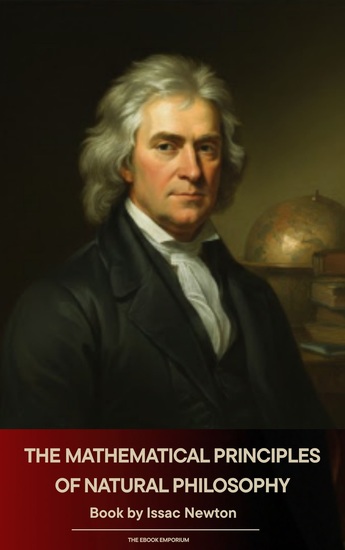
The Mathematical Principles of Natural Philosophy
Isaac Newton
Publisher: The Ebook Emporium
Summary
"The book that defined how the world works."

In The Mathematical Principles of Natural Philosophy, Isaac Newton didn't just explain how things move; he provided the mathematical proof for the mechanics of the entire universe. Moving beyond the speculative theories of his predecessors, Newton used rigorous geometric proofs to establish his Three Laws of Motion. From the falling of an apple to the orbits of the planets, he demonstrated that the same physical forces apply everywhere. This masterwork transformed the study of nature from a branch of philosophy into the modern discipline of physics, forever changing our understanding of space, time, and force.

The Law of Universal Gravitation: Newton's most famous contribution within these pages is the derivation of the inverse-square law of gravity. He proved that every mass in the universe attracts every other mass, providing the first coherent explanation for why the moon orbits the Earth and why the planets remain in their paths around the sun.

A Triumph of Mathematical Logic: Though Newton had developed calculus (which he called "fluxions"), he wrote the Principia using classical geometric proofs to ensure his contemporaries could follow his revolutionary logic. The result is a work of staggering intellectual density that remains the gold standard for scientific inquiry.

Why It Is Essential: To own the Principia is to own the spark of the Scientific Revolution. It is the bridge between the ancient world and the space age, a testament to the power of the human mind to decode the hidden laws of nature.

Own the foundation of modern science. Purchase "The Mathematical Principles of Natural Philosophy" today.
Available since: 01/15/2026.
Print length: 933 pages.