Join us on a literary world trip!
Add this book to bookshelf
Grey
Write a new comment Default profile 50px
Grey
Subscribe to read the full book or read the first pages for free!
All characters reduced
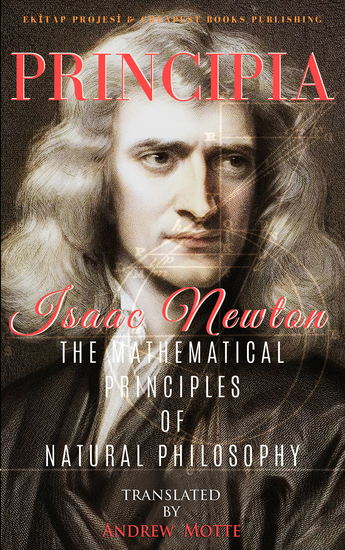
Principia - "The Mathematical Principles of Natural Philosophy" - cover

Principia - "The Mathematical Principles of Natural Philosophy"

Isaac Newton

Translator Motte Andrew

Publisher: E-Kitap Projesi & Cheapest Books

  • 0
  • 0
  • 0

Summary

Philosophiæ Naturalis Principia Mathematica (Latin for Mathematical Principles of Natural Philosophy), often referred to as simply the Principia, is a work in three books by Isaac Newton, in Latin, first published 5 July 1687. After annotating and correcting his personal copy of the first edition, Newton published two further editions, in 1713 and 1726. The Principia states Newton's laws of motion, forming the foundation of classical mechanics; Newton's law of universal gravitation; and a derivation of Kepler's laws of planetary motion (which Kepler first obtained empirically).

The Principia is considered one of the most important works in the history of science. The French mathematical physicist Alexis Clairaut assessed it in 1747: "The famous book of Mathematical Principles of Natural Philosophy marked the epoch of a great revolution in physics. The method followed by its illustrious author Sir Newton ... spread the light of mathematics on a science which up to then had remained in the darkness of conjectures and hypotheses."

A more recent assessment has been that while acceptance of Newton's theories was not immediate, by the end of the century after publication in 1687, "no one could deny that" (out of the Principia) "a science had emerged that, at least in certain respects, so far exceeded anything that had ever gone before that it stood alone as the ultimate exemplar of science generally".

In formulating his physical theories, Newton developed and used mathematical methods now included in the field of Calculus. But the language of calculus as we know it was largely absent from the Principia; Newton gave many of his proofs in a geometric form of infinitesimal calculus, based on limits of ratios of vanishing small geometric quantities. In a revised conclusion to the Principia (see General Scholium), Newton used his expression that became famous.

The Principia deals primarily with massive bodies in motion, initially under a variety of conditions and hypothetical laws of force in both non-resisting and resisting media, thus offering criteria to decide, by observations, which laws of force are operating in phenomena that may be observed. It attempts to cover hypothetical or possible motions both of celestial bodies and of terrestrial projectiles. It explores difficult problems of motions perturbed by multiple attractive forces. Its third and final book deals with the interpretation of observations about the movements of planets and their satellites.

It shows:
• How astronomical observations prove the inverse square law of gravitation (to an accuracy that was high by the standards of Newton's time);
• Offers estimates of relative masses for the known giant planets and for the Earth and the Sun;
• Defines the very slow motion of the Sun relative to the solar-system barycenter;
• Shows how the theory of gravity can account for irregularities in the motion of the Moon;
• Identifies the oblateness of the figure of the Earth;
• Accounts approximately for marine tides including phenomena of spring and neap tides by the perturbing (and varying) gravitational attractions of the Sun and Moon on the Earth's waters;
• Explains the precession of the equinoxes as an effect of the gravitational attraction of the Moon on the Earth's equatorial bulge; and
• Gives theoretical basis for numerous phenomena about comets and their elongated, near-parabolic orbits.
Available since: 12/21/2023.
Print length: 666 pages.

Other books that might interest you

  • Crusoe Castaways and Shipwrecks in the Perilous Age of Sail - cover

    Crusoe Castaways and Shipwrecks...

    Mike Rendell

    • 0
    • 1
    • 0
    “Fascinating” stories of real-life people and events that inspired the author of the classic adventure novel Robinson Crusoe (Historical Novel Society).   This book looks at some of the stories that inspired Daniel Defoe, author of Robinson Crusoe—stories of bravery, determination, and good fortune, as well as human negligence, sheer stupidity, and bad luck. In addition to an overview of Defoe’s life and his monumentally successful novel, it also considers some of the reasons why people found themselves cast away—as a result of being wrecked, abandoned as a punishment, or marooned by pirates, or even out of deliberate choice.   Major hurricanes in the eighteenth century causing huge damage to shipping and loss of life are also covered, along with catastrophes when ships were lost, and astonishing tales of survival in the face of adversity—down in the Falklands, in the Caribbean, and off the coast of Australia. It looks at how being cast away brings out the best in some—and in others the very worst. And it examines perhaps the most astonishing story of them all—sixty slaves abandoned on a desolate treeless island in the Indian Ocean and left there for fifteen years, some of whom survived against all odds.
    Show book
  • The Flood Prevention Handbook - How to Protect Your Home & Family When Waters Rise - cover

    The Flood Prevention Handbook -...

    Ryan Lee Price

    • 0
    • 0
    • 0
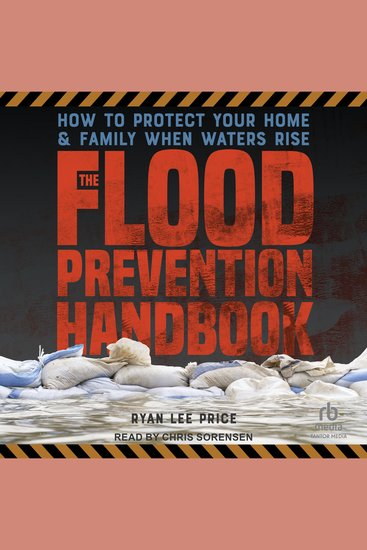
    Keep your peace of mind by learning proven safety methods to help you prepare your home, evaluate damage, and recover after a flood.In a world where extreme weather events are increasingly unpredictable, being ready for natural disasters is a necessity for every homeowner. The Flood Prevention Handbook is a comprehensive guide that covers each phase of flood safety, so that you can know exactly how to prepare yourself for every stage of the storm. Using step-by-step instructions and expert tips, you'll have the resources to act quickly and effectively to protect what matters most.In this book, you'll learn about water-related disaster statistics; how to navigate flood insurance policy; what to look for before renting or purchasing; practical methods to prepare your home and family for a flood; how to minimize damage during a flood; post-flood recovery and restoration; and more. 
    Stay calm during the storm. The Flood Prevention Handbook will equip you with practical advice and reliable resources to ensure you’re ready for anything, no matter the circumstance. Take control, stay informed, and stay safe.
    Show book
  • Lean Production Scale-up - cover

    Lean Production Scale-up

    Ilkka Taponen

    • 0
    • 0
    • 0
    This audiobook is an altered version of the Master’s thesis Lean Production Scale-up. How a startup can scale the manufacturing of physical product innovation by Ilkka Taponen. Approximately half of the original thesis has been removed to suit the audiobook format. The audiobook edit has been designed for an audience familiar with startups and business, meaning that large portions of the basics have been removed from the Theory chapter.Today the market entry for new ideas and entrepreneurs is easier than ever as the digital age is reshaping how business is done. Through digitalization, the business environment has become highly open and widely connected. The combinations of digital technologies like edge computing and artificial intelligence, AI, enable new business model opportunities. In this fast-changing environment, the most important thing is to learn as fast as possible what to do next and what is worth doing at all. Multiple non-fiction books like The Four Steps to the Epiphany by Steve Blank and Lean Startup by Eric Ries study the modern internet-era startup business environment.Still, one aspect has not been included in the broader public discussion. The tools presented in Lean Startup concentrate on finding the market fit as efficiently as possible but assume that the same level of uncertainties does not exist in the company's internal processes. “We wanted flying cars, instead we got 140 characters” is a famous quote by startup investor Peter Thiel. Behind the quote is the notion that there is something different and more challenging about developing physical technologies compared to online services. Manufacturing, indeed, is an underrated problem. It is much harder to take advanced technology and bring it to volume manufacturing than to design it in the first place.
    Show book
  • Conserving Nature in Greater Yellowstone - Controversy and Change in an Iconic Ecosystem - cover

    Conserving Nature in Greater...

    Robert B. Keiter

    • 0
    • 0
    • 0
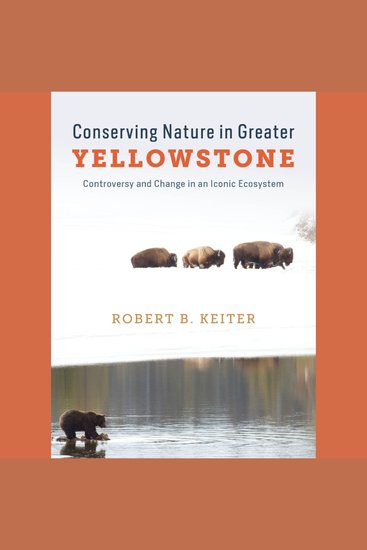
    The story of how Yellowstone, established in 1872 as the world’s first national park, has become synonymous with nature conservation—and an examination of today’s challenges to preserve the region’s wilderness heritage. For more than 150 years, the Yellowstone region—now widely known as the twenty-three million acre Greater Yellowstone Ecosystem—has played a prominent role in the United States’ nature conservation agenda. In this book, Robert B. Keiter, an award-winning public land law and policy expert, traces the evolution and application of fundamental ecological conservation concepts tied to Yellowstone.
     
    
    Keiter’s book highlights both the conservation successes and controversies connected with this storied region, which has been enmeshed in change. 
    But in the face of explosive human population growth and related development pressures, new efforts must also account for the region’s privately owned lands along with accelerating recreational activities that present quite different problems.
    
    Exploring both notable conservation accomplishments and the ongoing challenges confronting this special place, Keiter’s book explains the many forces—scientific, political, economic, legal, cultural, climatic, and more—at work driving controversy and change across the region. But more than this, Conserving Nature in Greater Yellowstone shows us that the lessons gleaned from Yellowstone’s expansive nature conservation efforts are profoundly important for both the country and the world.
    Show book
  • Ring of Downs - The North Downs' Eastern Ring - cover

    Ring of Downs - The North Downs'...

    Maryanne Traylen

    • 0
    • 0
    • 0
    ‘Ring of Downs’ is a feast of lyrically evocative writings and atmospheric images inspired by a landscape-loving woman’s walks with her beloved dog through an extraordinary part of Kent’s North Downs. 
    The places celebrated, from which these writings have drawn their inspiration, are on the North Downs Way path which forms an imperfect circle made up of two arcs. One meanders southeast through the Folkestone Downs along the coast to the White Cliffs of Dover. The other runs northeast through Canterbury. Yet this outer map corresponds to an inner one, a ‘mandala’, the perfect imaginative symbol of wholeness: as if tracks walked make patterns in our minds, words of wonder triggered by nature forging relationship between us and the land. 
    This black and white edition of ‘Ring of Downs’ is the author’s sequel to ‘A Dog on the Downs’, to be followed by ‘Flights of Nature’ and ‘Light of Land’.
    Show book
  • 10-Minute Summary NEXUS: A Brief History of Information Networks from the Stone Age to Artificial Intelligence - To what extent does information define the destiny of humanity? - cover

    10-Minute Summary NEXUS: A Brief...

    Yuval Noah Harari

    • 0
    • 0
    • 0
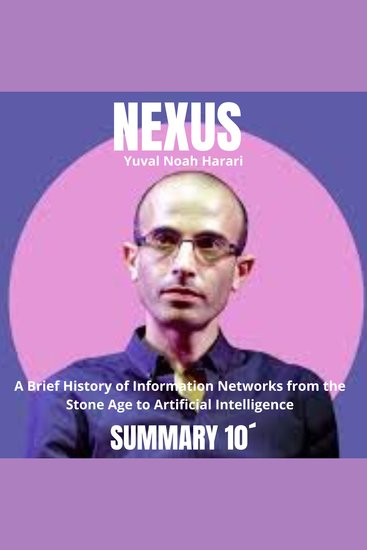
    Yuval Noah Harari poses a fundamental question: To what extent does information define the destiny of humanity? Since the dawn of civilization, information has been key to survival, social organization, and technological development. However, in the digital age, this question has taken on new significance: artificial intelligence has reached the capacity to process information autonomously and, in some cases, without human supervision.  
    Harari draws an analogy with ancient myths that warned about the dangers of invoking uncontrollable powers. Just as Prometheus brought fire to humanity with unpredictable consequences, AI is seen as a powerful tool that could radically transform our way of life. Its influence on politics, the economy, and daily life is so profound that it could reshape the very foundations of civilization.  
    Show book