Join us on a literary world trip!
Add this book to bookshelf
Grey
Write a new comment Default profile 50px
Grey
Subscribe to read the full book or read the first pages for free!
All characters reduced
The Indians of the Pike's Peak Region - Including an Account of the Battle of Sand Creek and of Occurrences in El Paso County Colorado - cover

The Indians of the Pike's Peak Region - Including an Account of the Battle of Sand Creek and of Occurrences in El Paso County Colorado

Irving Howbert

Publisher: Good Press

  • 0
  • 0
  • 0

Summary

In "The Indians of the Pike's Peak Region," Irving Howbert offers a meticulously researched exploration of the indigenous tribes who inhabited the iconic Rocky Mountain area, specifically focusing on the cultural and historical dimensions of their lives before and during European settlement. Howbert's prose is both clear and evocative, grounding his narrative in a rich tapestry of ethnographic detail and poignant anecdotes. The book serves not only as an historical account but also as a critical reflection on the complex interactions between Native Americans and settler populations, contributing to a broader understanding of the socio-political dynamics of 19th-century America. Irving Howbert was a prominent figure in Colorado's early history, his life interwoven with the narratives he documents. A businessman turned historian, Howbert possessed a deep personal interest in the Native American experience, shaped by his interactions and observations as a resident of the Pike's Peak region. His unique position enabled him to gather first-hand accounts and delve into archival resources, allowing him to present a comprehensive view of the indigenous peoples who faced tremendous upheaval during westward expansion. This book is essential reading for anyone interested in Native American history, anthropology, or the American West. It not only preserves the voices of those often marginalized in historical discourse but also prompts readers to reflect on the enduring legacy of these cultures. Howbert's work is a valuable addition to the canon of American history that deserves a prominent place on the shelves of both scholars and enthusiasts.
Available since: 11/11/2023.
Print length: 139 pages.


Other books that might interest you

  • Writer Career Coaching Audio Book - With Job Interview Preparation & Counseling for Teens Men Women & Young Adults - cover

    Writer Career Coaching Audio...

    Brian Mahoney

    • 0
    • 0
    • 0
    End Money Worries! 
    Writer Career Coaching Audio Book 
    With Job Interview Preparation & Counseling for Teens, Men, Women & Young Adults 
    by Brian Mahoney 
        Discover... 
    * What a Writer does 
      * How to Become a Writer  
        * What is the salary of a Writer  
         * What is the Writer Work Environment like 
           * What is the future Job outlook for a Writer  
         * How long does it take to become a Writer  
       * How to Prepare for Your Job Interview 
      * Tips the pros use to Ace their Job Interview 
    * You'll be confident with the best answers for the toughest job interview questions 
    The knowledge and ability to change your life all for less than the cost of 1 movie ticket! 
    If you are ready to get started & want the knowledge, help & motivation to change your life now!... 
    Then this Book is for you!!! 
               So Don't wait. You'll wait your life away...
    Show book
  • The Center of the Star - Understanding and Changing the US Healthcare System - cover

    The Center of the Star -...

    Judith Kunisch

    • 0
    • 0
    • 0
    How do we fix a healthcare system that’s too complex, costly, and often unequal? In The Center of the Star, Judith Kunisch offers a groundbreaking perspective on reform, introducing a practical framework that makes sense of healthcare’s tangled web of consumers, providers, payers, policymakers, and the health industrial complex.
    Show book
  • Crito - Justice Duty and Civil Disobedience – Socrates’ Reflections from His Prison Cell - cover

    Crito - Justice Duty and Civil...

    Plato, Tim Zengerink

    • 0
    • 0
    • 0
    What if a whispered conversation could change your view of duty forever? 
    Listen as Socrates and Crito wrestle with escape, loyalty, and the meaning of a life well lived: 
    •	Intimate, Moment-by-Moment Storytelling – Detailed narration places you inside the silent prison before dawn. 
    •	Arguments Made Audible – Hear each premise and rebuttal unfold with clarity, making complex reasoning easy to follow. 
    •	Contextual Introductions – Brief scene settings keep you oriented without interrupting the flow of the original dialogue. 
    •	A Companion for Reflection – Perfect for commutes, walks, or meditation on ethics and civic responsibility. 
    Press play and join Socrates in the cell—then ask yourself what justice demands of you.
    Show book
  • Black Power and the American Myth - 50th Anniversary Edition - cover

    Black Power and the American...

    C.T. Vivian

    • 0
    • 0
    • 0
    In 1970, C. T. Vivian, a close colleague of Martin Luther King, Jr. and a member of his executive staff, sat down to take stock of the civil rights movement and the progress it had made. His assessment was that it failed, and that the blame lay in the existence of myths about America. 


    As prophetic today as it was fifty years ago, Vivian's voice rings out as a critique and a call to action for a society in deep need of justice and peace. 


    The civil rights struggle that began when Rosa Parks, a seamstress in Montgomery, Alabama, decided to sit in the front of a bus has deeply altered American society and the American conscience. Yet from several perspectives, that movement has resulted in failure. The Black struggle for independence is more of an uphill climb than ever. Why? C. T. Vivian asserts that the civil rights movement failed because it was built on certain myths about America: 


    ● the myth that Americans will do what is right as soon as they know what is right. 


    ● the myth that legislation leads to justice. 


    ● the myth that America is an open society where any minority group can advance. 


    ● the myth that an ethic of love forms the core of the American conscience.
    Show book
  • Gold - The Metal That Rules The World - cover

    Gold - The Metal That Rules The...

    Tony Lee Moral

    • 0
    • 0
    • 0
    Explore the fascinating history of gold with this book. 
     
    Why are we so mesmerized by gold? Why is it so revered and so valued? From the earliest times to the present day, humans have been attracted by this sun-coloured metal, sometimes worshipping it, always prizing it. Gold: The Metal that Rules the World investigates the history of this versatile element, examining what it is, how it came to be found on Earth and why it has played such an important part in human history. 
     
    A precious commodity that still rules the world of finance, gold has taken many forms: from statues and beautiful, intricate jewellery to playing a vital role as a delicate component in highly sophisticated technology and, as medical science advances, as part of ever-more crucial treatments for serious illnesses.
    Show book
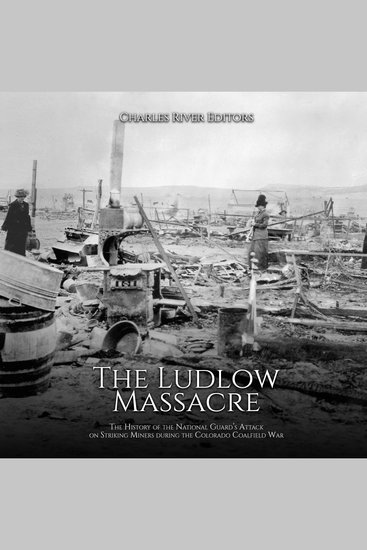
  • Ludlow Massacre The: The History of the National Guard’s Attack on Striking Miners during the Colorado Coalfield War - cover

    Ludlow Massacre The: The History...

    Editors Charles River

    • 0
    • 0
    • 0
    As labor unions and movements began to form and coalesce in the 19th century, the tensions between workers and companies led to demonstrations, encounters, and even conflicts that descended into violence. Among those, few were as notorious as the fight that took place on April 20, 1914 at Ludlow in the southern Colorado coalfields, during which two units of the Colorado National Guard had a firefight with striking miners who lived in a United Mine Workers (UMW) camp. The Guardsmen had at least one machine gun, and the strikers were also armed. The gunfire lasted most of the day, and at the day’s end, the miners were routed and fled the camp with their families.  
    	Perhaps as many as a dozen miners in the camp were killed during the fighting, but after it was over, the Guardsmen cautiously entered the camp, did some looting, and then soaked the miners’ tents with kerosene in order to burn the whole camp to the ground. The Guard’s arsonists were unaware that in one tent, four women and 11 children had hidden themselves in a sort of cellar under a tent, seeking protection from the gunfire. After the camp burned, a deeply disturbing aspect of the fighting was discovered: two of those women and all 11 children had been asphyxiated from the smoke of their burning tent. 
    	These grim deaths marked Ludlow as more than just another regrettable coal war battle and earned it the title of the Ludlow Massacre. In the previous several decades, there had been a number of violent incidents during strikes in several states that killed more people, but in 1914, Victorian sentimentality about women and children was still prevalent, and the Ludlow tragedy deeply shocked the nation.
    Show book