Join us on a literary world trip!
Add this book to bookshelf
Grey
Write a new comment Default profile 50px
Grey
Subscribe to read the full book or read the first pages for free!
All characters reduced
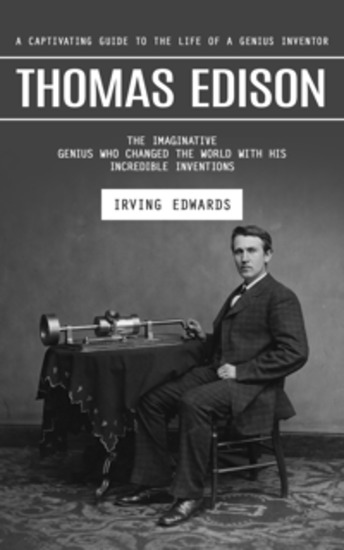
Thomas Edison: A Captivating Guide to the Life of a Genius Inventor (The Imaginative Genius Who Changed the World With His Incredible Inventions) - cover

Thomas Edison: A Captivating Guide to the Life of a Genius Inventor (The Imaginative Genius Who Changed the World With His Incredible Inventions)

Irving Edwards

Publisher: Arris Joe

  • 0
  • 0
  • 0

Summary

Edison’s life teaches us that curiosity and creativity can lead to incredible things. Just like edison, you can be curious about how things work and imaginative in coming up with new ideas. You don’t need to wait for a special moment to start inventing or exploring—every day is an opportunity to discover something new.Imagine building your own cool gadgets, experimenting with different materials, and creating your own unique projects. Whether you’re designing a new toy, making a simple circuit, or exploring how sound works, you’re stepping into edison’s shoes and becoming an inventor yourself. It’s all about having fun, being creative, and not being afraid to try new things.In this book include:America before edisonEnter the edisonsEdison’s mother and life in port huronTelegraphy and leaving homeInventing the future in menlo parkThe industrial revolution and lighting new yorkThe phonograph and moving picturesThe world columbian expositionThe war of the currentsLove, marriage and seminole lodgeEdison’s war workEdison and anti-semitismThis book is a comprehensive biography of thomas edison, one of the most influential inventors in history. From his early years as a curious and inventive child to his groundbreaking work in electricity, the phonograph, and the motion picture camera, this book covers every aspect of edison's life and legacy. Readers will gain a deep understanding of edison's approach to innovation, his impact on the world of technology, and his personal life and relationships
Available since: 06/12/2025.
Print length: 120 pages.


Other books that might interest you

  • Discovering Peace: How Violence Has Faded Through Time - Elevate your understanding with our audiobook on how violence has faded over time - cover

    Discovering Peace: How Violence...

    Ethan Drayton

    • 0
    • 0
    • 0
    Discovering Peace: How Violence Has Faded Through Time   
    ⭐⭐ Simplified Audio Guide ⭐⭐   
    Looking to deepen your understanding of how humanity has moved towards peace instead of conflict? 
    Seeking a comprehensive guide that covers all the elements leading to the embrace of peace over time? 
    Your search ends here! 
    This guide serves as your definitive companion for exploring the evolution of peace, applying historical insights, and engaging in thought-provoking analysis. With this, you're set for a journey of enlightenment. 
    Updated to reflect the latest insights into humanity's shift towards peace. 
    Key features of this enriched guide:   
    - Profound insights about humanity's embrace of peace over conflict 
    - Detailed explanation of how societies have turned away from violence 
    - Effective strategies for understanding and discussing these historical trends 
    Our guide distinguishes itself through comprehensive coverage, which is essential for your in-depth understanding. Concepts aren't merely skimmed; they are delved into with precision. 
    Please note that this guide is not affiliated with any official entity and is purely an independent resource for your benefit. 
    Designed with a clear structure and easy-to-understand language, our guide on Discovering Peace ensures smooth transitions between topics. Say goodbye to dense jargon and welcome clear, precise, and technically accurate content. 
    So, why wait? Click the BUY NOW button, secure your guide, and begin your journey to understanding how humanity has embraced peace over conflict!
    Show book
  • Illegitimate Authority - Facing the Challenges of Our Time - cover

    Illegitimate Authority - Facing...

    Noam Chomsky

    • 0
    • 0
    • 0
    A wide-ranging and incisive collection of interviews with Noam Chomsky, addressing the urgent questions of this tumultuous moment. 


    In these informative interviews, conducted for Truthout by C. J. Polychroniou, Noam Chomsky addresses the rapid deterioration of democracy in the United States and rising tensions globally. He examines the crumbling social fabric and fractures of the Biden era, including the halting steps toward a Green New Deal; the illegitimate authority of the Supreme Court, in particular its decision to overturn Roe vs. Wade; and the ongoing fallout from COVID-19. Chomsky also untangles the roots of the War in Ukraine, the diplomatic tensions among the United States, China, and Russia, and considers the need for climate action on an international scale. 


    Throughout, Chomsky "remains . . . a beacon of hope in the darkest of times" (Sarah Jaffe).
    Show book
  • History of the Jews - A Concise Guide to the Diaspora Gathering and Persecution of the Jews - cover

    History of the Jews - A Concise...

    Kelly Mass

    • 0
    • 0
    • 0
    Jewish history is a rich tapestry woven over millennia, shaped by the development of a people, their religion, and their culture as they interacted with various civilizations, faiths, and cultures. The earliest reference to Israel can be found on the Merneptah Stele, dated to between 1213–1203 BCE, marking the first historical mention of the ancient Israelite people. However, the religious and cultural narrative of the Jews stretches far earlier. Jewish tradition traces its origins to at least 1500 BCE, with religious texts such as the Torah recounting the story of the Israelites, beginning with the patriarchs Abraham, Isaac, and Jacob. This historical foundation laid the groundwork for the development of Judaism, which began to emerge as a distinct religion during the Hellenistic period, particularly around 323–31 BCE, as Greek scholars began documenting Jewish practices and beliefs. 
    The trajectory of Jewish history has been marked by a series of dispersals and captivities, with the first significant one being the Assyrian exile of the ten northern tribes in 722 BCE. This event set the stage for a larger dispersion that was solidified with the Babylonian captivity in 586 BCE, when the Jewish elite were taken into exile. Following the Babylonian conquest, Jews began to settle throughout the ancient Near East, which would later become a defining characteristic of Jewish existence. The Jewish people continued to spread across the Mediterranean world, particularly within the vast expanse of the Roman Empire, where they maintained distinct cultural and religious practices even as they interacted with surrounding civilizations. This trend persisted throughout Byzantine rule in the eastern Mediterranean, although the influence of Jewish communities diminished in these regions after the Byzantine Empire lost control of the Levant to the Arab Islamic Empire in 638 CE.
    Show book
  • The Western Xia Dynasty - The Tangut Kingdom and Its Struggles for Survival - cover

    The Western Xia Dynasty - The...

    Rolf Hedger

    • 0
    • 0
    • 0
    The Western Xia Dynasty, founded by the Tangut people, emerged as a powerful and distinct kingdom in northwestern China during the 11th century. Its establishment marked the rise of a unique civilization that balanced influences from the Chinese, Tibetan, and Central Asian cultures while maintaining its own identity. The Tanguts, originally a nomadic group, gradually settled in the Ordos region and later expanded into the Hexi Corridor, an area of strategic importance due to its location along the Silk Road. 
    The dynasty was officially established in 1038 by Li Yuanhao, who declared himself emperor and adopted the title of the Great Xia. Li Yuanhao sought to solidify Tangut sovereignty by breaking free from the dominance of the Song Dynasty. To emphasize independence, he introduced significant reforms, including the creation of the Tangut script, a writing system distinct from Chinese characters, reinforcing cultural identity. Under his rule, Western Xia developed a centralized government, with administrative structures modeled in part after the Song system but adapted to suit Tangut traditions. 
    Expansion and military strength played crucial roles in the rise of the Western Xia. The Tanguts, skilled in cavalry warfare, built a formidable army that enabled them to challenge the Song Dynasty, the Liao Dynasty of the Khitans, and later, the Jin Dynasty of the Jurchens. Frequent conflicts with these neighboring states shaped Western Xia’s military strategies, leading to a highly fortified kingdom capable of defending its territory against multiple threats. While diplomacy was occasionally pursued, warfare was often the means through which the dynasty maintained its influence.
    Show book
  • Native American Resistance in the Midwest: The History and Legacy of the Wars that Pushed Indigenous Groups Out of the Region - cover

    Native American Resistance in...

    Editors Charles River

    • 0
    • 0
    • 0
    Throughout history, there have been men of war and men of peace, but few have actually had a war named after them. One of them was Pontiac, also known as Obwandiyag, an Odawa chief who left his mark on history by continuing the battle against the British after their official triumph during the French and Indian War. While modern historians question how important Pontiac’s role was in shaping America’s destiny, his leadership during Pontiac’s War was seen at that time as important enough to warrant significant articles and even a few 18th century books. Since these books were written by the British, or at least men who supported their cause, the descriptions of Pontiac were often not complimentary. Likewise, 19th century authors tended to portray him as something of an evil genius who plotted against the British and then drove his people into battle.  
    For the most part, the conflicts that followed consisted mostly of the Native Americans suffering defeat in the face of a better-equipped adversary, interspersed with binding treaties, which, on the side of the federal government, proved not very binding at all. Occasionally, however, there arose a Native American leader of such ability that such defeats were temporarily reversed, and Little Turtle, the war chief of the Miami tribe, was one such man.  
    The Battle of Tippecanoe, fought on November 7, 1811 near present-day Lafayette, Indiana, involved forces of fewer than 2,000 Native American warriors and white soldiers, and only about 300 men were killed or wounded on both sides. Given those numbers, it’s apparent that the battle was far from being a Saratoga or a Gettysburg in terms of its scale or significance as an historical turning point, yet it was one of the most important battles in the early 19th century. 
    Show book
  • The Full English - cover

    The Full English

    Stuart Maconie

    • 0
    • 0
    • 0
    A Sunday Times Book of the Week and Top 10 BestsellerA Times bestsellerA Waterstones Paperback of the Year 2024A Spectator Book of the Year 
    What kind of country is England today? 
    What does it mean to be English? 
    Are we hungry for change or seeking old certainties? 
    Join Stuart Maconie on an enlightening, entertaining journey through England, from Bristol's Banksy to Durham's beaches, from Cotswolds corduroy to Stoke's oatcakes. 
    As his guide, Maconie walks in the footsteps of J.B. Priestley's classic travelogue, English Journey, to explore our national identity and how it has evolved over the last century. On his way, Stuart takes inspiration from the people he meets at bus stops and train stations, cafes and corner shops. 
    Travelling the length of the land, Maconie explores the differences between city and town, north and south, and examines our past and present with affection and insight. Whether he’s passing the boutique hotels of Manchester, the moors of Ilkley or the grand houses of Tynemouth, looking out over misty fens or urban skylines, he shines a light on the people who make these places and asks what the future holds for them. Along the way, he uncovers local heroes and secret histories over early breakfasts and last orders. 
    Through his journey, he lets us see our homes and habits, hopes and eccentricities with fresh eyes. The Full English challenges us to embrace the messy, shifting and diverse nature of England, and to ask ourselves what kind of country we want to be. 
    In this bestseller, Maconie offers a literary exploration of Britain, blending travelogues and essays to create a humorous and insightful non-fiction piece. This Sunday Times bestselling book delves into the history and social interests of Europe, making it a special read. 
    For fans of Tim Hannigan (The Granite Kingdom), Helen Rebanks (The Farmer's Wife), Michael Palin (Erebus), Ben Aitken (A Chip Shop in Poznan), and Alan Bennett (Keeping On Keeping On). 
    HarperCollins 2023
    Show book