Join us on a literary world trip!
Add this book to bookshelf
Grey
Write a new comment Default profile 50px
Grey
Subscribe to read the full book or read the first pages for free!
All characters reduced
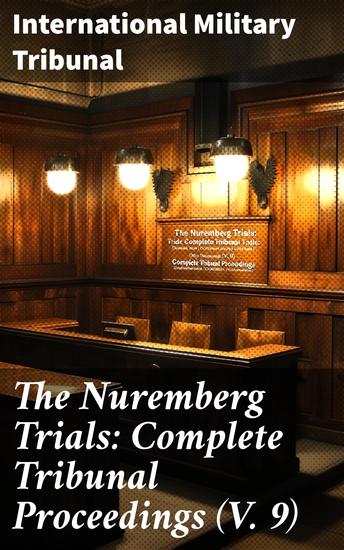
The Nuremberg Trials: Complete Tribunal Proceedings (V 9) - Trial Proceedings From 8 March 1946 to 23 March 1946 - cover

The Nuremberg Trials: Complete Tribunal Proceedings (V 9) - Trial Proceedings From 8 March 1946 to 23 March 1946

International Military Tribunal

Publisher: Good Press

  • 0
  • 0
  • 0

Summary

The Nuremberg Trials: Complete Tribunal Proceedings (V. 9) serves as a crucial document in the understanding of international law and justice, offering a comprehensive account of one of history's most significant legal proceedings. This volume meticulously presents the tribunal's transcripts, evidentiary submissions, and judicial deliberations, shedding light on the post-World War II ethos that sought accountability for war crimes. The clarity of the proceedings and the precision of the legal language reflect the gravity of the charges faced by the defendants, providing a unique lens through which readers can analyze the intersection of morality, legality, and the human condition in times of crisis. The International Military Tribunal, established in 1945, was driven by the urgent need to address the atrocities committed during the war. Comprising judges from various Allied nations, the Tribunal sought to set a precedent for future international jurisprudence. The integration of diverse legal traditions and the philosophical underpinning of justice against tyranny served not only to hold individuals accountable but also to articulate the aspirations of a world striving for peace and stability after unimaginable horrors. This volume is essential for scholars, students, and anyone interested in international law, human rights, and historical studies. By engaging with the firsthand proceedings, readers gain invaluable insights into the complexity of legal practices in the face of mass atrocities. It is an indispensable resource for understanding how the lessons learned from Nuremberg continue to resonate in contemporary discourses on justice and accountability.
Available since: 12/15/2023.
Print length: 604 pages.
Other books that might interest you

  • Passion Plays - How Religion Shaped Sports in North America - cover

    Passion Plays - How Religion...

    Randall Balmer

    • 0
    • 0
    • 0
    Randall Balmer was a late convert to sports talk radio, but he quickly became addicted, just like millions of other devoted American sports fans. As a historian of religion, the more he listened, Balmer couldn’t help but wonder how the fervor he heard related to religious practice. Houses of worship once railed against Sabbath-busting sports events, but today most willingly accommodate Super Bowl Sunday. On the other hand, basketball’s inventor, James Naismith, was an ardent follower of Muscular Christianity and believed the game would help develop religious character. But today those religious roots are largely forgotten. 
     
    Here one of our most insightful writers on American religion trains his focus on that other great passion—team sports—to reveal their surprising connections. From baseball to basketball and football to ice hockey, Balmer explores the origins and histories of big-time sports from the late nineteenth century to the present, with entertaining anecdotes and fresh insights into their ties to religious life. Referring to Notre Dame football, the Catholic Sun called its fandom “a kind of sacramental.” Legions of sports fans reading Passion Plays will recognize exactly what that means.
    Show book
  • Carbon Technocracy - Energy Regimes in Modern East Asia - cover

    Carbon Technocracy - Energy...

    Victor Seow

    • 0
    • 0
    • 0
    A forceful reckoning with the relationship between energy and power through the history of what was once East Asia’s largest coal mine. 
     
    The coal-mining town of Fushun in China’s Northeast is home to a monstrous open pit. First excavated in the early twentieth century, this pit grew like a widening maw over the ensuing decades, as various Chinese and Japanese states endeavored to unearth Fushun’s purportedly “inexhaustible” carbon resources. Today, the depleted mine that remains is a wondrous and terrifying monument to fantasies of a fossil-fueled future and the technologies mobilized in attempts to turn those developmentalist dreams into reality. 
     
    In Carbon Technocracy, Victor Seow uses the remarkable story of the Fushun colliery to chart how the fossil fuel economy emerged in tandem with the rise of the modern technocratic state. Taking coal as an essential feedstock of national wealth and power, Chinese and Japanese bureaucrats, engineers, and industrialists deployed new technologies like open-pit mining and hydraulic stowage in pursuit of intensive energy extraction. But as much as these mine operators idealized the might of fossil fuel–driven machines, their extractive efforts nevertheless relied heavily on the human labor that those devices were expected to displace. Under the carbon energy regime, countless workers here and elsewhere would be subjected to invasive techniques of labor control, ever-escalating output targets, and the dangers of an increasingly exploited earth. 
     
    Although Fushun is no longer the coal capital it once was, the pattern of aggressive fossil-fueled development that led to its ascent endures. As we confront a planetary crisis precipitated by our extravagant consumption of carbon, it holds urgent lessons. This is a groundbreaking exploration of how the mutual production of energy and power came to define industrial modernity and the wider world that carbon made.
    Show book
  • Warriors - An Infantryman’s Memoir of Vietnam - cover

    Warriors - An Infantryman’s...

    Robert Tonsetic

    • 0
    • 0
    • 0
    On the ground, in the air, and behind the lines, grunts made life-and-death decisions every day—and endured the worst stress of their young lives. 


    It was the tumultuous year 1968, and Robert Tonsetic was Rifle Company commander of the 4th Battalion, 12th Infantry in Vietnam. He took over a group of grunts demoralized by defeat but determined to get even. Through the legendary Tet and May Offensives, he led, trained, and risked his life with these brave men, and this is the thrilling, brutal, and honest story of his tour of duty. Tonsetic tells of leading a seriously undermanned ready-reaction force into a fierce, three-day battle with a ruthless enemy battalion; conducting surreal night airmobile assaults and treks through fetid, pitch-black jungles; and relieving combat stress by fishing with hand grenades and taking secret joyrides in Hueys. 


    During that fateful year, as unrest erupted at home and politicians groped for a way out of the war, Tonsetic and his men did their job as soldiers and earned the title "Warriors."
    Show book
  • Great Zimbabwe - Stone Cities Trade Networks and the Mystery of Southern Africa - cover

    Great Zimbabwe - Stone Cities...

    Rolf Hedger

    • 0
    • 0
    • 0
    The rise of Great Zimbabwe was shaped by geography, economic opportunities, and social organization, allowing it to become one of Africa’s most influential civilizations. Emerging around the 9th century, the settlement developed into a thriving political and economic center by the 11th century, reaching its peak between the 13th and 15th centuries. Its growth was fueled by abundant natural resources, a strategic location, and participation in regional and international trade. 
    The Zimbabwean plateau, with its fertile soil and favorable climate, provided ideal conditions for agriculture. The Shona people, who founded Great Zimbabwe, cultivated sorghum and millet, which sustained the growing population. In addition to farming, cattle herding played a crucial role in the economy. Cattle were a measure of wealth and social status, serving as currency in trade and marriage negotiations. The presence of large herds further reinforced the power of the elite, who controlled access to grazing lands and water sources. 
    Beyond agriculture, Great Zimbabwe’s location made it a key player in long-distance trade. The city was situated between the goldfields of southern Africa and the coastal trade hubs of the Swahili city-states. Gold mining became a major economic activity, with miners extracting the metal from riverbeds and underground deposits. This gold was traded with merchants from Kilwa, Sofala, and other Swahili ports, where it was exchanged for luxury goods such as Persian ceramics, Chinese porcelain, and Indian textiles. The wealth generated from trade allowed Great Zimbabwe to expand, attracting artisans, traders, and skilled laborers.
    Show book
  • Bamoun (Shupamom) Language Phrasebook - cover

    Bamoun (Shupamom) Language...

    Resulam, Shck Tchama

    • 0
    • 0
    • 0
    Bamoun Audio Phrasebook is your essential companion for learning and speaking Bamoun (Shupamom) — a gateway to the rich traditions, artistry, and history of Cameroon’s Bamoun kingdom. 
    Created and produced by Resulam, an organization dedicated to reviving and preserving African mother tongues, this phrasebook combines clear, native-speaker recordings with cultural insights to help you communicate naturally and meaningfully. 
    Inside you will find:Essential everyday expressions — greetings, introductions, numbers, food, travel, and cultural etiquette.Authentic pronunciation — voiced by native speakers to help you sound natural and confident.Cultural depth — notes and tips revealing Bamoun customs, values, and traditions so you can speak with respect and understanding.Easy navigation — phrases organized by real-life situations so you can listen, repeat, and use them right away. 
    Whether you are a traveler, language enthusiast, or part of the Bamoun-speaking community, this audio phrasebook will help you open doors to Bamoun culture, connect with people, and celebrate one of Africa’s most vibrant linguistic heritages.
    Show book
  • The Rory's Stories Guide to Parenting - cover

    The Rory's Stories Guide to...

    Rory O'Conor

    • 0
    • 1
    • 0
    THE PARENTING 'GUIDE' YOU'VE BEEN WAITING FOR!
    Sleep deprivation, stray Lego underfoot, mashed potato on the walls, missing spoons and the unmatched pride that comes with being a father!
    From the social media sensation, this is a hilarious and painfully accurate look at what parenting really entails – in all its messy glory.
    Show book