Join us on a literary world trip!
Add this book to bookshelf
Grey
Write a new comment Default profile 50px
Grey
Subscribe to read the full book or read the first pages for free!
All characters reduced
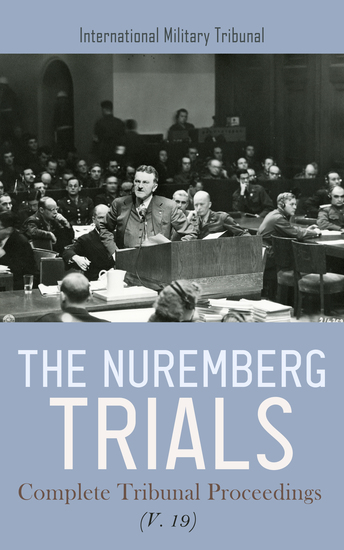
The Nuremberg Trials: Complete Tribunal Proceedings (V 19) - Trial Proceedings from 19th July 1946 to 29th July 1946 - cover

The Nuremberg Trials: Complete Tribunal Proceedings (V 19) - Trial Proceedings from 19th July 1946 to 29th July 1946

International Military Tribunal

Publisher: e-artnow

  • 0
  • 0
  • 0

Summary

The Nuremberg trials were a series of military tribunals held after World War II by the Allied forces under international law and the laws of war. The trials were most notable for the prosecution of prominent members of the political, military, judicial, and economic leadership of Nazi Germany, who planned, carried out, or otherwise participated in the Holocaust and other war crimes. The trials were held in Nuremberg, Germany. 
This volume contains trial proceedings from 19th July 1946 to 29th July 1946.
Available since: 08/20/2022.
Print length: 580 pages.

Other books that might interest you

  • An Appeal by Shirin Ebadi to the world - That's not what the Prophet meant - cover

    An Appeal by Shirin Ebadi to the...

    Shirin Ebadi

    • 0
    • 2
    • 0
    Shirin Ebadi - Iranian, Muslim, Lawyer, Nobel Peace Prize laureate - has personally experienced violence, oppression, and terrorism in the name of religion. Rising above these tribulations, she became a fighter for human rights and an activist for peace and stability. Her weapons are words: the only way to convinve people that religion can never justify violence and murder.
    Show book
  • Voices for the Future - 20 Years of the Trilogue Salzburg - cover

    Voices for the Future - 20 Years...

    Wolfgang Schüssel, Liz Mohn

    • 0
    • 0
    • 0
    How can culture, politics and business work together to meet the challenges of the future? Will united Europe fall victim to individual national interests? Is the economy the silver bullet when it comes to solving global challenges? Can policy makers still lead in an age of fake news and escalating expectations? What kind of support is needed – and from which culture – to shape a sustainable society?
    The book Voices for the Future documents the lively exchange between international thought leaders from the cultural, economic and political spheres on solutions to current and coming problems. Since 2002, they have been gathering at the Trilogue Salzburg to take a shared look at what the future holds. Where has the Trilogue been farsighted in terms of the issues that now dominate the policy agenda and our everyday lives? What must (still) happen if we are to respond effectively to future challenges? Voices for the Future essays answers to these questions, addressing the topics of Europe, the labor market, leadership, education and values.
    Show book
  • Medieval England: The History of England from the Fall of Rome to the Rise of the Tudor Dynasty - cover

    Medieval England: The History of...

    Editors Charles River

    • 0
    • 0
    • 0
    As the Western Roman Empire collapsed in the late 5th century, Hadrian’s Wall was abandoned and Roman control of the area broke down. Little is known of this period of British history, but soon the Anglo-Saxons – who had been harassing the Saxon Shore as pirates – showed up and began to settle the land, creating a patchwork of little kingdoms and starting a new era of British history. Several early medieval historians, writing well after the events, said the Anglo-Saxons were invited to Britain to defend the region from the northern tribes and ended up taking over. The Venerable Bede (672 or 673-735) said in his Historia ecclesiastica gentis Anglorum (“Ecclesiastical History of the English People”) that in the year 449, “The British consulted what was to be done and where they should seek assistance to prevent or repel the cruel and frequent incursions of the northern nations. They all agreed with their king Vortigern to call over to their aid, from the parts beyond the sea, the Saxon nation. … The two first commanders are said to have been Hengist and Horsa.” 
    However they came to control most of England, the Anglo-Saxons became the dominant power in the region for nearly 500 years, and the strength of their cultural influence could be felt even after William the Conqueror won the Battle of Hastings and became the first Norman ruler on the island. The efforts to consolidate his rule in England were complicated from the start, both due to external enemies and those jockeying for his position while he was still alive, but the Normans would manage just barely to cling to power over England, and William remains the last foreign conqueror of the island.
    Show book
  • A Rare Recording of Salvador Dali - cover

    A Rare Recording of Salvador Dali

    Salvador Dalí

    • 0
    • 0
    • 0
    Salvador Dalí (May 11, 1904 - January 23, 1989), was a Spanish surrealist artist renowned for his technical skill, precise draftsmanship, and the striking and bizarre images in his work. Dali also wrote a novel, Hidden Faces (1944), poetry, essays, art criticism, and a technical manual on art. The following recording is from a 1955 interview.
    Show book
  • History of Ukraine - The Country’s Origin Conflicts Holodomor Soviet Era and More - cover

    History of Ukraine - The...

    Kelly Mass

    • 0
    • 0
    • 0
    The early history of the territory now known as Ukraine is marked by a series of ancient cultures and civilizations that shaped the region's development before and during the Dark Ages. The area was initially inhabited by the Dacians, a group known for their connections to the wider Thracian culture, alongside various nomadic tribes such as the Cimmerians, Scythians, and Sarmatians. These peoples made significant contributions to the cultural and political landscape of Eastern Europe during the Iron Age. 
    From around 750 BC to 250 BC, the Scythians established a powerful kingdom that extended its influence over much of the Eurasian steppes, including the territories of modern-day Ukraine. The Scythian kingdom is well-known for its unique art, horse-riding culture, and its role as a dominant force in the region. Meanwhile, Greek colonists founded several cities on the northern shores of the Black Sea during the 6th century BC, including Tyras, Olbia, and Hermonassa. These cities became important trading hubs and cultural centers, remaining under Roman and later Byzantine control until the 6th century AD.
    Show book
  • Secret Societies - cover

    Secret Societies

    Philip Gardiner

    • 0
    • 0
    • 0
    Throughout Secret Societies, Gardiner; uncovers an ancient secret society thought to have died out many years ago and gets to the core of the secret societies’ belief systems. He explores the secret origins of Freemasonry and the links to secret Serpent Cults, Investigates the secret hidden meaning of King Arthur and Robin Hood and examines the claimants to the name of Illuminati, and analyzes the history of the group in Europe and America. Gardiner reveals the secret links within the Vatican and the Nazi Party and looks in-depth at the white-powdered gold theory supposedly kept secret by orders throughout time and radically re-appraises it. He also shows the link between the so-called enlightenment experience and the control of our minds. 
     
    Nobody in the genre involves themselves in the tale in the same way that Gardiner does, and here he shows that the search for ultimate truth can often be a terrifying one.
    Show book