Join us on a literary world trip!
Add this book to bookshelf
Grey
Write a new comment Default profile 50px
Grey
Subscribe to read the full book or read the first pages for free!
All characters reduced
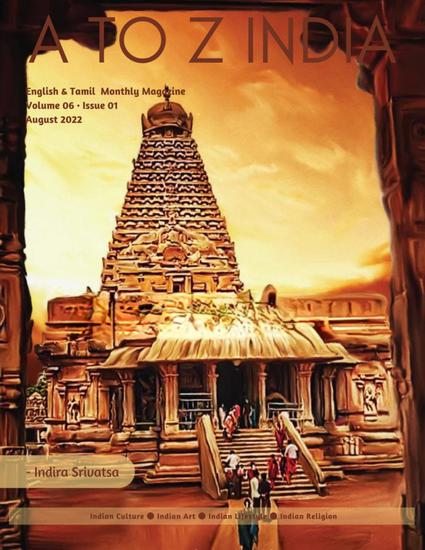
A to Z India - Magazine: August 2022 - cover

A to Z India - Magazine: August 2022

Indira Srivatsa

Publisher: BookRix

  • 1
  • 0
  • 0

Summary

 FROM THE EDITOR'S DESK: SHRI KRISHNA JANMASHTAMI FESTIVAL CELEBRATIONS 2022 - Observed on the eighth day (Ashtami) of the dark half of the month of Shraavana, this festival is widely celebrated across India since Shri Krishna is one of the most well recognized and worshipped deities in the Hindu pantheon of Gods; THANJAVUR BIG TEMPLE: THE ARCHITECTURAL WONDER - Rajaraja-I named this temple as Rajarajesvaram and the deity Shiva in Linga form as Peruvudaiyar.   
Available since: 08/08/2022.
Print length: 27 pages.

Other books that might interest you

  • Chemically Imbalanced - Everyday Suffering Medication and Our Troubled Quest for Self-Mastery - cover

    Chemically Imbalanced - Everyday...

    Joseph E. Davis

    • 0
    • 0
    • 0
    Everyday suffering—those conditions or feelings brought on by trying circumstances that arise in everyone’s lives—is something that humans have grappled with for millennia. But the last decades have seen a drastic change in the way we approach it. In the past, a person going through a time of difficulty might keep a journal or see a therapist, but now the psychological has been replaced by the biological: instead of treating the heart, soul, and mind, we take a pill to treat the brain. 
     
    Chemically Imbalanced is a field report on how ordinary people dealing with common problems explain their suffering, how they’re increasingly turning to the thin and mechanistic language of the “body/brain,” and what these encounters might tell us. Drawing on interviews with people dealing with struggles such as underperformance in school or work, grief after the end of a relationship, or disappointment with how their life is unfolding, Joseph E. Davis reveals the profound revolution in consciousness that is underway. We now see suffering as an imbalance in the brain that needs to be fixed, usually through chemical means. This has rippled into our social and cultural conversations, and it has affected how we, as a society, imagine ourselves and envision what constitutes a good life. Davis warns that what we envision as a neurological revolution, in which suffering is a mechanistic problem, has troubling and entrapping consequences. And he makes the case that by turning away from an interpretive, meaning-making view of ourselves, we thwart our chances to enrich our souls and learn important truths about ourselves and the social conditions under which we live.
    Show book
  • Stoicism in 5 Steps: How to Apply the Timeless Wisdom of the Stoics in Modern Everyday Life to Achieve Iron Discipline Inner Calm Resilience & Humility | incl a 28-Day Challenge - cover

    Stoicism in 5 Steps: How to...

    Konstantin Rensche

    • 0
    • 0
    • 0
     
    Stoicism: Using the Timeless Philosophy of the Ancient Greek Stoa to Achieve Greater Composure, Balance, and Contentment in Everyday Life
     
    "With stoic calm": That's how people describe individuals who seemingly can't be thrown off balance by anything—and perhaps you wish that for yourself more often, too? In that case, you should take a closer look at the actual Stoa, and this book will show you how easily Stoicism can be integrated into your everyday life!
    Reacting to events without emotion and not letting joyful occasions, annoyances, or strokes of fate affect you: this Stoa stereotype seems impossible and hardly desirable—but wouldn't a bit more control over your inner life be nice? Then a modern Stoicism approach is your royal road, because the fundamental idea of its founder Zeno is more relevant today than ever: leading a good life in which your internal and external worlds are in harmonious alignment. To achieve this, one must become master of their emotions and passions—and fortunately, with a little patience, it's quite simple to learn. In this book, you will first familiarize yourself with the theoretical foundations of Stoicism before discovering how to put them into practice. By working through a variety of exercises, tasks, and challenges, you will apply what you've learned and gradually develop the Stoa mindset. Prior knowledge or experience? Not required! Thanks to straightforward explanations and immediately applicable techniques, even newcomers can start effortlessly and achieve impressive results in no time.
    At a Glance: Dive into the origins, central teachings, and fundamental assumptions of Stoicism and learn the 5 steps to a Stoic mindset.
    Express Exercises: With simple, immediate strategies on topics such as gratitude, acceptance, or self-reflection, you will internalize the Stoa concept step by step.
    Train Your Virtues: Through advanced exercises on adaptability, self-control, reason, and more, you'll deepen your abilities and perfect the core Stoic virtues.
    The Ultimate Discipline: Find out how to apply your newly acquired skills in situations involving relationships, career development, or everyday challenges, and benefit from the Stoa in a comprehensive way.
    This book opens the door to a whole new level of balance and satisfaction, providing you with valuable tools for a more relaxed life. With the 28-day challenge in the bonus section, you can dive into the subject matter even faster and positively influence your mindset in no time.
    So, what are you waiting for? Click now on "Buy Now with 1-Click" and look forward to discovering the Stoic within you!
    Show book
  • Mughal Empire - The Early Modern Islamic Empire in South Asia - cover

    Mughal Empire - The Early Modern...

    Kelly Mass

    • 0
    • 0
    • 0
    The Mughal Empire, also referred to as the Mogul or Moghul Empire, was one of the most powerful and influential early modern Islamic empires in South Asia. Established in the 16th century, it controlled vast regions for over two centuries, encompassing territories from the peripheries of the Indus basin in the west, extending to northern Afghanistan, Kashmir in the north, present-day Bangladesh in the east, and stretching as far south as the Deccan Plateau's uplands.The origins of the Mughal Empire trace back to 1526 when Babur, a warrior chieftain from what is now Uzbekistan, founded the empire. Babur's military strategy combined traditional cavalry tactics with the latest artillery techniques, using matchlock guns and cast cannons acquired with Ottoman assistance. These advancements, alongside his strategic acumen, led him to a decisive victory against the Sultan of Delhi, Ibrahim Lodhi, at the First Battle of Panipat. This battle marked a turning point, allowing Babur to establish his dominance over northern India and subdue rival Rajput and Afghan forces.While Babur laid the foundation of the empire, the true structure of the Mughal state is often attributed to his grandson, Akbar the Great. By the late 16th century, under Akbar's rule, the empire expanded its reach and established a well-organized imperial administration that laid the groundwork for political stability, cultural integration, and economic prosperity. Akbar's reign is particularly noted for promoting a policy of religious tolerance, encouraging a synthesis of Hindu and Muslim cultures, and setting up an efficient centralized bureaucracy.
    Show book
  • Making Meaning of Difficult Experiences - A Self-Guided Program - cover

    Making Meaning of Difficult...

    Sheila A.M. Rauch, Barbara O....

    • 0
    • 0
    • 0
    Up to 90% of adults in the US will experience one or more traumatic events in their lifetimes, including interpersonal violence, traffic collisions, and sexual assault. While most who suffer a trauma naturally recover over time, for others difficulties continue, and may lead to full-blown depression, posttraumatic stress disorder (PTSD), substance use, anxiety disorders, and other problems that interfere with healthy daily functioning. 


    Making Meaning of Difficult Experiences is a self-guided mental health resource for people who have had potentially traumatic experiences and who wish to work through them independently, outside of a formal therapeutic setting. Based on psychological treatments with strong scientific support, this book introduces listeners to several useful tools that will help them to emotionally process difficult experiences, with the goal of moving on from the event and building future resilience. The program takes the listener step-by-step through four skill sets to facilitate emotional processing of difficult experiences: Memory Exposure and Processing, Behavioral Activation, Social Connection, and Self-Care. Listeners use this self-evaluation to determine what is working or not working for them, enabling them to focus more on certain skills, or to complete the full program based on their needs.
    Show book
  • The Mali Empire - The Tales of Sundiata Keita Mansa Musa and Timbuktu - cover

    The Mali Empire - The Tales of...

    History Retold

    • 0
    • 0
    • 0
    Discover the untold story of Mansa Musa and the Empire of Mali - the first great African kingdom of the Middle Ages!  
    This book paints a vivid picture of the rise and fall of Mansa Musa and the Empire of Mali, and explores the cultural, political, and spiritual foundations of this incredible civilization. 
    This book is a must-have for anyone interested in African history. With engaging stories, this book will take you deep into the past to discover the secrets of Mansa Musa and his kingdom. 
    Get this book today and explore the captivating history of Mansa Musa and the Mali Empire!
    Show book
  • Popular Works Volume 1 - The Vocation of the Scholar The Nature of the Scholar and The Vocation of Man - cover

    Popular Works Volume 1 - The...

    Johann Gottleib Fitche

    • 0
    • 0
    • 0
    History placed Johann Gottlieb Fichte (1762-1814) between two giants of German philosophy – Immanuel Kant (1724-1804) and Georg Hegel (1770-1831) – so it was not surprising that his light may have dimmed as the 19th century developed. It didn’t help that he also was regarded as one of the proponents of German nationalism, a legacy that spilled over into the darker times of the 20th century.  
    However, his singular character and his role in developing, (following Kant), transcendental idealism has resulted in a re-evaluation in recent years. His views on ethics, a practical approach towards the matter of free will, and the value he placed on culture, the intellect and the self, informed his output. 
    The three works in this collection, Volume 1, offer a steady insight into Fichte’s thought and personality. Many of his key works emerged in the form of lectures rather than books, and as such are eminently accessible: Fichte was certainly a popular speaker. When at the University of Jena (1794-1799) he drew large audiences for the five lectures which comprise The Vocation of the Scholar (1794). The main principles of the Enlightenment are examined here, in terms of culture, education, morality. As he writes in his Preface: ‘That the Ideal cannot be manifested in the Actual world, we know as well as they do, perhaps better. All we maintain is, that the Actual must be judged by the Ideal, and modified in accordance with it by those who feel themselves capable of such a task.’ 
    In 1799, he was dismissed from his post at Jena following accusations of atheism, and the last two works in this collection appeared while he was at the University of Berlin. The Nature of the Scholar and its Manifestations dates from 1806 and comprises 10 lectures which develop ideas initially presented in The Vocation of the Scholar. The final work here, The Vocation of Man, appeared in book form rather than as a series of lectures and is regarded as one of his most important. In it, Fichte sets out to examine ‘the true purpose of man’.  
    It is divided into three sections, Doubt, Knowledge, Faith. He addresses issues of free will and cause and effect, natural existence and perceived reality; and, finally, the ‘guiding’ matter of faith and God.
    Show book