Junte-se a nós em uma viagem ao mundo dos livros!
Adicionar este livro à prateleira
Grey
Deixe um novo comentário Default profile 50px
Grey
Assine para ler o livro completo ou leia as primeiras páginas de graça!
All characters reduced
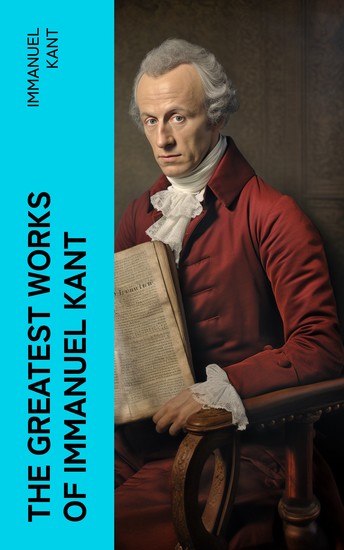
The Greatest Works of Immanuel Kant - cover
LER

The Greatest Works of Immanuel Kant

Immanuel Kant

Tradutor Thomas De Quincey, Paul Carus, J. H. Bernard, T. K. Abbott, William Hastie, J. M. D. Meiklejohn, W. J. Eckoff, Emanuel F. Goerwitz, R. B. Haldane

Editora: e-artnow

  • 0
  • 0
  • 0

Sinopse

e-artnow presents to you this unique and meticulously edited Kant collection: Introduction: IMMANUEL KANT by Robert Adamson KANT'S INAUGURAL DISSERTATION OF 1770 Three Critiques: THE CRITIQUE OF PURE REASON THE CRITIQUE OF PRACTICAL REASON THE CRITIQUE OF JUDGMENT Critical Works: PRELOGOMENA TO ANY FUTURE METAPHYSICS FUNDAMENTAL PRINCIPLES OF THE METAPHYSIC OF MORALS THE METAPHYSICS OF MORALS Philosophy of Law; or, The Science of Right The Metaphysical Elements of Ethics Pre-Critical Works and Essays: DREAMS OF A SPIRIT-SEER IDEA OF A UNIVERSAL HISTORY ON A COSMOPOLITICAL PLAN Preface to THE METAPHYSICAL FOUNDATIONS OF NATURAL SCIENCE PERPETUAL PEACE: A Philosophical Essay OF THE INJUSTICE OF COUNTERFEITING BOOKS Criticism: CRITICISM OF THE KANTIAN PHILOSOPHY by Arthur Schopenhauer Immanuel Kant (1724-1804) was a German philosopher, who, according to the Stanford Encyclopedia of Philosophy is "the central figure of modern philosophy." Kant argued that fundamental concepts of the human mind structure human experience, that reason is the source of morality, that aesthetics arises from a faculty of disinterested judgment, that space and time are forms of our understanding, and that the world as it is "in-itself" is unknowable. Kant took himself to have effected a Copernican revolution in philosophy, akin to Copernicus' reversal of the age-old belief that the sun revolved around the earth.
Disponível desde: 13/12/2023.
Comprimento de impressão: 820 páginas.


Outros livros que poderiam interessá-lo

  • Pax Romana: A Captivating Guide to Ancient Rome during the Roman Peace Period - cover

    Pax Romana: A Captivating Guide...

    Captivating History

    • 0
    • 0
    • 0
    Did you know that the biggest territorial expansion in ancient Rome took place during the reign of its first emperor, who also ruled the longest out of all of the rulers prior to the fall of the Western Roman Empire? 
    The Roman Empire reached its zenith within the first two centuries of the fall of the Roman Republic, expanding its territory and spreading its influence well beyond the borders of Europe. During that time, a sort of global peace was achieved, which historians call the Pax Romana. But what exactly is the Pax Romana, and how does one delve into this huge, ever-expanding subject? 
    Like many other segments of Roman history, the Pax Romana is riddled with murky areas, contradictory information from contemporary sources, and fascinating archaeological finds. In this book, you’ll discover what made Rome tick during those roughly two hundred years of relative peace. 
    Throughout the pages of this tome, you’ll get brief glimpses of the reigns of many emperors who made the Pax Romana into what it was. Discover the Pax Romana’s long-term effects and how it managed to cement the Roman Empire as the go-to empire for many later civilizations to try and emulate. 
    Among other things, you’ll gain new knowledge on the following facts:How the empire evolved from the former republic and who the men were that brought about the changes What made the reign of each emperor uniqueWho the best emperors during the Pax Romana were, and which ones were considered the worstWhat role the provinces and territorial expansion played in the growth and development of the empireHow the imperial Romans were stratifiedWhat societal changes came about with the abolition of the republic and the return to a monarchic model 
    Scroll up, and give that “add to cart” button a click to learn more about the Pax Romana!
    Ver livro
  • Fever in the Heartland A: Book Summary and Analysis - cover

    Fever in the Heartland A: Book...

    Briefly Summaries

    • 0
    • 0
    • 0
    This is a concise summary and analysis of A Fever in the Heartland, by Timothy Egan.
     
    It is not the original book and is not affiliated with or endorsed by Timothy Egan.
     
    Ideal those seeking a quick and insightful overview.


    In A Fever in the Heartland, embark on a gripping journey through one of the darkest and most disturbing chapters of American history—the rise and fall of the Ku Klux Klan in the 1920s. This audiobook delves into the Klan’s resurgence, exploring how it capitalized on social fear, political turmoil, and cultural shifts to regain influence across the United States, particularly in the Midwest.
     
    Led by figures like D.C. Stephenson, the Klan expanded its reach into local governments and law enforcement, embedding itself deeply into the fabric of American life. With its rhetoric of nationalism and white supremacy, the Klan thrived on divisiveness, targeting not only African Americans but also immigrants, Catholics, and Jews. However, as its influence grew, so did the organization’s internal corruption and hypocrisy.
    Ver livro
  • Rain of Ruin - Tokyo Hiroshima and the Surrender of Japan - cover

    Rain of Ruin - Tokyo Hiroshima...

    Richard Overy

    • 0
    • 0
    • 0
    A leading historian of World War II sheds new light on the purposes and impact of the U.S. incendiary and atomic bombing of Japan’s cities in 1945. 
      
    With the development of the B-29 “Superfortress” in summer 1944, strategic bombing, a central component of the Allied war effort against Germany, arrived in the Pacific theater. In 1945 Japan experienced the three most deadly bombing attacks of the war. The firebombing of Tokyo in March burned the city’s most densely populated sector, killed some 85,000 residents, and left more than one million homeless. The attack was part of a months-long campaign of incendiary bombing that destroyed almost two-thirds of Japan’s cities. The two atomic blasts in August killed hundreds of thousands in Hiroshima and Nagasaki, most of them civilians. The bombing brought a destabilizing devastation that, combined with a declaration of war by the Soviet Union, induced Japan, as they put it, to terminate the war. 
      
    Many at the time and since have credited American air power, and especially the two atomic bombs, with Japan’s surrender. But Richard Overy tells a different, more dimensional story. Drawing on his expertise on the war and its bombing campaigns, he delivers a precise recounting of these aerial attacks, and a balanced, informed assessment of how and why they occurred. Overy is astute on the Allied decision-making, and, notably, integrates the Japanese leadership as well. He ably navigates the dramatic endgame of the war, which featured factional infighting within the Japanese cabinet, a scramble by American officials to formulate an acceptable version of “unconditional surrender,” and the crucial role played by the emperor, Hirohito. The atomic bombing emerges as impactful but not decisive in this rich, multilayered history.
    Ver livro
  • Forgiveness - An Alternative Account - cover

    Forgiveness - An Alternative...

    Matthew Ichihashi Potts

    • 0
    • 0
    • 0
    A deeply researched and poignant reflection on the practice of forgiveness in an unforgiving world 


    In this sensitive and probing book, Matthew Ichihashi Potts explores the complex moral terrain of forgiveness, which he claims has too often served as a salve to the conscience of power rather than as an instrument of healing or justice. Though forgiveness is often linked with reconciliation or the abatement of anger, Potts resists these associations, asserting instead that forgiveness is simply the refusal of retaliatory violence through practices of penitence and grief. It is an act of mourning irrevocable wrong, of refusing the false promises of violent redemption, and of living in and with the losses we cannot recover. 


    Drawing on novels by Kazuo Ishiguro, Marilynne Robinson, Louise Erdrich, and Toni Morrison, and on texts from the early Christian to the postmodern era, Potts diagnoses the real dangers of forgiveness yet insists upon its enduring promise. Sensitive to the twenty-first-century realities of economic inequality, colonial devastation, and racial strife, and considering the role of forgiveness in the New Testament, the Christian tradition, philosophy, and contemporary literature, this book heralds the arrival of a new and creative theological voice.
    Ver livro
  • The Nature of the Beast - cover

    The Nature of the Beast

    David J. Anderson

    • 0
    • 0
    • 0
    Does your dog get sad when you leave for the day? Does your cat purr because she loves you? Do bears attack when they’re angry? You can’t very well ask them.  
     
    In fact, scientists haven’t been able to reach a consensus on whether animals even have emotions like humans do, let alone how to study them. Yet studies of animal emotion are critical for understanding human emotion and mental illness. 
     
    In The Nature of the Beast, pioneering neuroscientist David J. Anderson describes a new approach to solving this problem. He and his colleagues have figured out how to study the brain activity of animals as they navigate real-life scenarios, like  
    fleeing a predator or competing for a mate. His research has revolutionized what we know about animal fear and aggression. Here, he explains what studying emotions and related internal brain states in animals can teach us about human  
    behavior, offering new insights into why isolation makes us more aggressive, how sex and violence connect, and whether there’s a link between aggression and mental illness. 
     
    Full of fascinating stories, The Nature of the Beast reconceptualizes how the brain regulates emotions—and explains why we have them at all.
    Ver livro
  • Baruch Spinoza - God Nature and the Ethics of Reason - cover

    Baruch Spinoza - God Nature and...

    Hector Davidson

    • 0
    • 0
    • 0
    Baruch Spinoza's philosophy is a comprehensive system that integrates metaphysics, epistemology, ethics, and political theory into a unified framework. Central to his thought is the idea of God and nature as a single, infinite substance, which Spinoza refers to as "Deus sive Natura" (God or Nature). This concept encapsulates his pantheistic view that everything that exists is a part of this one, all-encompassing reality. 
      
    Metaphysics and Substance 
      
    Spinoza's metaphysical framework revolves around the notion of substance monism. He argues that there is only one substance in the universe, which is both God and nature. This substance possesses an infinite number of attributes, with thought and extension being the two that humans can comprehend. Everything that exists, according to Spinoza, is a mode or manifestation of this single substance. This idea challenges traditional theistic views by rejecting the notion of a personal, transcendent God who is separate from the world. 
      
    Epistemology and Knowledge 
      
    In epistemology, Spinoza emphasizes the role of reason and intuitive knowledge in understanding the nature of reality. He distinguishes between different types of knowledge: imagination, reason, and intuition. Imaginative knowledge, based on sensory experience and inadequate ideas, is unreliable and often leads to confusion. Rational knowledge, which arises from understanding the necessary connections between ideas, is more accurate. The highest form of knowledge, according to Spinoza, is intuitive knowledge—an immediate, direct understanding of the essence of things.
    Ver livro