Join us on a literary world trip!
Add this book to bookshelf
Grey
Write a new comment Default profile 50px
Grey
Subscribe to read the full book or read the first pages for free!
All characters reduced
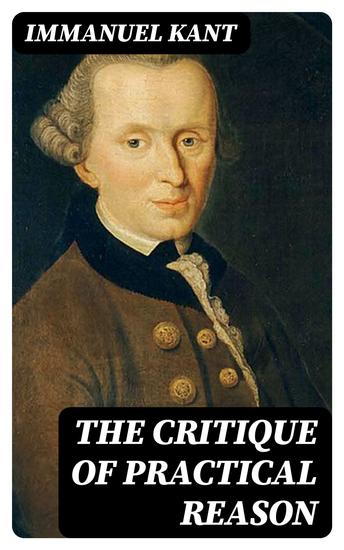
The Critique of Practical Reason - cover

The Critique of Practical Reason

Immanuel Kant

Translator Thomas Kingsmill Abbott

Publisher: DigiCat

  • 0
  • 0
  • 0

Summary

In "The Critique of Practical Reason," Immanuel Kant meticulously explores the foundations of moral philosophy, presenting a thorough analysis of the nature of practical reason. Written in 1788 as the second of his critically acclaimed works, this treatise expounds upon the principles of ethics through a rigorous examination of human autonomy and the concept of duty. Kant's distinctive style, characterized by dense, yet eloquent prose, invites readers to engage deeply with his argumentation, which is firmly rooted in Enlightenment ideals, asserting that moral law is inherent to rational beings and can be apprehended through reason alone. Immanuel Kant, a pivotal figure of modern philosophy, was profoundly influenced by the scientific developments and philosophical debates of his time. His earlier works laid the groundwork for his ethical framework, emphasizing the importance of rationality and freedom in moral actions. Growing up amid the tumultuous changes of the late 18th century, Kant's thoughts reflect a synthesis of empirical observation and rational inquiry that continues to inform contemporary discussions on morality and ethics. This book is indispensable for anyone seeking to understand the intricacies of moral reasoning, as it not only elucidates Kant's ethical theories but also challenges readers to contemplate their own moral agency. Scholars, students, and enthusiasts of philosophy will find "The Critique of Practical Reason" to be a profound source of insight into the perennial questions surrounding duty, morality, and the role of reason in ethical decision-making.
Available since: 05/17/2022.
Print length: 315 pages.
Other books that might interest you

  • Crime and Punishment - cover

    Crime and Punishment

    Fyodor Dostoevsky

    • 0
    • 0
    • 0
    Crime and Punishment is a novel by the Russian author Fyodor Dostoevsky. It was first published in the literary journal The Russian Messenger in twelve monthly installments during 1866. It was later published in a single volume. It is the second of Dostoevsky's full-length novels following his return from ten years of exile in Siberia. Crime and Punishment is considered the first great novel of his mature period of writing. The novel is often cited as one of the supreme achievements in world literature.
    Show book
  • Republic The: Book Summary & Analysis - cover

    Republic The: Book Summary &...

    Briefly Summaries

    • 0
    • 0
    • 0
    This is a concise summary and analysis of The Republic, by Plato
     
    It is not the original book and is not affiliated with or endorsed by Plato .
     
    Ideal those seeking a quick and insightful overview.
     
    The Republic is a timeless philosophical masterpiece that explores justice, politics, and the nature of the ideal society. Through a series of thought-provoking dialogues, the book delves into questions about morality, the role of government, and the pursuit of truth. With its visionary concepts like the philosopher-king, the allegory of the cave, and the theory of forms, this work remains a cornerstone of Western philosophy and an enduring guide to understanding human nature and governance.
    Show book
  • Worst Cases - Terror and Catastrophe in the Popular Imagination - cover

    Worst Cases - Terror and...

    Lee Clarke

    • 0
    • 0
    • 0
    Al Qaeda detonates a nuclear weapon in Times Square during rush hour, wiping out half of Manhattan and killing 500,000 people. A virulent strain of bird flu jumps to humans in Thailand, sweeps across Asia, and claims more than fifty million lives. A single freight car of chlorine derails on the outskirts of Los Angeles, spilling its contents and killing seven million. An asteroid ten kilometers wide slams into the Atlantic Ocean, unleashing a tsunami that renders life on the planet as we know it extinct. 
     
    We consider the few who live in fear of such scenarios to be alarmist or even paranoid. But Worst Cases shows that such individuals—like Cassandra foreseeing the fall of Troy—are more reasonable and prescient than you might think. In this book, Lee Clarke surveys the full range of possible catastrophes that animate and dominate the popular imagination, from toxic spills and terrorism to plane crashes and pandemics. Along the way, he explores how the ubiquity of worst cases in everyday life has rendered them ordinary and mundane. Fear and dread, Clarke argues, have actually become too rare: only when the public has more substantial information and more credible warnings will it take worst cases as seriously as it should. 
     
    A timely and necessary look into how we think about the unthinkable, Worst Cases will be must reading for anyone attuned to our current climate of threat and fear.
    Show book
  • The First Airplane Flight – The Wright Brothers’ Legacy - How Two Brothers Changed the World with the Power of Flight - cover

    The First Airplane Flight – The...

    Charlie Hill

    • 0
    • 0
    • 0
    From bicycles to the skies, two brothers changed the course of history forever. But how did Orville and Wilbur Wright achieve the impossible? 
    This audiobook takes you deep into the story of the first airplane flight, uncovering the inventions, failures, and groundbreaking moments that led to the dawn of aviation. Discover: 
    ✅ How the Wright brothers turned their bicycle shop into an innovation lab 
    ✅ The secrets behind their early flight experiments and wind tunnel tests 
    ✅ The dramatic first successful flight at Kitty Hawk 
    ✅ How their discovery sparked a revolution in modern aviation and space travel 
    The First Airplane Flight – The Wright Brothers’ Legacy is a must-listen for history lovers, aviation enthusiasts, and anyone fascinated by the pioneers who dared to reach for the skies.
    Show book
  • The Rise of Socialism - 1884-1918 - cover

    The Rise of Socialism - 1884-1918

    William Morris, Annie Besant,...

    • 0
    • 0
    • 0
    The birth of liberation movements in the C19th saw a rise in fighting for the rights of workers.William Morris believed decries the belief “not that Commerce was made for man, but that man was made for Commerce”, with the profit motive that renders all work miserable when “It is right and necessary that all men should have work to do which shall be worth doing, and be of itself pleasant to do; and which should be done under such conditions as would make it neither over-wearisome nor over-anxious.”Edward Carpenter demands of those whose only question is “Does It Pay?” to know why any action is undertaken. On starting a farm, he found, “that if I was happy in the life..., and if we were cultivating genuine and useful products… that it might really pay me better to get 1%, than 10% with jangling and wrangling.”Annie Besant attacks a reactionary appeal to the ‘natural’ role of men and women by pointing out that it is equality of opportunity and representation that women want.Eduard Bernstein confronts a misunderstanding that people still have today. Marx and Engels realized in their lifetimes that society was further away than they initially thought from a genuine socialism – that many small revolutions would be necessary, and that a single grand rewriting of society could not work. The next writer also refers to it, in saying that “A few.. only know what Socialism is, and they are Socialists. The rest are opposed to it because the little they know about it is not true.”Eugene Debs rails against the approach government takes in promoting “equality” between capitalist and labourer.We end with Debs' response to being sentenced to ten years imprisonment, for the crime of “opposing a social order in which it is possible for one man who does absolutely nothing that is useful to amass a fortune, while millions work all the days of their lives secure barely enough for a wretched existence. .”
    Show book
  • Civil disobedience - cover

    Civil disobedience

    Henry David Thoreau

    • 0
    • 0
    • 0
    Unleash the power of your conscience with "Civil Disobedience," a timeless manifesto on personal integrity and social justice. Written by the influential thinker Henry David Thoreau, this work challenges individuals to rise against unjust governance and take action to align their lives with moral principles. 
    Through eloquent prose and compelling arguments, Thoreau makes a case for nonviolent resistance, urging citizens to prioritize justice over blind allegiance to authority. This audiobook dives deep into the responsibility of each individual to act according to their conscience and make meaningful contributions toward a more equitable society. 
    Perfect for those seeking inspiration to champion change, "Civil Disobedience" remains a cornerstone of movements for freedom and equality, influencing leaders like Gandhi and Martin Luther King Jr. Whether you’re an activist, a scholar, or a curious mind, this audiobook will challenge and empower you to rethink the boundaries of obedience and justice in the pursuit of a better world. 
    Listen to Thoreau’s revolutionary ideas brought to life in this dynamic and thought-provoking rendition. Let it spark your courage to act on your beliefs and transform your understanding of civil liberties.
    Show book