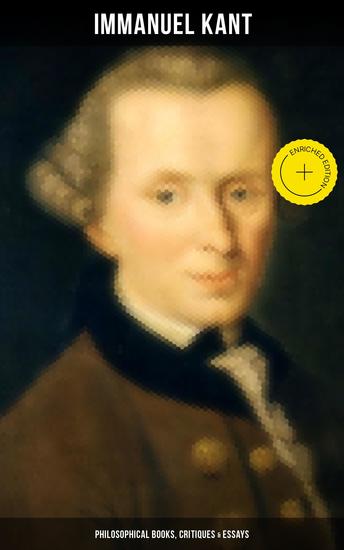
IMMANUEL KANT: Philosophical Books Critiques & Essays - Enriched edition The Critique of Pure Reason Practical Reason and Judgment; Philosophy of Law…
Immanuel Kant
Translator Thomas De Quincey, Paul Carus, J. H. Bernard, T. K. Abbott, William Hastie, J. M. D. Meiklejohn, W. J. Eckoff, Emanuel F. Goerwitz, R. B. Haldane
Publisher: Musaicum Books
Summary
Immanuel Kant's 'Philosophical Books, Critiques & Essays' is a collection of his most significant works that delve into metaphysics, epistemology, ethics, and aesthetics. Known for his complex and systematic style, Kant provides profound insights into the nature of reality, human knowledge, and moral philosophy. This collection includes his groundbreaking 'Critique of Pure Reason,' 'Critique of Practical Reason,' and 'Critique of Judgment,' which have shaped the foundation of modern philosophy. Kant's rigorous and analytical approach to philosophical inquiry sets him apart as one of the most influential thinkers in Western philosophy. His emphasis on reason, autonomy, and the categorical imperative continues to be debated and studied by scholars worldwide. With its thought-provoking content and philosophical depth, this collection serves as a cornerstone for anyone interested in understanding Kantian philosophy.

In this enriched edition, we have carefully created added value for your reading experience:
- An Introduction draws the threads together, discussing why these diverse authors and texts belong in one collection.
- Historical Context explores the cultural and intellectual currents that shaped these works, offering insight into the shared (or contrasting) eras that influenced each writer.
- A combined Synopsis (Selection) briefly outlines the key plots or arguments of the included pieces, helping readers grasp the anthology's overall scope without giving away essential twists.
- A collective Analysis highlights common themes, stylistic variations, and significant crossovers in tone and technique, tying together writers from different backgrounds.
- Reflection questions encourage readers to compare the different voices and perspectives within the collection, fostering a richer understanding of the overarching conversation.
Available since: 07/04/2017.
Print length: 1811 pages.