Join us on a literary world trip!
Add this book to bookshelf
Grey
Write a new comment Default profile 50px
Grey
Subscribe to read the full book or read the first pages for free!
All characters reduced
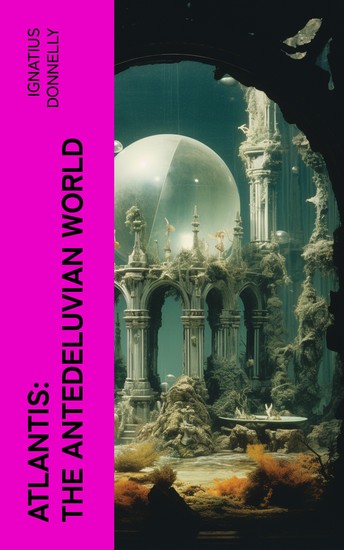
Atlantis: The Antedeluvian World - cover

Atlantis: The Antedeluvian World

Ignatius Donnelly

Publisher: e-artnow

  • 0
  • 0
  • 0

Summary

This book is an excellent classic of Atlantis. We may say this book, more than any other, established the existence of this lost continent for the modern world. Being an essential source of information, it attracted hundreds of thousands of readers and stimulated vast debate on the reality of the lost continent. The book attracts countless scientists who do serious work in their fields and numerous science-fiction writers. Thanks to this work, the idea of a submerged Atlantic Ocean continent remains vigorous today, long after it first appeared.
Available since: 11/20/2023.
Print length: 392 pages.
Other books that might interest you

  • Capturing News Capturing Democracy - Trump and the Voice of America - cover

    Capturing News Capturing...

    Mel Bunce, Kate Wright, Martin...

    • 0
    • 0
    • 0
    The Voice of America (VOA) is the oldest and largest US government-funded international media organization. In 2020, Donald Trump nominated Michael Pack, a right-wing documentarian and close friend of Steve Bannon, to lead the US Agency for Global Media—the independent federal agency overseeing US-funded international media. During Pack's seven month tenure, more than thirty whistleblowers filed complaints against him, and a judge ruled that he had infringed journalists' constitutional right to freedom of speech. 


    How did such a major international public service media network become intensely politicized by government allies in such a short time, despite having its editorial independence protected by law? 


    Capturing News, Capturing Democracy puts these events in historical and international context—and develops a new analytical framework for understanding government capture and its connection to broader processes of democratic backsliding. Drawing from in-depth interviews with network managers and journalists, and analysis of private correspondence and internal documents, Kate Wright, Martin Scott, and Mel Bunce analyze how political appointees, White House officials, and right-wing media influenced VOA—changing its reporting of the Black Lives Matter movement, and the 2020 presidential election.
    Show book
  • The Leading Ladies at The School - cover

    The Leading Ladies at The School

    Andi Sulistiadi

    • 0
    • 0
    • 0
    The characteristics of school leaders who are appointed merely on the instructions of their superiors differ significantly from those of principals who enter the profession out of a deep sense of calling. Leaders appointed by directive often carry out their responsibilities as an obligation or administrative duty, focusing primarily on compliance and fulfilling external expectations. Their authority is derived from positional power rather than intrinsic motivation. In contrast, school principals who assume their role on the basis of personal calling demonstrate a greater sense of commitment, passion, and responsibility for the growth of both students and teachers. Their leadership is not confined to administrative functions but extends to fostering a vision, building a positive culture, and inspiring others. The difference becomes evident in the way they make decisions, manage challenges, and build relationships within the school community. Ultimately, this divergence can be traced back to their initial motivations: while one group enters education out of necessity or appointment, the other chooses the path because of a genuine dedication to the educational mission. The women in this book remind us that leadership is not about power, it is not about status,  it is about service, it is about the courage to balance logic with compassion. Through their vision, education is transformed.
    Show book
  • Summary of Bradley Hope & Justin Scheck’s Blood and Oil - cover

    Summary of Bradley Hope & Justin...

    Falcon Press

    • 0
    • 0
    • 0
    Buy now to get the main key ideas from Bradley Hope & Justin Scheck’s Blood and Oil 
      
    Mohammed bin Salman Al Saud, Saudi Arabia’s crown prince and de facto ruler, is one of the most influential political figures in the world, yet much about him remains mysterious, even to those who are impressed by his groundbreaking economic and social decisions and unprecedented reforms.  
    In Blood and Oil (2020), journalists Bradley Hope and Justin Scheck immerse readers into the twisted world of the Saudi dynasty. They explore the political and foreign agenda of the 36-year-old ruler, who, despite claiming openness and modernity, uses coercion and deadly means to silence dissidents and impose fear. They tackle Saudi Arabia’s strategic relations with the US and its regional allies, as well as its moves against its arch-enemy Iran.
    Show book
  • The Communist Manifesto - cover

    The Communist Manifesto

    Karl Marx, Friedrich Engels

    • 0
    • 0
    • 0
    The Communist Manifesto, originally the Manifesto of the Communist Party (German: Manifest der Kommunistischen Partei), is an 1848 political document by German philosophers Karl Marx and Friedrich Engels. Commissioned by the Communist League and originally published in London just as the Revolutions of 1848 began to erupt, the Manifesto was later recognised as one of the world's most influential political documents. It presents an analytical approach to the class struggle (historical and then-present) and the conflicts of capitalism and the capitalist mode of production, rather than a prediction of communism's potential future forms.The Communist Manifesto summarises Marx and Engels' theories concerning the nature of society and politics, namely that in their own words "the history of all hitherto existing society is the history of class struggles". It also briefly features their ideas for how the capitalist society of the time would eventually be replaced by socialism. In the last paragraph of the Manifesto, the authors call for a "forcible overthrow of all existing social conditions", which served as a call for communist revolutions around the world. In 2013, The Communist Manifesto was registered to UNESCO's Memory of the World Programme along with Marx's Capital, Volume I.
    Show book
  • Islamic Invasions of Europe The: The History of the Ottoman and Moorish Campaigns across the Continent - cover

    Islamic Invasions of Europe The:...

    Charles River Editors

    • 0
    • 0
    • 0
    The history of the Spanish Peninsula is closely bound to that of the Moors. The term “Spain” was not in wide use until the region was united by the monarchs of Aragon and Castile, and the Moors called the lands they ruled in the Iberian Peninsula Al-Andalus, traditionally thought to be an Arabic transliteration of Vandal, the Germanic tribe which briefly ruled the region in the early fifth century. The English name Andalusia derives from the Spanish Andalucia, which is still used by Spain to name its southern region. 
    	Not surprisingly, three religions attempting to coexist during medieval times resulted in nearly incessant conflicts, marked by high taxation, disparate societies, rigid cultural controls, and systemic violence. Despite the odds, these three religions managed to live in a state of quasi-acceptance and peace in most of the major cities in the Iberian Peninsula like Cordoba and Tolaydough, with sporadic warfare occurring on the borders between Al-Andalus and the Christian kingdoms near the Pyrenees Mountains. Muslims, Christians, and Jews would attempt to reorganize their societies several times over the centuries through warfare, always with Jews on the lower rungs and Christians and Muslims fighting it out above them.  
    	The end of the Byzantine Empire had a profound effect not only on the Middle East but Europe as well. Constantinople had played a crucial part in the Crusades, and the fall of the Byzantines meant that the Ottomans now shared a border with Europe. The Islamic empire was viewed as a threat by the predominantly Christian continent to their west, and it took little time for different European nations to start clashing with the powerful Turks. In fact, the Ottomans would clash with Russians, Austrians, Venetians, Polish, and more before collapsing as a result of World War I, when they were part of the Central Powers. 
    Show book
  • End of World War II The: The History of the Battles that Ended the Fighting in Europe and the Pacific - cover

    End of World War II The: The...

    Editors Charles River

    • 0
    • 0
    • 0
    After the successful amphibious invasion on D-Day in June 1944, the Allies began racing east toward Germany and liberating France along the way. The Allies had landed along a 50 mile stretch of French coast, and despite suffering 8,000 casualties on D-Day, over 100,000 still began the march across the western portion of the continent. By the end of August 1944, the German Army in France was shattered, with 200,000 killed or wounded and a further 200,000 captured. However, Adolf Hitler reacted to the news of invasion with glee, figuring it would give the Germans a chance to destroy the Allied armies that had water to their backs. As he put it, “The news couldn’t be better. We have them where we can destroy them.” While that sounds delusional in retrospect, it was Hitler’s belief that by splitting the Allied march across Europe in their drive toward Germany, he could cause the collapse of the enemy armies and cut off their supply lines.  
    Near the end of 1944, as Allied forces were pushing across the Pacific and edging ever closer to Japan, plans were drawn up to invade the Ryuku islands, the most prominent of them being Okinawa. Military planners anticipated that an amphibious campaign would last a week, but instead of facing 60,000 Japanese defenders as estimated, there were closer to 120,000 on the island at the beginning of the campaign in April 1945. The Battle of Okinawa was the largest amphibious operation in the Pacific theater, and it would last nearly 3 months and wind up being the fiercest in the Pacific theater during the war, with nearly 60,000 American casualties and over 100,000 Japanese soldiers killed. In addition, the battle resulted in an estimated 40,000-150,000 Japanese civilian casualties.
    Show book