Join us on a literary world trip!
Add this book to bookshelf
Grey
Write a new comment Default profile 50px
Grey
Subscribe to read the full book or read the first pages for free!
All characters reduced
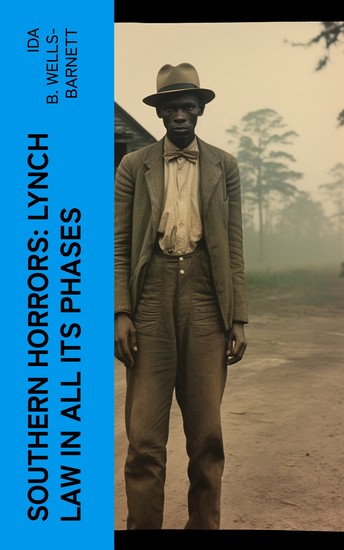
Southern Horrors: Lynch Law in All Its Phases - cover

Southern Horrors: Lynch Law in All Its Phases

Ida B. Wells-Barnett

Publisher: e-artnow

  • 0
  • 0
  • 0

Summary

Southern Horrors: Lynch Law in All Its Phases is an essay by Ida B. Wells-Barnett. It presented the horrors of lynching and advocated ending the practice entirely after the US Civil War.
Available since: 11/22/2023.
Print length: 190 pages.

Other books that might interest you

  • 7 SECRETS to Rapid Skill Mastery - "Elevate your skills now! Discover powerful audio lessons showcasing the 7 Secrets to Rapid Skill Mastery!" - cover

    7 SECRETS to Rapid Skill Mastery...

    Bastian Ashworth

    • 0
    • 0
    • 0
    7 SECRETS to Rapid Skill Mastery: A Simplified Guide with Clear Explanations 
    Are you eager to advance your career and enhance your expertise by acing the upcoming exam for 2025? 
    Looking for a thorough guide that covers everything you need to know to succeed in the exam for 2025? 
    Your search ends here! 
    This guide is your ultimate resource for expanding your knowledge, practicing your skills, and engaging in hands-on activities. With this, you’re on the path to success. 
    Now updated for the 2025 Exam Structure. 
    Key features of this comprehensive guide include: 
    - In-depth insights into the 2025 Certification 
    - Thorough explanations tailored to help you Unlock your potential 
    - Effective strategies for exam preparation and problem-solving 
    Our guide stands out through its meticulous coverage, essential for your exam triumph. Concepts are explored in depth, not simply glossed over. 
    Please note that this guide is an independent resource and is not affiliated with any official certification organization. 
    Crafted with a logical layout and accessible language, our Exam Guide for 2025 ensures seamless transitions between subjects. Say goodbye to convoluted terminology and hello to clear, concise, and technically accurate content. 
    So, why wait? Click the BUY NOW button to secure your guide and kickstart your journey toward success in your 2025 exam! 
    Unlock your potential—accelerate learning and retention today!
    Show book
  • Familiar Violence - A History of Child Abuse - cover

    Familiar Violence - A History of...

    Heather Montgomery

    • 0
    • 0
    • 0
    Child abuse casts a long shadow over the history of childhood. Across the centuries there are numerous accounts of children being beaten, neglected, sexually assaulted, or even killed by those closest to them. This book explores this darker side of childhood history, looking at what constituted cruelty towards children in the past and at the social responses towards it. Focusing primarily on England, it is a history of violence against children in their own homes, covering a large timeframe which extends from medieval times to the present. 


    Undeniably, the experience of children in the past was often brutal, and children were treated with, what seems to contemporary mores, callousness and cruelty. However, historians have paid far less attention to how the mistreatment of children was understood within its contemporary context. Most parents, both now and in the past, loved their children and there have always been widely shared understandings of the boundaries that separate the acceptable treatment of children from the intolerable and morally wrong. This book will examine how these boundaries have changed and been contested over time and, in doing so, provides a context to the many forms of violence experienced by children in the past.
    Show book
  • The Real Moby Dick - The True Story behind the Legendary White Whale - cover

    The Real Moby Dick - The True...

    John Harpoon

    • 0
    • 0
    • 0
    For more than a century, Moby-Dick has captivated readers with its epic tale of obsession, revenge, and the relentless pursuit of an almost mythical white whale. Herman Melville’s novel, often considered one of the greatest works of American literature, is filled with symbolism and philosophical depth. Yet, behind this work of fiction lies a true story—one of survival, maritime danger, and an extraordinary encounter with a real-life white whale that terrorized whalers in the early 19th century. The legend of Moby Dick is more than just fiction; it is rooted in historical events, shaped by firsthand accounts, and woven into the fabric of seafaring lore.  
      
    The inspiration for Melville’s famous novel came from two key sources: the Essex tragedy and the real-life white whale known as Mocha Dick. The Essex, a whaling ship from Nantucket, was attacked and sunk by a massive sperm whale in 1820, leaving its crew stranded in the open ocean. Their harrowing tale of survival, including desperate decisions that pushed them to the limits of human endurance, became one of the most infamous maritime disasters of the era. Meanwhile, whalers of the Pacific frequently told stories of an unusually large and aggressive albino whale that had survived multiple harpoon attacks. This whale, named Mocha Dick after the Chilean island where he was often seen, was known to fight back with remarkable intelligence and force. These real events formed the foundation for Melville’s fictional masterpiece, blending reality with myth in a way that continues to spark curiosity and debate. 
    Show book
  • Kaiser Wilhelm II - Biography of the Last German Emperor and King of Prussia - cover

    Kaiser Wilhelm II - Biography of...

    Kelly Mass

    • 0
    • 0
    • 0
    Wilhelm II, the last German Emperor (Kaiser) and King of Prussia, ruled from June 15, 1888, until his abdication on November 9, 1918, marking the end of the German Empire. His reign was tumultuous, characterized by grand ambitions and disastrous decisions that not only reshaped Germany but also contributed to the broader context of global conflict. Although Wilhelm's creation of a powerful navy and his drive to position Germany as a dominant world power earned him recognition, his erratic public statements and volatile foreign policy alienated many, making him a central figure in the lead-up to World War I. 
    Born in 1859 to Prince Frederick William of Prussia and Victoria, Princess Royal of the United Kingdom, Wilhelm II was part of a deeply interconnected European royal family. His mother, Queen Victoria’s eldest daughter, brought him into a web of political alliances that spanned several major European nations. Wilhelm’s father, Frederick III, briefly held the throne for only 99 days in 1888 before his untimely death, making it a year of remarkable transitions. Just months after his father’s passing, Wilhelm succeeded to the throne during what historians refer to as the "Year of the Three Emperors," as Wilhelm’s grandfather, Wilhelm I, had also died earlier that year.
    Show book
  • Democracy Rules - cover

    Democracy Rules

    Jan-Werner Müller

    • 0
    • 0
    • 0
    A much-anticipated guide to saving democracy, from one of our most essential political thinkers. 


    Everyone knows that democracy is in trouble, but do we know what democracy actually is? Jan-Werner Müller, author of the widely translated and acclaimed What Is Populism?, takes us back to basics in Democracy Rules. In this short, elegant volume, he explains how democracy is founded not just on liberty and equality, but also on uncertainty. The latter will sound unattractive at a time when the pandemic has created unbearable uncertainty for so many. But it is crucial for ensuring democracy's dynamic and creative character, which remains one of its signal advantages over authoritarian alternatives that seek to render politics (and individual citizens) completely predictable. 


    Müller shows that we need to re-invigorate the intermediary institutions that have been deemed essential for democracy's success ever since the nineteenth century: political parties and free media. Contrary to conventional wisdom, these are not spent forces in a supposed age of post-party populist leadership and post-truth. Müller suggests concretely how democracy's critical infrastructure of intermediary institutions could be renovated, re-empowering citizens while also preserving a place for professionals such as journalists and judges.
    Show book
  • Ancient Celtic Legends: The History of Celtic Folk Tales and Myths that Influenced European Mythology - cover

    Ancient Celtic Legends: The...

    Editors Charles River

    • 0
    • 0
    • 0
    The Celts are one of the most well-known groups in Europe and one of the least understood. Depending on which classifications are used, the Celts are also one of the oldest civilizations in Europe. In the centuries before Christ, the Celts were spread out across much of continental Europe, and though they are mostly identified with Gaul, evidence suggests they also spread as far as Portugal. Though they were spread out across Europe before the height of the Roman Empire, most people associate the Celts with the British Isles today, particularly Ireland and Scotland. After they had been relegated to those smaller regions as a result of the Romans and other migrations, the culture of the Celts as it is currently understood began to congeal during the Early Middle Ages, and Celtic culture, folklore, and legend have all become inextricably intertwined with Irish history and British history as a whole. 
    Historically, Celtic cultures differ from their English and French neighbors in a number of ways, including social organization, language, values and economic systems, but one of the most captivating of these has always been their myths. Celtic Myths, which can be read in translation without needing special training in grammar, are more accessible than the Celtic languages, and unlike the other distinctive features that have faded over the centuries, myths still have their immediacy and power when read today. While much has undoubtedly been lost from the ancient Celts over time, medieval manuscripts help scholars understand how Celtic myths have reached the form they have today. Like many ancient belief systems, Celtic mythology shares Indo-European roots, meaning Celtic beliefs have cousins in related societies like the Norse, Greeks, Romans and Slavs, with a foundation of shared mythmaking that goes back several millennia.
    Show book