Join us on a literary world trip!
Add this book to bookshelf
Grey
Write a new comment Default profile 50px
Grey
Subscribe to read the full book or read the first pages for free!
All characters reduced
Mob Rule in New Orleans - cover

Mob Rule in New Orleans

Ida B. Wells-Barnett

Publisher: Interactive Media

  • 0
  • 0
  • 0

Summary

Ida B. Wells-Barnett's work on "Mob Rule in New Orleans" is a seminal examination of the dynamics of racial violence and lynching during the Jim Crow Era. Through her meticulous research and critical analysis, Wells-Barnett illuminates how mob rule functioned as an extrajudicial form of racial terror, providing the impetus to challenge oppressive structures of white supremacy.
Available since: 01/20/2023.
Print length: 66 pages.

Other books that might interest you

  • Secret Society Secrets - cover

    Secret Society Secrets

    Raphael Terra

    • 0
    • 0
    • 0
    This audiobook has been recorded using Text to speech (TTS). 
     
    Secret societies have their origin in religions, mysteries, folklore, myths and legends. They very often created them and in each of these tales can be found the ultimate truths of the secret societies of the world. 
     
    Tales of the children of Jesus, the Holy Grail, hidden chambers in ancient structures and profound inner wisdom are all part and parcel of the fascinating world of secret societies. It is a world of the occult. It is hidden right before our very eyes and all we need is new sight. 
     
    In this film we will reveal the very heart of the ancient secret orders and their beliefs. We will show exactly what it is they are hiding and how these secrets have been hidden right before our eyes. These secrets are highly esoteric and mystical and we will need to alter our perspective inorder to see the truth. This is the quantum world of the mind itself and the revelation of sacred and secret truths of the universe itself. Suddenly mysteries will reveal their secrets. From the Holy Grail to the Ark of the Covenant, from Sufi mysticism to enlightenment itself, the occult nature of these profound and enigmatic tales will be revealed. 
     
    The inner teachings and secrets of these hidden groups is one of profound wisdom. This is why it has been so powerful. It is time to walk the path of the initiate and discover the ultimate sacred hidden truths for ourselves.
    Show book
  • Sickening - Anti-Black Racism and Health Disparities in the United States - cover

    Sickening - Anti-Black Racism...

    Anne Pollock

    • 0
    • 0
    • 0
    A crucial component of anti-Black racism is the unconscionable disparity in health outcomes between Black and white Americans. Sickening examines this institutionalized inequality through dramatic, concrete events from the past two decades, revealing how unequal living conditions and inadequate medical care have become routine. 


    From the spike in chronic disease after Hurricane Katrina to the lack of protection for Black residents during the Flint water crisis—and even the life-threatening childbirth experience for tennis star Serena Williams—author Anne Pollock takes listeners on a journey through the diversity of anti-Black racism operating in healthcare. She goes beneath the surface to deconstruct the structures that make these events possible, including mass incarceration, police brutality, and the hypervisibility of Black athletes' bodies. Ultimately, Sickening shows what these shocking events reveal about the everyday racialization of health in the United States. 


    Concluding with an examination of racialized healthcare during the COVID pandemic and the Black Lives Matter rebellions of 2020, Sickening cuts through the mind-numbing statistics to vividly portray healthcare inequalities. In a gripping style, Pollock shows the devastating reality and consequences of systemic racism on the lives and health of Black Americans.
    Show book
  • How School Makes Kids Stupid - The Flaws in Modern Education and What Needs to Change - cover

    How School Makes Kids Stupid -...

    John Harpoon

    • 0
    • 0
    • 0
    Education is supposed to be the foundation of knowledge, personal growth, and future success. However, the modern school system has become a rigid, outdated structure that often fails to serve its true purpose. Instead of fostering curiosity, creativity, and independent thinking, it enforces memorization, conformity, and a narrow definition of intelligence. The system was designed for an industrial era that no longer exists, yet it continues to shape young minds in ways that leave them unprepared for the real world.   
    The purpose of education has shifted drastically over time. Originally, learning was a means of survival and personal development, allowing individuals to acquire skills and knowledge relevant to their environment. With the rise of industrialization, schools were structured to produce disciplined, obedient workers rather than innovative thinkers. Today, that outdated model remains largely intact. Instead of adapting to the needs of a rapidly changing world, schools continue to prioritize standardization over flexibility, forcing students into a one-size-fits-all system that often stifles their potential.  
    At the core of this broken system is an overemphasis on memorization rather than true understanding. Students are expected to absorb and regurgitate information for tests, only to forget most of it shortly after. Critical thinking and problem-solving take a backseat to rote learning, leaving students ill-equipped to navigate complex real-world challenges. The grading system further reinforces this problem, reducing learning to a numbers game where students are judged by their ability to recall facts rather than their capacity for deep thinking. 
    Show book
  • Aztec Myths and Legends - Gods Rituals and the Cosmic Worldview - cover

    Aztec Myths and Legends - Gods...

    Odessa Nightshade

    • 0
    • 0
    • 0
    The myths and legends of the Aztecs offer a glimpse into a world both vibrant and complex, where gods walked among mortals, and cosmic forces shaped the destiny of an empire. Rooted in the beliefs of the Nahua peoples of central Mexico, Aztec mythology was more than just a collection of stories—it was a sacred system that explained the origins of the universe, the role of humanity, and the ever-present struggle between order and chaos. These myths provided meaning to daily life, justified political and military expansion, and reinforced the religious practices that were central to Aztec society.  
    The origins of Aztec mythology are intertwined with the migrations and conquests that shaped their civilization. The Mexica, the people who would later establish the powerful city of Tenochtitlan, believed they were divinely chosen. According to their legends, they embarked on a long journey from a mythical homeland called Aztlán under the guidance of their patron god, Huitzilopochtli. Their eventual settlement on an island in Lake Texcoco fulfilled a prophecy that marked the beginning of their great empire. By weaving their own history into the fabric of myth, the Aztecs established their right to rule and their connection to the gods.  
    In Aztec society, mythology was inseparable from religion, politics, and even warfare. The gods required constant nourishment through human sacrifice, a practice that was not seen as cruel but as essential for maintaining cosmic balance. Warriors who died in battle were honored as they were believed to ascend to the sun’s domain, while sacrificial victims were thought to sustain the gods with their blood. Mythology also shaped the Aztec worldview through their intricate calendar system, which guided ceremonies, agriculture, and daily life. Time was cyclical, and each era was destined to end and be reborn—a belief that influenced their response to the arrival of the Spanish. 
    Show book

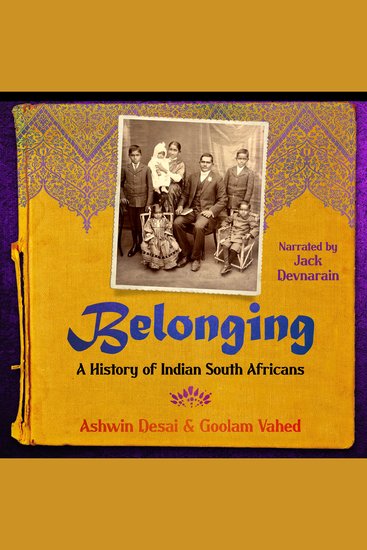
  • Belonging - A History of Indian South Africans - cover

    Belonging - A History of Indian...

    Ashwin Desai, Goolam Vahed

    • 0
    • 0
    • 0
    What does it mean to belong? 
    Across oceans and centuries, this sweeping narrative shuttles between the corridors of the Colonial Office in London, the contested streets of Durban, and the changing power dynamics within the British Raj.  
    The first boatload of indentured Indians arrived in Natal in 1860. Thousands were to follow. In haunting detail, the book captures the plight of these labourers as well as the vicious onslaught faced by the merchant class for daring to outpace their colonial rivals. At its core are the untold struggles of Indian South Africans as they confront the ever-present threat of repatriation.  
    Sensitive to shifting political terrains, the book weaves together seismic events – the independence of India, the coming of apartheid and the threat once more of mass expulsions – with the texture of everyday life. The granting of citizenship in 1961 is accompanied by mass relocations as the Group Areas Act rips communities from their roots. Yet, out of this despair, barren townships on the edges of cities are turned into places of hope.  
    In the final chapters, the fall of apartheid offers a moment of transcendence. Yet it also asks: what does it mean, at last, to belong? It is a fascinating story of the global and the local, of resistance and collaboration, and undefeated optimism. This is a book for anyone who has ever sought a place to call home.
    Show book
  • Food Allergy Advocacy - Parenting and the Politics of Care - cover

    Food Allergy Advocacy -...

    Danya Glabau

    • 0
    • 0
    • 0
    A detailed exploration of parents' fight for a safe environment for their kids, interrogating how race, class, and gender shape health advocacy 


    The success of food allergy activism in highlighting the dangers of foodborne allergens shows how illness communities can effectively advocate for the needs of their members. In Food Allergy Advocacy, Danya Glabau follows parents and activists as they fight for allergen-free environments, accurate labeling, the fair application of disability law, and access to life-saving medications for food-allergic children in the United States. At the same time, she shows how this activism also reproduces the culturally dominant politics of personhood and responsibility, based on an idealized version of the American family, centered around white, middle-class, and heteronormative motherhood. 


    By holding up the threat of food allergens to the white nuclear family to galvanize political and scientific action, Glabau shows, the movement excludes many, including Black women and disabled adults, whose families and health have too often been marginalized from public health and social safety net programs. Further, its strategies are founded on the assumption that market-based solutions will address issues of social exclusion and equal access to healthcare.
    Show book