Begleiten Sie uns auf eine literarische Weltreise!
Buch zum Bücherregal hinzufügen
Grey
Einen neuen Kommentar schreiben Default profile 50px
Grey
Jetzt das ganze Buch im Abo oder die ersten Seiten gratis lesen!
All characters reduced
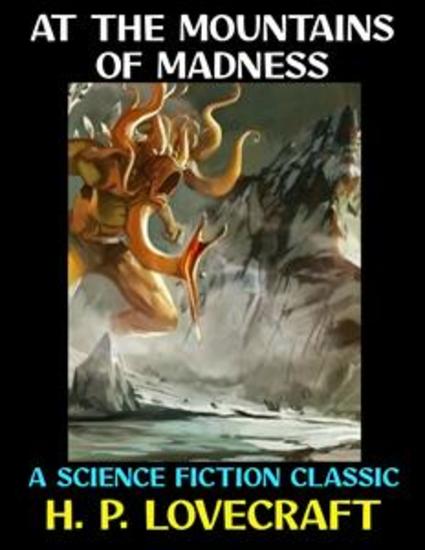
At the Mountains of Madness - A Science Fiction Classic - cover

At the Mountains of Madness - A Science Fiction Classic

H.P. Lovecraft

Verlag: Diamond Book Publishing

  • 0
  • 0
  • 0

Beschreibung

The story details the events of a disastrous expedition to Antarctica in September 1930, and what is found there by a group of explorers led by the narrator, Dr. William Dyer of Miskatonic University. Throughout the story, Dyer details a series of previously untold events in the hope of deterring another group of explorers who wish to return to the continent. These events include the discovery of an ancient civilization older than the human race, and realization of Earth's past told through various sculptures and murals. At the Mountains of Madness is one of the master-pieces by H. P. Lovecraft.
Verfügbar seit: 02.05.2023.

Weitere Bücher, die Sie mögen werden

  • Kitty's Class Day - cover

    Kitty's Class Day

    Louisa May Alcott

    • 0
    • 0
    • 0
    Louisa May Alcott’s Kitty’s Class Day is a delightful short story that blends youthful vanity, sisterly devotion, and gentle moral lessons with Alcott’s trademark wit and warmth. 
    Seventeen-year-old Kitty Heath is determined to shine at Harvard’s Class Day celebrations, outfitted in a fashionable Paris organdie gown with daisies in her bonnet and a train she insists upon having. Behind her excitement stands her devoted sister Priscilla, quietly sacrificing to make Kitty’s dreams possible. But amid flirtations, mishaps, and a humiliating tumble, Kitty learns that true happiness lies not in appearances or admiration, but in the steadfast love of family and the honest affection of her cousin Jack. 
    Charming, humorous, and heartfelt, this timeless tale captures the follies and triumphs of girlhood, offering listeners both laughter and life lessons.
    Zum Buch
  • Can You Forgive Her? Volume 3 - cover

    Can You Forgive Her? Volume 3

    Anthony Trollope

    • 0
    • 0
    • 0
    In Volume 3, Alice Vavasor seeks to resolve her tumultuous relationships, torn between George’s charm and John Grey’s steadfastness. As she confronts the consequences of her choices, Lady Glencora finds stability in her marriage, balancing duty with personal growth. Trollope masterfully concludes his exploration of love, forgiveness, and societal pressures, emphasizing redemption and self-awareness. With wit and insight, the novel critiques Victorian norms while celebrating resilience and moral clarity. This final volume delivers a satisfying resolution, reflecting on whether forgiveness—of oneself and others—is key to lasting happiness.
    Zum Buch
  • Evening Guest An - From their pens to your ears genius in every story - cover

    Evening Guest An - From their...

    Alexander Kuprin

    • 0
    • 0
    • 0
    Alexander Kuprin was born in Narovchat, Penza in Russia on 7th September 1870. 
    At 3 his Father died and he and mother moved to Moscow. By 10 he was enrolled at the Second Moscow Military High School and there his interest in literature began. The Alexander Military Academy followed and two years later he was a sub-lieutenant and posted to an Infantry Regiment for a further four years. 
    Despite his duties he was a now a keen writer and published his first short story at this time. His military duties also garnered him experiences for his breakthrough work ‘The Duel’.  Leaving the military he left for Kiev to work for local newspapers.  He continued to publish both stories and novels and by 1901 he was in St Petersburg becoming part of a group that included Chekhov, Ivan Bunin, Maxim Gorky and Leonid Andreyev.  
    In the years that followed further controversial works and acclaim followed.  His comments on the regime meant he was also put under secret police surveillance.   
    As World War I erupted, Kuprin opened a military hospital but was then given command of an infantry company in Finland. He was soon discharged on grounds of ill health.  
    The October Revolution saw him praise Lenin, but he warned that the Bolsheviks threatened Russian culture and might cause further widespread suffering to the peasants.  As Civil War raged he took his family to Helsinki and then on to Paris. 
    Exile saw his talents decline further and his succumbing to alcoholism. He became lonely and withdrawn. The family's poverty increased his malaise.   
    In May 1937, the Kuprin’s returned to Moscow.  He now saw his work published but wrote almost nothing new.  In 1938 his health rapidly deteriorated.  Already suffering from a kidney problems and sclerosis, he had now developed cancer of the oesophagus.  
    Alexander Kuprin died on 25th August 1938.
    Zum Buch
  • Aloysha the Pot - From their pens to your ears genius in every story - cover

    Aloysha the Pot - From their...

    Leo Tolstoy

    • 0
    • 0
    • 0
    Leo Tolstoy was born in 1828 in the Russian province of Tula to a wealthy noble family. As a child, he had private tutors but he showed little interest in any formal education. When he went to the University of Kazan in 1843 to study oriental languages and law, he left without completing his courses.  Life now was relaxed and idle but with some writing also taking place.  Gambling debts forced an abrupt change of path and he joined the army to fight in the Crimean War.  He was commended for his bravery and promoted but was appalled at the brutality and loss of life.  He recorded these and other earlier experiences in his diaries which formed the basis of several of his works. 
    In 1852 ‘Childhood’ was published to immediate success and was followed by ‘Boyhood’ and ‘Youth’. 
    His experience in the army and the horrors he witnessed resulted in ‘The Cossacks’ in 1862 and the trilogy ‘Sevastopol Tales’. After the war he travelled around Europe, visiting London and Paris and meeting such luminaries as Victor Hugo and Charles Darwin.  
    It was now that Tolstoy began his masterpiece, ‘War and Peace’. Published in 1869 it was an epic work that changed literature. He quickly followed this with ‘Anna Karenina’.  
    These successes made Tolstoy rich and helped him accomplish many of his dreams but also brought problems as he grappled with his faith and the lot of the oppressed poor. These revolutionary views became so popular that the authorities now kept him under surveillance.  
    He led a life of asceticism and vegetarianism and put his socialist ideals into practice by establishing numerous schools for the poor and food programmes. He also believed in giving away his wealth, which caused much discord with his wife.  
    His writing continued to bring forth classics such as ‘The Death of Ivan Ilyich’ and many brilliant and incisive short stories such as ‘How Much Land Does A Man Need’.  
    In 1901 Tolstoy was excommunicated from the Church and controversially deselected for the Nobel Prize for Literature. 
    Whilst undertaking a pilgrimage by train in October 1910 with his daughter Aleksandra he caught pneumonia in the nearby town of Astapovo.  Leo Tolstoy died on November 9th, 1910, he was 82.
    Zum Buch
  • God Sees the Truth But Waits - From their pens to your ears genius in every story - cover

    God Sees the Truth But Waits -...

    Leo Tolstoy

    • 0
    • 0
    • 0
    Leo Tolstoy was born in 1828 in the Russian province of Tula to a wealthy noble family. As a child, he had private tutors but he showed little interest in any formal education. When he went to the University of Kazan in 1843 to study oriental languages and law, he left without completing his courses.  Life now was relaxed and idle but with some writing also taking place.  Gambling debts forced an abrupt change of path and he joined the army to fight in the Crimean War.  He was commended for his bravery and promoted but was appalled at the brutality and loss of life.  He recorded these and other earlier experiences in his diaries which formed the basis of several of his works. 
    In 1852 ‘Childhood’ was published to immediate success and was followed by ‘Boyhood’ and ‘Youth’. 
    His experience in the army and the horrors he witnessed resulted in ‘The Cossacks’ in 1862 and the trilogy ‘Sevastopol Tales’. After the war he travelled around Europe, visiting London and Paris and meeting such luminaries as Victor Hugo and Charles Darwin.  
    It was now that Tolstoy began his masterpiece, ‘War and Peace’. Published in 1869 it was an epic work that changed literature. He quickly followed this with ‘Anna Karenina’.  
    These successes made Tolstoy rich and helped him accomplish many of his dreams but also brought problems as he grappled with his faith and the lot of the oppressed poor. These revolutionary views became so popular that the authorities now kept him under surveillance.  
    He led a life of asceticism and vegetarianism and put his socialist ideals into practice by establishing numerous schools for the poor and food programmes. He also believed in giving away his wealth, which caused much discord with his wife.  
    His writing continued to bring forth classics such as ‘The Death of Ivan Ilyich’ and many brilliant and incisive short stories such as ‘How Much Land Does A Man Need’.  
    In 1901 Tolstoy was excommunicated from the Church and controversially deselected for the Nobel Prize for Literature. 
    Whilst undertaking a pilgrimage by train in October 1910 with his daughter Aleksandra he caught pneumonia in the nearby town of Astapovo.  Leo Tolstoy died on November 9th, 1910, he was 82.
    Zum Buch
  • The Wouldbegoods - cover

    The Wouldbegoods

    Edith Nesbit

    • 0
    • 0
    • 0
    "The Wouldbegoods" by Edith Nesbit continues the adventures of the Bastable siblings as they earnestly attempt to be good but find themselves entangled in humorous escapades. Their well-intentioned deeds lead to comical mishaps, revealing the challenges of virtue. Nesbit's charming narrative explores the complexities of childhood innocence, mischief, and the enduring warmth of family dynamics in this delightful sequel.
    Zum Buch