¡Acompáñanos a viajar por el mundo de los libros!
Añadir este libro a la estantería
Grey
Escribe un nuevo comentario Default profile 50px
Grey
Suscríbete para leer el libro completo o lee las primeras páginas gratis.
All characters reduced
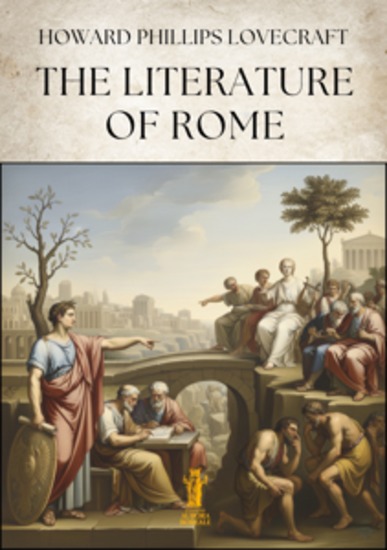
The Literature of Rome - cover

The Literature of Rome

Howard Phillips Lovecraft

Editorial: Edizioni Aurora Boreale

  • 0
  • 0
  • 0

Sinopsis

Howard Phillips Lovecraft (1890-1937) was an American writer, poet, literary critic and essayist, recognized as one of the greatest writers of horror literature together with Edgar Allan Poe and considered by many to be one of the precursors of Anglo-American science fiction. His works, a contamination between horror, soft science fiction, dark fantasy and low fantasy, have often been described, even by himself, with the term weird fiction (where weird stands for "strange"), being recognized among the main origins of the modern literary genre of the new weird.Published in November 1918 in The United Amateur, official organ of the United Amateur Press Association, the brief essay The Literature of Rome offers a compelling glimpse into the scholarly mind of a young Howard Phillips Lovecraft. Long before he became the master of "cosmic horror", Lovecraft was a devoted neoclassicist, and this text serves as a concise, passionate chronological survey of Latin letters, from their rough beginnings to their golden age.In this essay, Lovecraft argues that the Roman literary tradition is not merely a shadow of the Greek one, but a vital pillar of Western civilization. He traces the evolution of the Roman voice, emphasizing how the language transitioned from the "rude and unpolished" verses of the early Republic to the sublime sophistication of the Augustan Age.
Disponible desde: 30/12/2025.


Otros libros que te pueden interesar

  • The Pax Romana - Peace and Prosperity in the Roman Empire - cover

    The Pax Romana - Peace and...

    Rogan Fish

    • 0
    • 0
    • 0
    The Pax Romana, meaning "Roman Peace," was a remarkable period of stability and prosperity that lasted for over two centuries. It began with the rise of Augustus, Rome’s first emperor, following the chaotic years of civil war that had plagued the late Republic. This era saw the establishment of a strong centralized government, economic growth, and the expansion of Rome’s influence across the Mediterranean and beyond. The foundations of this peace were carefully laid through political reforms, military strength, and a redefined vision of Roman leadership. 
    The aftermath of the civil wars that marked the late Republic left Rome in a state of disarray. The assassination of Julius Caesar in 44 BCE triggered a power struggle, culminating in the final confrontation between Octavian—Caesar’s adopted heir—and Mark Antony. With his victory at the Battle of Actium in 31 BCE, Octavian secured his position as the dominant ruler of Rome. In 27 BCE, he formally accepted the title of Augustus from the Senate, marking the beginning of the imperial system. This transition ended the Republic but ushered in an era of stability that would define the next two centuries. 
    Augustus carefully crafted a government that appeared to preserve Republican traditions while consolidating power in his hands. By maintaining the illusion of senatorial authority, he avoided the fate of his great-uncle, Julius Caesar. However, his rule was firmly grounded in the principles of autocracy. He reorganized the military, ensuring its loyalty through direct financial incentives, and established a standing army with permanent stations along the empire’s borders. This professionalization of the military reduced internal conflicts and safeguarded the empire from external threats.
    Ver libro
  • All About Amy (Little Women Essay) - cover

    All About Amy (Little Women Essay)

    Niina Niskanen

    • 0
    • 0
    • 0
    Join me on a journey to study Amy March and her real-life inspiration May Alcott Nieriker. The misconceptions about Jo´s insecurities and especially about her looks. Society likes to put two characters against one another but is this true to reality? Find out that and more in the Little Women podcast. 
    People often praise Jo for being a tomboy and how she rejects femininity, but Jo´s idealization of the masculine has very toxic elements. Amy is a character who is more governed by her brain, whereas Jo is in fact governed by her emotions, which is considered a feminine trait. In the novel, Jo struggles to show her feelings because she considers that weak and "feminine". When their father is wounded in the war she shouts to her sisters not to cry. A couple of years later Laurie says that she doesn't show emotions and calls her out about it. Because Jo tries to shut down an important human part of herself, simply because she considers it feminine, is actually something that slowly eats her inside and contributes to her loneliness. This is why the umbrella chapter is so important because Friedrich says to Jo that it is okay to be vulnerable. 
    Amy does the opposite. She considers rational marriage with Fred Vaughn because it allows her to secure her family´s financial future. When Laurie reminds Amy that she is her mother´s daughter, and she simultaneously inspires Laurie to become a productive member of society, Amy allows herself to listen to her heart and her own feelings and allowing herself to become more open and it is this inner work that the couples do in Little Women, that makes these relationships work. 
    Unfortunately, the adaptations rarely pay any attention to this. There are people who have not read the novel, have only seen the films, and don´t understand why the couples end up together. This is because the adaptations, never bother to show what actually happens between these people in the novel.
    Ver libro
  • Good Newes From New England - A True Relation of Things Very Remarkable at the Plantation of Plimoth in New England - cover

    Good Newes From New England - A...

    Edward Winslow

    • 1
    • 0
    • 0
    Good Newes From New England is Edward Winslow's journal which covers the events that occurred between 1622 and 1623 at Plymouth Colony.  It includes firsthand information from the earliest American colonial history such as Tisquantum's death, the sickness of Massasoit, Thomas Weston's Wessagussett Colony, and many more.
    Ver libro
  • The Shortest History of France - From Roman Gaul to Revolution and Cultural Radiance―A Global Story for Our Times - cover

    The Shortest History of France -...

    Colin Jones

    • 0
    • 0
    • 0
    France is the most popular tourist destination in the world, thanks to its unsurpassed cultural and historical riches. Gothic architecture, Louis XIV opulence, revolutionary spirit, café society, haute cuisine and couture . . . what could be more quintessentially French? 


    Rarely, however, do we think of France as a melting pot, and yet historian Colin Jones asserts it's no less a mélange of foreign ingredients than the United States, and by some measures more. As nationalism and anti-immigration rhetoric surge in France (and elsewhere), The Shortest History of France presents a portrait of a nation whose politics and society have always been shaped by global forces. Grounded in up-to-date historical scholarship that avoids the traps of national exceptionalism, Jones reminds us that it was only after the first millennium of French history that a nation-state began to emerge. 


    France has been home to the Enlightenment, The Universal Declaration of Human Rights, and The Paris Agreement. Meanwhile, its darker moments have included the Vichy regime and the Algerian War, along with persistent racism, police brutality, and civil unrest. From the serious to the sublime, The Shortest History of France is a dynamic, global story enhanced with touches of cultural radiance—truly a retelling for our times.
    Ver libro
  • World War II in the Arctic: The History of the Aleutian Islands Campaign and Nazi Germany’s Arctic Invasion of the Soviet Union - cover

    World War II in the Arctic: The...

    Editors Charles River

    • 0
    • 0
    • 0
    Today, everyone remembers the most famous consequences of Hitler’s choice, particularly the fighting at Leningrad and Stalingrad, but the invasion was so comprehensive that it also involved fighting in the barren lands near the Arctic Circle, bringing fierce combat to the taiga and tundra. In fact, Arctic combat occurred in both the Pacific and European theaters of the war, and in both cases the operations were related in some measure to external lines of supply to the USSR. 
    Meanwhile, the Wehrmacht and the Red Army also met in the boreal pine forests, bogs, and tundra of Lapland and far northern Russia during the Barbarossa campaign of 1941. Fighting separately from the other Army Groups of the Third Reich, elite German Gebirgs (mountain) division soldiers and tough, resourceful Finns clashed with relatively determined and experienced Red Army soldiers in the forbidding terrain east of Finland’s border. This campaign bore the elegant operational tile of Silberfuchs, or “Silver Fox.” Aiming for Murmansk, a key Soviet port, or at least to sever the rail lines connecting it to points south and east, the Germans found themselves contending with the rugged, unfamiliar landscape, tough Soviet resistance, and as all too frequently occurred, the half-baked strategic meddling of Adolf Hitler, Fuhrer of the Third Reich. 
    For the Japanese, the secondary operation to the Aleutian Islands proved more successful than the main thrust at Midway Island. In a triumph of cryptanalytic skill and poker-player daring, codebreaker Joseph Rochefort and his team at “Hypo” cracked Japanese messages proving the main effort aimed at Midway. The U.S. Navy intercepted Yamamoto's fleet at Midway and smashed its carriers in one of the most decisive actions of the Pacific Theater on June 3rd to 7th, 1942. The Aleutians invasion, on the other hand, gave Japan a foothold on American territory that required almost a year to dislodge.
    Ver libro
  • Jo March Woman Of Contradictions - Little Women Podcast - cover

    Jo March Woman Of Contradictions...

    Niina Niskanen, Christina Scott

    • 0
    • 0
    • 0
    Delve into the multifaceted world of Jo March in this captivating audiobook, "Jo March, Woman of Contradictions," which explores the complex dimensions of one of literature’s most beloved characters. This insightful narrative not only examines Jo’s personal journey but also unveils the real-life inspirations behind the characters of Laurie and Friedrich, shedding light on Louisa May Alcott’s inner circle and the influential figures who shaped her storytelling. 
    The audiobook addresses a curious trend in adaptations of "Little Women"—the absence of a German actor in the role of Friedrich Bhaer. Despite Friedrich’s German heritage being a significant aspect of his character, this detail has often been overlooked in cinematic portrayals. The narrative delves into possible reasons for this casting choice and its implications for the character’s authenticity. 
    Alcott's deep admiration for German culture is a recurrent theme in this exploration. Her writings reflect a profound appreciation for German literature, philosophy, and traditions, which significantly influenced her creation of Friedrich Bhaer. Through this lens, listeners gain a deeper understanding of Alcott's cultural influences and the nuances they bring to her work.
    Ver libro