Join us on a literary world trip!
Add this book to bookshelf
Grey
Write a new comment Default profile 50px
Grey
Subscribe to read the full book or read the first pages for free!
All characters reduced
The Bark Canoes and Skin Boats of North America - cover

The Bark Canoes and Skin Boats of North America

Howard Irving Chapelle, Tappan Adney

Publisher: e-artnow

  • 0
  • 0
  • 0

Summary

"The Bark Canoes and Skin Boats of North America" by Howard Irving Chapelle, Tappan Adney. Published by e-artnow. e-artnow publishes a wide range of titles that encompasses every genre. From well-known classics & literary fiction and non-fiction to forgotten−or yet undiscovered gems−of world literature, we issue the books that need to be read. Each e-artnow edition has been meticulously edited and formatted to boost readability for all e-readers and devices. Our goal is to produce eBooks that are user-friendly and accessible to everyone in a high-quality digital format.
Available since: 11/26/2023.
Print length: 10170 pages.

Other books that might interest you

  • Gitanjali - Song Offerings - cover

    Gitanjali - Song Offerings

    Rabindranath Tagore

    • 0
    • 0
    • 0
    GitanjaliBy Rabindranath TagoreWith an Introduction by W. B. YeatsGitanjali (song offerings) is a collection of 103 devotional poems written originally in Bengali and first published in 1910.  In 1912 a translation into English by the author was published in 1912, and led to his being awarded the Nobel Prize for Literature in 1913.The Indian sage, Paramahansa Yogananda, who was a friend and admirer of Tagore, made the following comment on his poetry:  "The beauty of his lines, to me, lies in his art of referring to God in nearly every stanza, yet seldom mentioning the sacred Name. 'Drunk with the bliss of singing,' Tagore writes, 'I forget myself and call thee friend who art my lord.'"Production copyright 2024 Voices of Today
    Show book
  • DESTROY Digital Media Platforms - How Competitive Streaming Levels the Playing Field for Creatives - cover

    DESTROY Digital Media Platforms...

    Christopher Grant Sr.

    • 0
    • 0
    • 0
    You take your shot at success and fame. You tell anyone who will listen, “Hey, check me out! I’m on Spotify, Amazon, and YouTube!” Finally, you’re validated. You’re at the table with the big kids — Right? WRONG. 
    YOUR CONTENT EVERYWHERE GETS YOU NOWHERE... 
    Music industry insider Christopher Grant Sr. introduces UnderRepresented Creatives to the groundbreaking concept of Competitive Streaming™  and DESTROYs the idea that creatives must rely on traditional digital media platforms for discovery. He levels the playing field for URCs, as he calls them, to achieve success — regardless of fame, connections, or net worth.  
    “I’m not here to bash traditional digital media platforms like Spotify, Netflix, Amazon, etc., but I know what they’re good at and what they’re not good at. Unfortunately, one thing they’re not good at is making you a star.”        —CGrantSr.                                  
    Christopher Grant, Sr. has nearly 20 years of successful experience in the entertainment industry. As founder and CEO of upstart media company SEVENHORNS, host of the DESTROY Podcast, and founder of TraxBox, Inc., Chris believes in the power of multimedia to impact society for good. One of his lifelong pursuits has been to create and deliver culturally relevant content that challenges the human condition.
    Show book
  • Magus - The Art of Magic from Faustus to Agrippa - cover

    Magus - The Art of Magic from...

    Anthony Grafton

    • 0
    • 0
    • 0
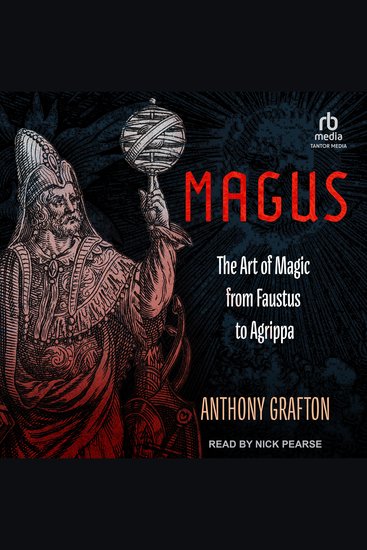
    In literary legend, Faustus is the quintessential occult personality of early modern Europe. The historical Faustus, however, was something quite different: a magus—a learned magician fully embedded in the scholarly currents and public life of the Renaissance. And he was hardly the only one. Anthony Grafton argues that the magus in sixteenth-century Europe was a distinctive intellectual type, both different from and indebted to medieval counterparts as well as contemporaries like the engineer, the artist, the Christian humanist, and the religious reformer. Alongside these better-known figures, the magus had a transformative impact on his social world. 


    Magus details the arts and experiences of several learned magicians. Grafton explores their methods, the knowledge they produced, the services they provided, and the overlapping political and social milieus to which they aspired—often, the circles of kings and princes. During the late fifteenth and early sixteenth centuries, these erudite men anchored debates about licit and illicit magic, the divine and the diabolical, and the nature of "good" and "bad" magicians. Over time, they turned magic into a complex art, which drew on contemporary engineering as well as classical astrology, probed the limits of what was acceptable in a changing society, and promised new ways to explore the self and exploit the cosmos.
    Show book
  • The World Is Always Coming to an End - Pulling Together and Apart in a Chicago Neighborhood - cover

    The World Is Always Coming to an...

    Carlo Rotella

    • 0
    • 0
    • 0
    An urban neighborhood remakes itself every day—and unmakes itself, too. Houses and stores and streets define it in one way. But it’s also people—the people who make it their home, some eagerly, others grudgingly. A neighborhood can thrive or it can decline, and neighbors move in and move out. Sometimes they stay but withdraw behind fences and burglar alarms. If a neighborhood becomes no longer a place of sociability and street life, but of privacy indoors and fearful distrust outdoors, is it still a neighborhood? 
      
    In the late 1960s and 1970s Carlo Rotella grew up in Chicago’s South Shore neighborhood—a place of neat bungalow blocks and desolate commercial strips, and sharp, sometimes painful social contrasts. In the decades since, the hollowing out of the middle class has left residents confronting—or avoiding—each other across an expanding gap that makes it ever harder for them to recognize each other as neighbors. Rotella tells the stories that reveal how that happened—stories of deindustrialization and street life; stories of gorgeous apartments with vistas onto Lake Michigan and of Section 8 housing vouchers held by the poor. 
     
    Blending journalism, memoir, and archival research, The World Is Always Coming to an End uses the story of one American neighborhood to challenge our assumptions about what neighborhoods are, and to think anew about what they might be if we can bridge gaps and commit anew to the people who share them with us. Tomorrow is another ending.
    Show book
  • 101 Weird Moments in Human History - cover

    101 Weird Moments in Human History

    Ahoy Publications

    • 0
    • 0
    • 0
    Discover the weirdest moments in human history! 
    Are you ready to embark on a journey through the quirkiest, most bizarre, and utterly astonishing moments in human history? 
    Have you ever wondered what strange events and curious oddities have shaped our world? Are you curious to delve into the depths of the past, where the extraordinary meets the ordinary in ways you never imagined? 
    Welcome to “101 Weird Moments in Human History,” a remarkable journey through the annals of time that will leave you astounded, amused, and enlightened. 
    This journey will expose you to a number of facts, including:Stunts of the Stone AgeThe Enigmatic World of Ancient EgyptThe Roman Empire’s Bizarre StoriesStrange Beliefs of the Medieval AgePractices That Shaped the WorldBreakthroughs in Science and PhilosophyThe Eccentric Royals of Victorian EnglandShocking Events of the 20th CenturyThe Digital Modern Age 
    These are just a few of the bizarre and mind-boggling stories that await you in this audiobook. Whether it’s tales of historical blunders, unusual customs, or inexplicable phenomena, each story will leave you hungry for more knowledge and amazed by the diversity of human experiences. 
    So, what are you waiting for? Click the “Add to Cart” button and dive into the extraordinary world of “101 Weird Moments in Human History” today!
    Show book
  • Ecce Homo - How to Become Who You Are - cover

    Ecce Homo - How to Become Who...

    Friedrich Nietzsche, Tim Zengerink

    • 0
    • 0
    • 0
    What does it mean to truly understand yourself and your purpose? How can you embrace your individuality and rise above society’s constraints? 
    Ecce Homo is Nietzsche’s unapologetic declaration of his philosophy and achievements. This modern translation brings his powerful ideas to life, guiding readers through themes of self-discovery, individualism, and the pursuit of greatness. 
    Part autobiography, part philosophical manifesto, Ecce Homo offers a rare glimpse into Nietzsche’s mind while challenging readers to reflect deeply on their own lives. 
    What You’ll Discover: 
    - The Path to Authenticity – Learn how to embrace your true self and live with purpose. 
    - Philosophy for Self-Discovery – Explore the role of individuality, creativity, and courage in shaping your life. 
    - A Bold Critique of Society – Understand Nietzsche’s critique of morality, religion, and societal norms, and discover how to rise above them. 
    - Inspiration to Overcome Challenges – Gain insights on turning adversity into strength and embracing life’s chaos. 
    Imagine finding the courage to live authentically, the strength to overcome obstacles, and the clarity to define your own path. Ecce Homo is more than a book—it’s a call to action for those who seek to embrace their individuality and live boldly. 
    Start your journey today. Get your copy now and unlock the wisdom of one of history’s most inspiring philosophers.
    Show book