Join us on a literary world trip!
Add this book to bookshelf
Grey
Write a new comment Default profile 50px
Grey
Subscribe to read the full book or read the first pages for free!
All characters reduced
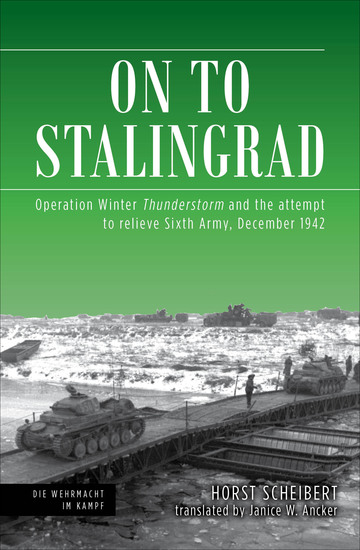
On to Stalingrad - Operation Winter Thunderstorm and the Attempt to Relieve Sixth Army December 1942 - cover

On to Stalingrad - Operation Winter Thunderstorm and the Attempt to Relieve Sixth Army December 1942

Horst Scheibert

Translator Janice W. Ancker

Publisher: Casemate

  • 0
  • 0
  • 0

Summary

The first English translation of a German account of the attempt to relieve the Nazis’ Sixth Army at Stalingrad during World War II. In late November 1942, Soviet forces surrounded General Friedrich Paulus’ Sixth Army in a pocket at the Russian city of Stalingrad. In response the Germans planned a relief operation, Operation Winter Thunderstorm, intended to break through the Soviet forces and open the pocket, releasing the encircled units. The 6th Panzer Division was the spearhead of the German relief force. The attack started on 12 December 1942 and was aborted on 23 December after heavy Soviet counterattacks. This failure sealed the fate of the German Sixth Army in Stalingrad. This account of the operation was first published in German in 1956, written by the well-respected military historian and retired German officer, Horst Scheibert, who was a tank commander in 6th Panzer Division during the attempt. Utilizing many excerpts from war diaries, and telegrams sent during operations, it is a unique account of the entire operation from the situation in mid-November through the two German offensives, the Soviet counteroffensive, and ongoing fighting until early January. This book includes 16 maps from the original edition and is the first English translation of this important German account.Praise for On to Stalingrad “Rich and detailed like very few of its kind are, with a crisp writing style and critical eye for the events of the battlefield that almost makes you feel as if you were there with Sixth Panzer. On to Stalingrad is a book so compelling that it simply should not be overlooked for your personal and professional enjoyment.” —ARMOR Magazine “Offers a unique viewpoint from an actual veteran who is able to provide an immediate military analysis of this mostly forgotten operation of the Stalingrad campaign.” —New York Journal of Books
Available since: 01/10/2022.
Print length: 144 pages.


Other books that might interest you

  • Art of Fantacy - cover

    Art of Fantacy

    Mervat Abu Ouf

    • 0
    • 0
    • 0
    Dr. Mervat Abou Oaf chronicles the journey of Egypt's film industry from the days of its commencement to the contemporary era of digitization and streaming platforms, all while painting a better, brighter, and bigger picture of what the future could entail.
    
    The book maneuvers around significant dates and milestones, highlighting Egyptian cinema's cultural, political, and economic importance.
    
    Through the lens of expert interviews, Dr. Abou Oaf examines regulatory frameworks operating backstage and maps out what's required to sustain and develop a thriving industry, proposing a regulatory model that embraces economic prosperity, cultural values, and industry independence.
    Show book
  • Modernising Irish Government - The Politics of Administrative Reform - cover

    Modernising Irish Government -...

    Neil Collins, Terry Cradden

    • 0
    • 0
    • 0
    Modernising Irish Government presents the major historical turning points in the development of Irish public services with a particular focus on the civil service, covering the mid-nineteenth-century reforms, the foundations of the State and the Lemass-Whittaker economic initiative. It introduces the Strategic Management Initiative, its origins and its impact, discussed in terms of efficiency, responsibility and democracy.
    Authors Neil Collins, Terry Cradden and Patrick Butler examine the current, key issues within the Civil Service, including the contentious issue of decentralisation. Providing reviews of the institutional framework for regulating monopolies in such sectors as telecommunications, aviation and retail competition, they present a critique of the new kinds of relationships between government and the people by reviewing Social Partnership, the Citizen Charters of government departments and other similar instruments.
    This textbook at once examines the scale, scope and structure of the delivery of services to the public and their relationship to the civil service, government departments, commercial semi-state companies and other public bodies, while identifying a number of significant failures in service delivery in detail and offering an analysis for their reasons.
    Show book
  • The Yoga Sutras of Patanjali - The Book of the Spiritual Man - cover

    The Yoga Sutras of Patanjali -...

    Maharishi Patanjali

    • 0
    • 0
    • 0
    "The Yoga Sutras of Patanjali: The Book of the Spiritual Man" by Maharishi Patanjali is a timeless spiritual manual that distills the essence of yoga philosophy into concise aphorisms. This profound work elucidates the path to spiritual enlightenment, focusing on ethical disciplines, physical postures, breath control, and meditation. Patanjali's sutras offer invaluable insights and practices for achieving inner peace, self-realization, and ultimate union with the divine, guiding seekers on their spiritual journey.
    Show book
  • Psychological Coercion - Using Psychological Persuasion to Force Compliance - cover

    Psychological Coercion - Using...

    Cito Harder

    • 0
    • 0
    • 0
    Psychological coercion is a powerful and often insidious form of manipulation designed to force an individual to act against their will or better judgment. It involves the use of mental and emotional tactics to instill fear, guilt, or pressure, making the person feel compelled to comply with demands or expectations. While it does not rely on physical force, the impact of psychological coercion can be just as damaging, if not more so, as it leaves lasting emotional scars that can affect an individual’s sense of self-worth, autonomy, and mental health. 
    At its core, psychological coercion undermines a person’s ability to make decisions freely. It exploits their vulnerabilities—whether emotional, psychological, or social—in order to gain control or influence their behavior. This form of coercion can take many different shapes, including threats, isolation, intimidation, manipulation, or subtle forms of pressure. While the methods may vary, the common thread is the intentional use of mental and emotional tactics to manipulate or control another person’s actions. 
    Psychological coercion is distinct from other forms of persuasion because it involves the use of power and control to manipulate an individual into compliance. In many cases, the person being coerced may not even recognize the pressure being applied to them. This is due to the subtlety with which coercion often operates—it can take place in everyday interactions, with the perpetrator using psychological manipulation in a way that may seem harmless or even caring at first. Over time, however, the individual being manipulated becomes increasingly susceptible to the influence of the coercer, often leading to a loss of personal agency and a sense of powerlessness.
    Show book
  • Bye Bye I Love You - The Story of Our First and Last Words - cover

    Bye Bye I Love You - The Story...

    Michael Erard

    • 0
    • 0
    • 0
    With our earliest utterances, we announce ourselves—and are recognized—as persons ready for social life. With our final ones, we mark where others must release us to death's embrace. In Bye Bye I Love You, linguist and author Michael Erard explores these phenomena, commonly called "first words" and "last words," uncovering their cultural, historical, and biological entanglements and honoring their deep private significance. Erard draws from personal, historical, and anthropological sources to provide a sense of the breadth of beliefs and practices about these phenomena across eras, religions, and cultures around the world. 


    What do babies' first words have in common? How do people really communicate at the end of life? In the first half of the book, Erard tells the story of first words in human development and evolution, and how the attention to children's early language—a modern phenomenon—arose. In the second half, he provides a groundbreaking overview of language at the end of life and the cultural conventions that surround it. Throughout he reveals the many parallels and asymmetries between first and last words and asks whether we might be able to use a linguistic understanding of end of life to discover what we truly want.
    Show book
  • Handsome Lake: The Life and Legacy of the Iroquois Prophet - cover

    Handsome Lake: The Life and...

    Editors Charles River

    • 0
    • 0
    • 0
    The name "Iroquois", like many Native American tribal names, is not a name the people knew themselves by, but a word applied to them by their enemies the Huron, who called them “Iroquo” (rattlesnake) as an insult. The French later added the suffix “ois.” Moreover, the Iroquois are not even a single tribe but a confederation of several different tribal nations that include the Seneca, Oneida, Onondaga, Mohawk, Cayuga and the Tuscarora, who didn’t become part of the union until the early 1700’s. The name Haudenosaunee (pronounced “ho-den-oh-SHO-nee”) is the name the people use for themselves, which translates as “the People of the Longhouse.” They are also commonly known as the Six Nations. 
    	Despite their own cultural differences, the nations that comprised the Iroquois Confederacy established their political dominance across much of America’s East Coast and Midwest through conquest, and it is that aspect which has perhaps best endured among Americans in terms of the Iroquois’ legacy. European settlers who came into contact with the Mohawks in the Northeast certainly learned to respect their combat skills, to the point that there were literally bounties on the Mohawks’ heads, with scalps fetching money for colonists who succeeded in slaying them and carrying away the “battle prize”. 
    	Handsome Lake (1735-1815) lived through the confederacy’s most turbulent time. His long life started when the Iroquois were powerful and widely feared and respected by all the tribal peoples in the region, and also by the French and the British. He lived through wars, some victories and some defeats, as well as the disunity and the collapse of traditional ways. Handsome Lake experienced his visions late in his life, at a time when the Six Nations, and his own life, were at their nadir.
    Show book