Join us on a literary world trip!
Add this book to bookshelf
Grey
Write a new comment Default profile 50px
Grey
Subscribe to read the full book or read the first pages for free!
All characters reduced
The History of King George the Third - Enriched edition All 4 Volumes - cover

The History of King George the Third - Enriched edition All 4 Volumes

Horace Walpole

Publisher: Musaicum Books

  • 0
  • 0
  • 0

Summary

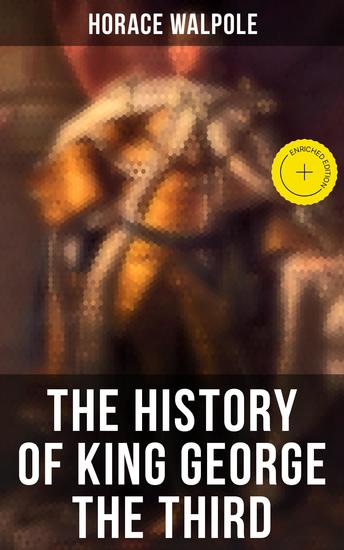
Horace Walpole's 'The History of King George the Third' is a comprehensive and meticulously researched account of the reign of King George III, exploring the political and social landscape of the time. Written in a detailed and eloquent style, Walpole provides a thorough examination of the events that shaped the era, including the American Revolution and the Napoleonic Wars. Drawing on a wealth of primary sources, the book offers readers a valuable insight into the intricate web of power dynamics and personal relationships that defined the period. Walpole's narrative is both engaging and informative, making it a must-read for history enthusiasts and scholars alike. As a prominent political figure in his own right, Horace Walpole's unique perspective and firsthand experience undoubtedly influenced his decision to write this historical account. Known for his keen interest in politics and a penchant for writing, Walpole brought his expertise to bear in crafting a detailed and nuanced portrayal of King George III's reign. His sharp intellect and astute observations shine through in the pages of this book, adding depth and credibility to his narrative. For those seeking a rich and engaging exploration of the reign of King George III, Horace Walpole's 'The History of King George the Third' is a definitive source. With its insightful analysis and compelling storytelling, this book offers a fascinating glimpse into a pivotal period in British history, making it a valuable addition to any history lover's library.

In this enriched edition, we have carefully created added value for your reading experience:
- A succinct Introduction situates the work's timeless appeal and themes.
- The Synopsis outlines the central plot, highlighting key developments without spoiling critical twists.
- A detailed Historical Context immerses you in the era's events and influences that shaped the writing.
- An Author Biography reveals milestones in the author's life, illuminating the personal insights behind the text.
- A thorough Analysis dissects symbols, motifs, and character arcs to unearth underlying meanings.
- Reflection questions prompt you to engage personally with the work's messages, connecting them to modern life.
- Hand‐picked Memorable Quotes shine a spotlight on moments of literary brilliance.
- Interactive footnotes clarify unusual references, historical allusions, and archaic phrases for an effortless, more informed read.
Available since: 12/17/2020.
Print length: 1226 pages.
Other books that might interest you

  • The Fundamentals of Community Organizing - cover

    The Fundamentals of Community...

    George Goehl

    • 0
    • 0
    • 0
    The Fundamentals of Community Organizing is George Goehl’s bedrock principles of organizing — the modern organizer’s bible, much as Shel Trapp’s Basics of Organizing was for George 30 years ago. Use these fundamentals to hone your craft and become a more effective organizer. The book is available for sale on fundamentalsoforganizing.org, and now, available for listening as an audiobook in this special offering of the podcast. Listen and re-listen to your most necessary fundamentals as many times as you need.
    Show book
  • Artists On Art - A Short Story Volume - Stories about all manner of arts in both fun and scary settings - cover

    Artists On Art - A Short Story...

    H. P. Lovecraft, Edgar Allan...

    • 0
    • 0
    • 0
    Art. The greatest standard bearer of what the human condition really is?  Or Emperor’s Clothes, cheap gimmicks displayed as all-knowing? 
    When it comes to writing we have our favourite authors.  But what of the authors themselves. What are they keen to write of? 
    For our classic authors; from Poe to Lovecraft, from Woolf to Fitzgerald art in their words, is something to be admired.  From many angles, many views, their stories, their characters interact with art and the consequences fall as they may. 
     
    01 - Artists on Art - A Short Story Volume 
    02 - Pickman's Model by H. P. Lovecraft 
    03 - The Mezzotint by M. R. James 
    04 - Psyche's Art by Louisa May Alcott 
    05 - Fun In An Artist's Studio by F. Scott Fitzgerald 
    06 - Blue & Green by Virginia Woolf 
    07 - The Oval Portrat by Edgar Allan Poe
    Show book
  • F Scott Fitzgerald - A Short Story Collection - A wonderful collection from the legendary American author of The Great Gatsby - cover

    F Scott Fitzgerald - A Short...

    F. Scott Fitzgerald

    • 0
    • 0
    • 0
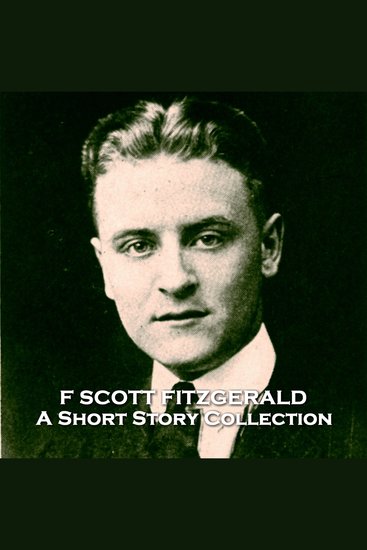
    Francis Scott Key Fitzgerald was born on September 24th 1896 in Saint Paul, Minnesota, to an upper-middle-class family. His early years in Buffalo, New York showed him to be a boy of high intelligence and drive with a thirst for literature.  
     
    In 1908, his father was fired from Procter & Gamble, and the family returned to Minnesota. Here Fitzgerald attended St. Paul Academy, in St. Paul, until 1911. At 13 he was published in the school newspaper, it was, of all things, a detective story. In 1911, aged 15, he was sent to the prestigious Newman School, in Hackensack, New Jersey. And, after graduating in 1913, he decided to continue at Princeton University. Here he firmly dedicated himself to writing. Unfortunately his writing pursuits came at the expense of his coursework. In 1917 he dropped out to join the U.S. Army.  
     
    However this service to his country came with the very real fear that he might perish in the trenches of Western Europe with his literary dreams not yet begun. So he spent the weeks before reporting for duty at work on a novel entitled The Romantic Egotist.  Fitzgerald was assigned to Camp Sheridan, in Alabama. It was there that Fitzgerald met the love of his life; Zelda Sayre, the "golden girl," of Montgomery youth society.  
     
    The war ended before Fitzgerald could be deployed, and he moved to New York City hoping to start a career in advertising that would be lucrative enough to convince Zelda to marry him. Unable to convince her that his means were enough to support her she broke off the engagement. Fitzgerald returned to his parents in St. Paul, to revise The Romantic Egoist, now recast as This Side of Paradise. His revised novel was accepted by Scribner's and published in 1920 becoming an instant success.  
     
    It launched Fitzgerald's career as a writer and provided a steady income suitable for Zelda's ambitions. The engagement resumed and they married at St. Patrick's Cathedral in New York. Frances Scott "Scottie" Fitzgerald, their only child, was born on October 26, 1921. 
     
    Inspired by the parties he had attended visiting Long Island's north shore Fitzgerald began planning the greatest of his novels, The Great Gatsby, in 1923, wanting to produce "something new—something extraordinary and beautiful and simple and intricately patterned."  Published in April 1925, The Great Gatsby received mixed reviews and sold poorly; only 20,000 in its first year.  Today, it is considered a literary classic and one of a small circle vying for the title "Great American Novel".  
     
    Fitzgerald continued to supplement his income by writing short stories for magazines and to sell his stories and novels to Hollywood. He called this "whoring".  
     
    In February 1932, Zelda was hospitalized with schizophrenia. Fitzgerald rented a house nearby and worked on his latest book, Tender Is the Night, and finally published it in 1934.  
     
    Fitzgerald's heavy and excessive drinking had now developed into alcoholism and with recurring financial difficulties, the emotional toll of Zelda's mental illness, this meant several difficult years.  
     
    In 1937, Fitzgerald moved to Hollywood. His income improved and he began to work in the film industry. He found movies beneath his talents, but was once again in perilous financial straits, and so spent the second half of the 1930s in Hollywood, working on a triangle of short stories, scripts for MGM, and his final novel, The Love of the Last Tycoon.   
     
    In 1939, MGM ended the contract, and Fitzgerald became a writer for hire. Still an alcoholic, he now became estranged from Zelda and developed a relationship with Sheilah Graham, the Hollywood gossip columnist. They quickly became lovers.  
     
    In this last period of his life his alcoholism had left him physically wrecked. After suffering a heart attack, in Schwab's Drug Store, he was ordered to avoi
    Show book
  • Searching for Alpha Centauri - A Boyhood Memoir - cover

    Searching for Alpha Centauri - A...

    Gary Spetz

    • 0
    • 0
    • 0
    Three complaisant kids, two stormy parents, one anxious French poodle, too many U-haul trailers, and the potholed road of the early 1960s. Searching for Alpha Centauri is American Public Television artist Gary Spetz's boyhood memoir of living a nomadic life with an impetuous mother, a discontent casino-security-guard step-father, an anxious French poodle, and two complaisant siblings -- during the early 1960s. The artist/author paints his moving landscape with words. He adeptly colors these words with both humor and tenderness. Mixed into this tale is the author's deference of history. He effectively interweaves his backdrop of an impending nuclear war, an exciting new space race, an escalating conflict in Vietnam, a rising civil rights movement, the invasion of Beatlemania, and the shocking assassination of a President. Searching for Alpha Centauri is a story of innocence, edification, intrigue, adventure, and endurance. As its boy-protagonist explains, it was "a time of flying bears, where everyone, it seemed, danced into the mystic."
    Show book
  • Marcus Aurelius - The Stoic Emperor - cover

    Marcus Aurelius - The Stoic Emperor

    Donald J. Robertson

    • 0
    • 0
    • 0
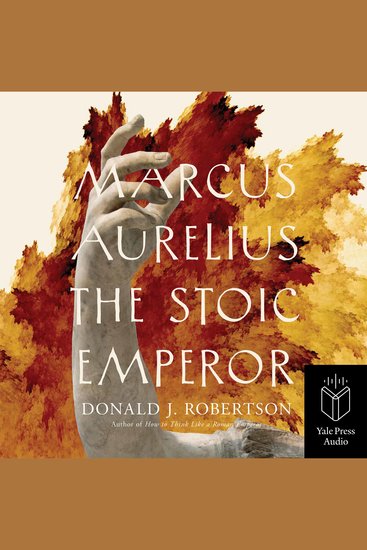
    Experience the world of Roman emperor Marcus Aurelius and the tremendous challenges he faced and overcame with the help of Stoic philosophy 
     
    This novel biography brings Marcus Aurelius (121–180 CE) to life for a new generation of readers by exploring the emperor’s fascinating psychological journey. Donald J. Robertson examines Marcus’s relationships with key figures in his life, such as his mother, Domitia Lucilla, and the emperor Hadrian, as well as his Stoic tutors. He draws extensively on Marcus’s own Meditations and correspondence, and he examines the emperor’s actions as detailed in the Augustan History and other ancient texts. 
     
    Marcus Aurelius struggled to reconcile his philosophy and moral values with the political pressures he faced as emperor at the height of Roman power. Robertson examines Marcus’s attitude toward slavery and the moral dilemma posed by capturing enemies in warfare; his attitude toward women; the role of Stoicism in shaping his response to the threat of civil war; the treatment of Christians under his rule; and the naming of his notorious son Commodus as his successor.  
     
    Throughout, the Meditations is used to shed light on the mind of the emperor—his character, values, and motives—as Robertson skillfully weaves together Marcus’s inner journey as a philosopher with the outer events of his life as a Roman emperor. 
     
    Donald J. Robertson, a cognitive-behavior psychotherapist and writer, is a founding member of the organization Modern Stoicism and the president and founder of the Plato’s Academy Centre nonprofit. The author of How to Think Like a Roman Emperor: The Stoic Philosophy of Marcus Aurelius and Stoicism and the Art of Happiness, he lives in Canada and Greece.
    Show book
  • Milestone - The Strangest Conduit - cover

    Milestone - The Strangest Conduit

    Gus Antos, Mark Robson

    • 0
    • 0
    • 0
    When Mark and Gus first met, they had no way of knowing they would one day be the owners of the largest home service company in Dallas–Fort Worth! From the onset of their first meeting, these two men knew they were part of something unique, something bigger, something they hope can be an example for others. While they shared every business owner's dream of success, it wasn't the money that was most important. At first, it was the challenge of overcoming normal start-up hardships alongside real-life crises, learning the ropes, and finding creative solutions to challenges they never saw coming. By keeping their eyes on what they considered most important—faith, family, and excellence—Mark and Gus embraced each challenge with love, loyalty to the vision, and compassion for the greater DFW community they serve. The values they put in place and their impact on the team, customers, and community are the heart and soul of Milestone. Discover the elements they put in place to create a company that works not just for its customers but for its team members and its community. Within these pages, you will learn how Gus and Mark turned each roadblock they met into an extraordinary opportunity to grow personally and professionally, while remaining true to their core values and beliefs.
    Show book