Join us on a literary world trip!
Add this book to bookshelf
Grey
Write a new comment Default profile 50px
Grey
Subscribe to read the full book or read the first pages for free!
All characters reduced
Childhood in literature and art with some observations on literature for children : A study - cover

Childhood in literature and art with some observations on literature for children : A study

Horace Elisha Scudder

Publisher: Good Press

  • 0
  • 0
  • 0

Summary

In "Childhood in Literature and Art: With Some Observations on Literature for Children," Horace Elisha Scudder embarks on a profound exploration of how childhood is represented across various artistic mediums. Scudder intricately weaves literary analysis with visual art criticism, illustrating the evolution of child representation from innocence to complexity throughout history. His meticulous examination reveals a rich tapestry of themes, such as the interplay between nurture and nature, the moral implications of storytelling, and the transformative power of imagination. Scudder's scholarly style and historical context provide a robust framework for understanding the importance of these representations in shaping societal perceptions of childhood. Horace Elisha Scudder was a prominent editor and literary critic, with a deep commitment to children's literature. His experiences as an educator and his role in the publication of notable children's works undoubtedly influenced his perspective on the significance of literature in the development of a child's identity. Scudder's unique insights stem from his belief that literature serves as a reflection of societal values and childhood experiences, and he aims to illuminate the necessity of quality literature for the younger audience. Highly recommended for educators, literary scholars, and parents alike, Scudder's study offers invaluable reflections on the integral role of childhood in narrative forms. Readers will not only gain an understanding of the literature and art surrounding childhood but also an appreciation for the implications such narratives have on both individual growth and collective cultural consciousness.
Available since: 04/24/2025.
Print length: 200 pages.

Other books that might interest you

  • The Amish of Lancaster County - cover

    The Amish of Lancaster County

    Donald B. Kraybill

    • 0
    • 0
    • 0
    “Reveals the heart and soul of the Amish culture. This is the best introduction to Lancaster’s Amish community.” —Steven M. Nolt, author of A History of the Amish   More than eight million people visit Lancaster County, Pennsylvania, every year to experience the culture of the oldest Amish community in the world. This book by the leading scholar of the Amish explains the uncommon lifestyle of these simple-living people who intrigue so many visitors.    Mini-essays on all aspects of Amish life, from dress and spirituality to horse-and-buggy transport, are accompanied by beautiful full-color photographs. The author also discusses myths about the Amish, their selective use of technology, the recent media attention to Rumspringa, and the tragedy at the Nickel Mines school.
    Show book
  • How to Go on After The Loss of Your Mother - A Life-Changing Guide to Stop Feeling Guilty Forgiving Yourself and Coping with Grief and Loss - cover

    How to Go on After The Loss of...

    Melanie Aniston

    • 0
    • 0
    • 0
    We Don't "Move On" From Grief. We Move Forward with It 
    If you're feeling heartbroken after losing your mother and this heartache has been going on for a remarkably long time (and nothing you do seems to help get you out of this state) 
    If you are “stuck” after the loss of your mother and feel you can’t move past feeling heartbroken over the grief, then ... 
    This book will work to help you to find your peace. 
    Do the following symptoms sound familiar? 
    Agitation – Inability to relax, shaken up 
    Anger – A strong emotion of displeasure with others or with an event 
    Anxiety – Feeling nervous and worried 
    Apathy – Things do not seem important anymore, not caring what happens 
    Betrayal – Feeling someone purposely chose to hurt you 
    Despair – To lose hope 
    Disbelief – Trouble accepting the loss really happened 
    Emptiness – Feeling hopeless and sad, with nothing to give others 
    Fear – The individual does not feel safe or worries for the safety of loved ones 
    Guilt – Self-blame, feeling regretful about doing or not doing something 
    Isolation – Removed or away from others 
    Shame – Feeling dishonored or disgraced 
    Strength – Tough, powerful 
    The list goes on…. 
    You don't have to live this way forever. 
    Here's a little sneak preview of what you’ll get: 
    - Resolving family conflict after the loss 
    - The grief process 
    - Grief and Anxiety 
    - Grief and Relationships 
    - The Physical Impact of Grief 
    - How to deal with regrets 
    - Coping with your mother’s reappearance 
    - Finding grief-coping techniques 
    - What not to say to someone who is grieving 
    - Strategies to finding happiness again 
    - Ways to heal after the loss
    Show book
  • Natural Attachments - The Domestication of American Environmentalism 1920–1970 - cover

    Natural Attachments - The...

    Pollyanna Rhee

    • 0
    • 0
    • 0
    A nuanced analysis takes a California oil spill as its point of departure to show how affluent homeowners pushed for an environmentalism that would protect not only the earth but also property and community norms. A massive oil spill in the Pacific Ocean near Santa Barbara, California, in 1969 quickly became a landmark in the history of American environmentalism, helping to inspire the creation of both the Environmental Protection Agency and Earth Day. But what role did the history of Santa Barbara itself play in this? As Pollyanna Rhee shows, the city’s past and demographics were essential to the portrayal of the oil spill as momentous. Moreover, well-off and influential Santa Barbarans were positioned to “domesticate” the larger environmental movement by embodying the argument that individual homes and families—not society as a whole—needed protection from environmental abuses. This soon would put environmental rhetoric and power to fundamentally conservative—not radical—ends.
    Show book
  • Essays of Schopenhauer - cover

    Essays of Schopenhauer

    Arthur Schopenhauer

    • 0
    • 0
    • 0
    "Essays of Schopenhauer" by Arthur Schopenhauer is a captivating collection of philosophical essays that delve into the depths of human existence and offer profound insights into the complexities of life. In this thought-provoking anthology, Schopenhauer combines his keen intellect with his distinctive writing style to explore a range of philosophical ideas and themes. Throughout the essays, Schopenhauer contemplates the human condition, shedding light on the fundamental aspects of our existence. He reflects on the nature of suffering, the pursuit of happiness, and the inevitability of death, delving into the intricate relationship between desire and fulfillment. Read in English, unabridged.
    Show book
  • Southern Beauty - Race Ritual and Memory in the Modern South - cover

    Southern Beauty - Race Ritual...

    Elizabeth Bronwyn Boyd

    • 0
    • 0
    • 0
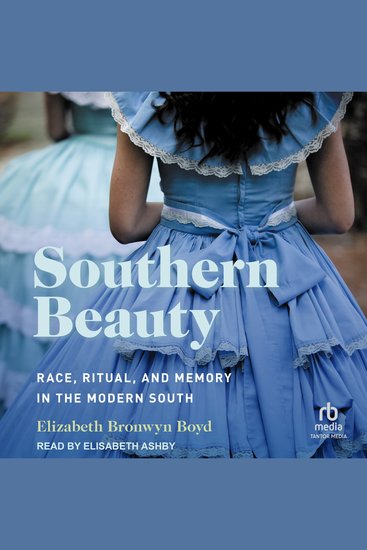
    In a trio of popular gender rituals—sorority rush, beauty pageants, and the Confederate Pageant of the Natchez (Mississippi) Pilgrimage—young white southern women have readily ditched contemporary modes of dress and comportment for performances of purity, gentility, and deference. Clearly, the ability to "do" white southern womanhood, convincingly and on cue, has remained a valued performance. 


    Based on ethnographic research and more than sixty taped interviews, Southern Beauty goes behind the scenes of the three rituals to explore the motivations and rewards associated with participation. The picture that Boyd paints is not pretty: it is one of southern beauties securing status and sustaining segregation by making nostalgic gestures to the southern past. Boyd also maintains that the audiences for these rituals and pageants have been complicit, unwilling to acknowledge the beauties' racial work or their investment in it. 


    Southern Beauty moves beyond representations to show how femininity in motion—stylized and predictable but ephemeral—has succeeded as an enduring emblem, where other symbols faltered, by failing to draw scrutiny. Continuing to make the moves of region and race even as many Confederate symbols have been retired, the southern beauty has persisted, maintaining power and privilege through consistent performance.
    Show book
  • Hope Made A Way - cover

    Hope Made A Way

    Lucy Wanjiku Njenga

    • 0
    • 0
    • 0
    She walks the streets of New York and other countries like she walked the slums of Nairobi growing up. She knows the depths of poverty, the scars of abuse inflicted at a tender age, the trials of teenage motherhood, the unbearable loss of a child, and the agony of living with an abusive partner. As if it wasn't enough, she got diagnosed with a chronic condition all before she was 21 years old.  But now, she stands tall as a beacon of resilience and triumph. Leading a successful community-based organization, serving on influential boards, and speaking alongside renowned figures in global health. Her  dedication being to empower girls and women across Africa.This inspiring memoir offers solace, comfort and a path forward. It reminds us all that no matter where we come from or how dire our circumstances may be, hope has the power to guide us through the darkest of times. Brace yourself for a remarkable story that will captivate your heart, uplift your spirit, and leave you yearning for more
    Show book