Join us on a literary world trip!
Add this book to bookshelf
Grey
Write a new comment Default profile 50px
Grey
Subscribe to read the full book or read the first pages for free!
All characters reduced
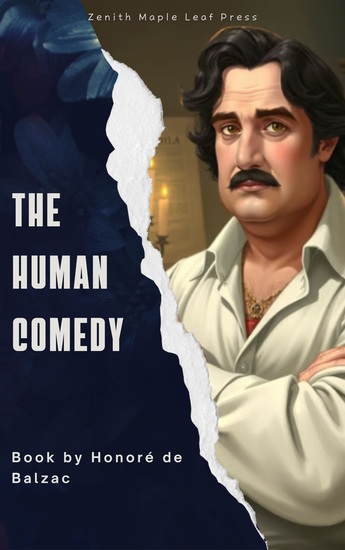
The Human Comedy - cover

The Human Comedy

Honoré de Balzac

Publisher: Zenith Maple Leaf Press

  • 0
  • 0
  • 0

Summary

One of the greatest achievements in world literature — over 90 works, one sweeping vision.

The Human Comedy (La Comédie humaine) is Honoré de Balzac's monumental series of novels and stories portraying French society during the early 19th century. With extraordinary detail, psychological depth, and realism, Balzac brings to life the struggles, ambitions, passions, and corruptions of an entire nation.

This complete edition presents Balzac's entire cycle — an interconnected world of characters and themes spanning aristocracy, bourgeoisie, criminals, clerks, soldiers, and dreamers. More than just fiction, it is a living encyclopedia of human experience.

Why readers love it:

Unparalleled scope. Dozens of novels and stories woven into a single grand tapestry.

Richly detailed. Balzac captures every layer of society, from Parisian salons to provincial towns.

Timeless relevance. Themes of ambition, greed, love, and morality still resonate today.

Praised as a masterpiece
Writers like Marcel Proust, Charles Dickens, and Émile Zola admired Balzac's genius, and The Human Comedy remains a cornerstone of literary realism. It is indispensable for readers who wish to understand not only 19th-century France but also the timeless drama of human nature.

✨ Enter Balzac's world — vast, intricate, and unforgettable.

👉 Click "Buy Now" and own The Human Comedy by Honoré de Balzac—a definitive collection of literature, society, and timeless human stories.
Available since: 08/26/2025.
Print length: 13755 pages.

Other books that might interest you

  • 81 Days Below Zero - The Incredible Survival Story of a World War II Pilot in Alaska's Frozen Wilderness - cover

    81 Days Below Zero - The...

    Brian Murphy, Toula Vlahou

    • 0
    • 0
    • 0
    The untold story of Leon Crane, the only surviving crew member of a World War II B-24 crash on a remote mountain near the Arctic Circle, who managed to stay alive 81 days in sub-zero temperature by making peace with nature, and end his ordeal by walking along a river to safety. Part World War II story, part Alaskan adventure story, part survival story, and even part inspirational story, this is what we call " a good read." This is the first full length retelling of Crane' s incredible survivalist story. It has been noted in magazines and in story collections over the years: most notably, just after the war ended, Crane' s story was included in a book aptly titled, The 100 Best True Stories of World War II , and in the 1970s, the story was a part of John McPhee' s hot-selling collection of Alaskan survival tales, Coming into the Country. The author suggests that we think Jon Krakauer' s Into the Wild " meets" Alfred Lansing' s Endurance . I would suggest that we also think Dick Proenneke' s Alone in the Wilderness " meets" Slavomir Rawicz' s The Long Walk . These meetings can go on and on; but there are some very impressive WWII survival stories that have become bestselling books-- even with previously " untold" and " unknown" stories, like Crane' s.
    Show book
  • The Autobiography of Benjamin Franklin - cover

    The Autobiography of Benjamin...

    Benjamin Franklin

    • 0
    • 0
    • 0
    "The Autobiography of Benjamin Franklin" is a foundational work of American literature, offering an intimate portrayal of one of the United States' founding fathers. Written from 1771 to 1790, this work is divided into four parts, reflecting different periods in Franklin’s life. The Autobiography offers insights into his formative years, diverse accomplishments, inventions, philosophical insights, and contributions to American society and governance. Franklin's narrative is imbued with wit, wisdom, and a sense of self-reflection, making it not only a historical document but also a work of literature that explores themes of self-improvement, virtue, and civic duty.
    Show book
  • A Wireless Message - From their pens to your ears genius in every story - cover

    A Wireless Message - From their...

    Ambrose Bierce

    • 0
    • 0
    • 0
    Ambrose Gwinnett Bierce was born on 24th June 1842 at Horse Cave Creek in Meigs County, Ohio. His parents were poor but they introduced him to literature at an early age, instilling in him a deep appreciation of books, the written word and the elegance of language.  
    Growing up in Koscuisko County, Indiana poverty and religion were defining features of his childhood, and he would later describe his parents as “unwashed savages” and fanatically religious, showing him little affection but always quick to punish. He came to resent religion, and his introduction to literature appears to be their only positive effect. 
    At age 15 Bierce left home to become a printer’s devil, mixing ink and fetching type at The Northern Indian, a small Ohio paper. Falsely accused of theft he returned to his farm and spent time sending out work in the hopes of being published. 
    His Uncle Lucius advised he be sent to the Kentucky Military Institute. A year later he was commissioned as an Officer.  As the Civil War started Bierce enlisted in the 9th Indiana Infantry Regiment.  
    In April 1862 Bierce fought at the Battle of Shiloh, an experience which, though terrifying, became the source of several short stories. Two years later he sustained a serious head wound and was off duty for several months. He was discharged in early 1865.  
    A later expedition to inspect military outposts across the Great Plains took him all the way to San Francisco. He remained there to become involved with publishing and editing and to marry, Mary Ellen on Christmas Day 1871.  They had a child, Day, the following year.  
    In 1872 the family moved to England for 3 years where he wrote for Fun magazine. His son, Leigh, was born, and first book, ‘The Fiend’s Delight’, was published.  
    They returned to San Francisco and to work for a number of papers where he gained admiration for his crime reporting. In 1887 he began a column at the William Randolph Hearst’s San Francisco Examiner.  
    Bierce’s marriage fell apart when he discovered compromising letters to his wife from a secret admirer. The following year, 1889 his son Day committed suicide, depressed by romantic rejection. 
    In 1891 Bierce wrote and published the collection of 26 short stories which included ‘An Occurrence at Owl Creek Bridge’.  Success and further works including poetry followed.  
    Bierce with Hearst’s resources helped uncover a financial plot by a railroad to turn 130 million dollars of loans into a handout. Confronted by the railroad and asked to name his price Bierce answered “my price is $130 million dollars. If, when you are ready to pay, I happen to be out of town, you may hand it over to my friend, the Treasurer of the United States”.  
    He now began his first foray as a fabulist, publishing ‘Fantastic Fables’ in 1899.  But tragedy again struck two years later when his second son Leigh died of pneumonia relating to his alcoholism.  
    He continued to write short stories and poetry and also published ‘The Devil’s Dictionary’.  
    At the age of 71, in 1913 Bierce departed from Washington, D.C., for a tour of the battlefields where he had fought during the civil war. At the city of Chihuahua he wrote his last known communication, a letter to a friend. It’s closing words were “as to me, I leave here tomorrow for an unknown destination,” Ambrose Bierce then vanished without trace.
    Show book
  • Returning العودة - cover

    Returning العودة

    Mais Amad

    • 0
    • 0
    • 0
    The journey of a woman who was raised and developed between West & East. Through reality's pitfalls and joyful bursts, she begins a path to experience the Divine within, or so she thinks until the years and experiences around her have shown her that she, along with many others, are in fact returning to their spiritual essence. Returning is subtle, it looks like sleeping habits, physical activity, eating well, embracing community, and enriching the mind & soul. The dramatic outcome, yet also subtle, is ego shifting, pride lifting, inward sincerity deepening, and the limitless and weightless way of living.
    Show book
  • The Search - The life of a mountain rescue search dog team - cover

    The Search - The life of a...

    Paul Besley

    • 0
    • 0
    • 0
    Coming from a working-class background, Paul Besley knew the worst and best of life in a Yorkshire steel town. He had always been drawn to the solitude of the hills, but that life nearly ended when a fall while hillwalking left him critically injured and alone in the mountains of the Lake District. Paul was found and brought to safety by a mountain rescue team. This was the trigger for him to transform his life, first by joining his local team, then by finding Scout, his very own Border collie puppy, and training him to become a mountain rescue search dog.
    In The Search, Paul writes with humour and honesty as we follow him and Scout through their complex training, with searches and rescue incidents sometimes tragic and often funny. Paul's demons and headstrong characters threaten to derail them, until his past finally catches up with him and his life inescapably unravels. It's up to Scout to keep an eye on him now as Paul tries to build the best life he can.
    Show book
  • Bobby Sands and the Tragedy of Northern Ireland - cover

    Bobby Sands and the Tragedy of...

    John M. Feehan

    • 0
    • 0
    • 0
    Bobby Sands captured the imagination of the world when, despite predictions, he was elected a Member of Parliament to the British House of Commons while still on hunger-strike in the Northern Ireland concentration camp of Long Kesh.
    When he later died after sixty-six gruelling days of hunger he commanded more television, radio and newspaper coverage than the papal visits or royal weddings.
    What was the secret of this young man who set himself against the might of an empire and who became a microcosm of the whole Northern question and a moral catalyst for the Southern Irish conscience?
    In calm restrained language John M. Feehan records the life of Bobby Sands with whom he had little sympathy in the beginning - though this was to change. At the same time, he gives us an illumination and crystal-clear account of the terrifying statelet of Northern Ireland today and of the fierce guerilla warfare that is rapidly turning Northern Ireland into Britain's Vietnam.
    Show book